4-Day Cappadocia Tour or 3-Day? A Kurban Bayramı Guide
Four days in Cappadocia for Kurban Bayramı, or three?
Most people planning a Cappadocia trip for Kurban Bayramı (Eid al-Adha) hit the same wall: how many days do you actually spend on the ground when the journey starts in Istanbul? This is not a travel brochure. It is a decision guide that puts two packages side by side and shows which one fits whom. Because in a four-day programme, day one is an overnight drive and day four is the return, and that single fact shapes everything else.
See the 4-day Kurban Bayramı Cappadocia tour on Turlago and read the fine print carefully: the product is sold as four days, but it includes two nights in a hotel. One night is spent on the road, two in the hotel, and the last day is the drive home. That is the cleanest way to understand how it differs from a standard three-day Cappadocia tour.
The package includes two open-buffet breakfasts and two evening meals at the hotel, transport in luxury vehicles sized to the group, professional guiding, in-vehicle bottled water, agency coverage and compulsory travel insurance under Turkish Tourism Law 1618. Departure is from Istanbul, capacity is 100 guests, and the starting price is 10,999 TL. Below I walk through the real day-by-day programme, what is inside and outside the price, and where the genuine difference from a three-day trip begins.
What the Bayram calendar actually changes in Cappadocia
Cappadocia works in every season, but the Bayram week has three specific effects. The first is crowding. Göreme Open Air Museum, Kaymaklı Underground City and the Ihlara Valley fill with similar groups at similar hours. That is exactly why the itinerary contains flexibility clauses: depending on density, one of Ağaçaltı, Sümbüllü or Yılanlı Church is visited, and if Kaymaklı is too busy the group moves to Derinkuyu Underground City instead. These are operational escape hatches, and they are a sign of a well-prepared operator rather than a flaw.
The second effect is sunrise timing. The programme states plainly that the group reaches Lake Tuz in the early hours, but that on dates when sunrise comes later, this particular view may not be visible. Depending on which dates Kurban Bayramı falls on in a given year, sunrise can shift by hours, so the same itinerary delivers different light conditions. If photographing sunrise reflected on the salt flats is a priority for you, manage that expectation from the start, based on the departure time and the season.
The third effect is price and availability. Bayram is when hotel and balloon capacity disappears fastest. A capacity of 100 sounds generous, but this is a Bayram-week allocation that can sell out two to three months ahead. The balloon is a separate quota and a separate budget line, which I cover in its own section below.
Day one: the 22:00 departure and choosing your pickup point
The first day has no hotel and no sightseeing — only movement. The coach leaves Yenibosna Airport AVM car park at 22:00 and then collects guests at Mecidiyeköy Torun Center at 22:30, Kadıköy Evlendirme Dairesi car park at 23:00, below Kartal Bridge at 23:15, Çayırova McDonald’s at 23:30 and İzmit Halkevi at 00:15.
The practical question is which stop gives you the best first night’s sleep. Board at Kartal and the coach reaches you at 23:15; board in İzmit and it is 00:15. Joining later in the route shortens the time you have to settle, because the noise and movement of pickups keep finding you. If you live on the European side, Mecidiyeköy at 22:30 is the balanced option. On the Anatolian side, Kadıköy at 23:00 is easy to reach and sits in the middle of the pickup sequence.
One warning about day one: breakfast on the first morning is not included. Leaving at 22:00 and driving through the night means packing your own food is on you. Anyone who has done overnight coaches knows the drill — a thin blanket, a neck pillow and earplugs are the three items that determine whether you have energy for the 380 steps down into Ihlara the next day.
Day two: Lake Tuz, Ihlara Valley, Narlıgöl, Kaymaklı and Avanos
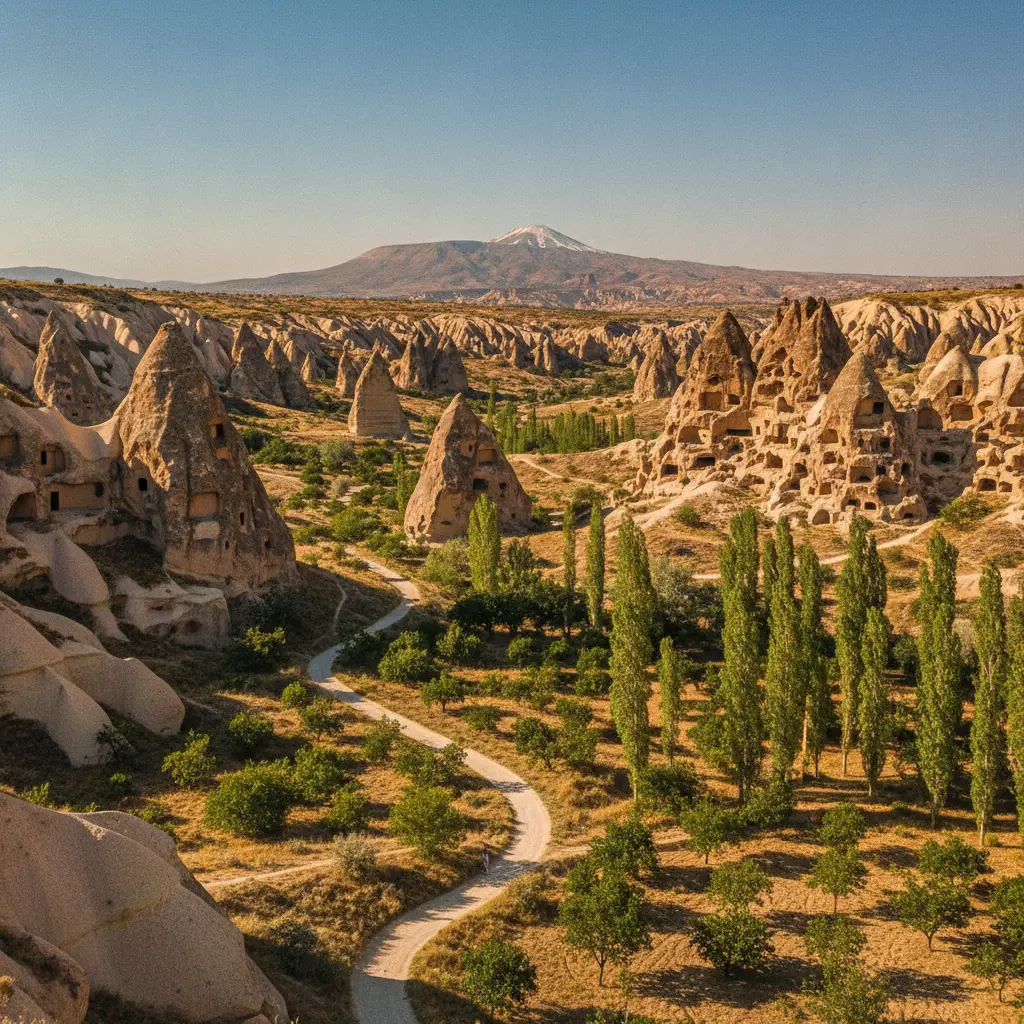
This is the heaviest day of the programme. The group reaches Lake Tuz in the early hours, has free time, then stops for breakfast. From there it continues towards the Ihlara Valley with Mount Hasan in view. The valley is 14 km long and reached by descending 380 steps; inside, the Melendiz river cuts a gorge that in places exceeds 120 metres in depth. Depending on density, one of Ağaçaltı, Sümbüllü or Yılanlı Church is visited with the guide, followed by photo time and free time.
The decision point here is physical preparation. Those 380 steps sound dramatic, but the real challenge is the walking pace inside the valley and the uphill gradient on the way back. In Bayram season, scheduling this walk for the early morning is the smartest part of the itinerary; the same route in the afternoon would be far more punishing. Bring a litre of water, a hat and shoes with real grip. Flip-flops or thin-soled sneakers will not serve you well on that valley floor.
The afternoon continues with a short photo stop at Narlıgöl crater lake and then Kaymaklı Underground City with a guide, moving through levels carved into the tuff rock. There are narrow passages and tunnels you cross bent over. If you are claustrophobic, it helps to know this in advance, because the route in and out is single and narrow. Then come Güvercinlik Valley, Paşabağ, Dervent Valley, the pottery workshop and Avanos.
Dinner at the hotel on the second evening is included. All lunches are not, so whatever you eat at the Ihlara exit or along the Aksaray road is extra. Keep that in your budget calculation.
Day three: balloon, Ürgüp, Göreme and ATV
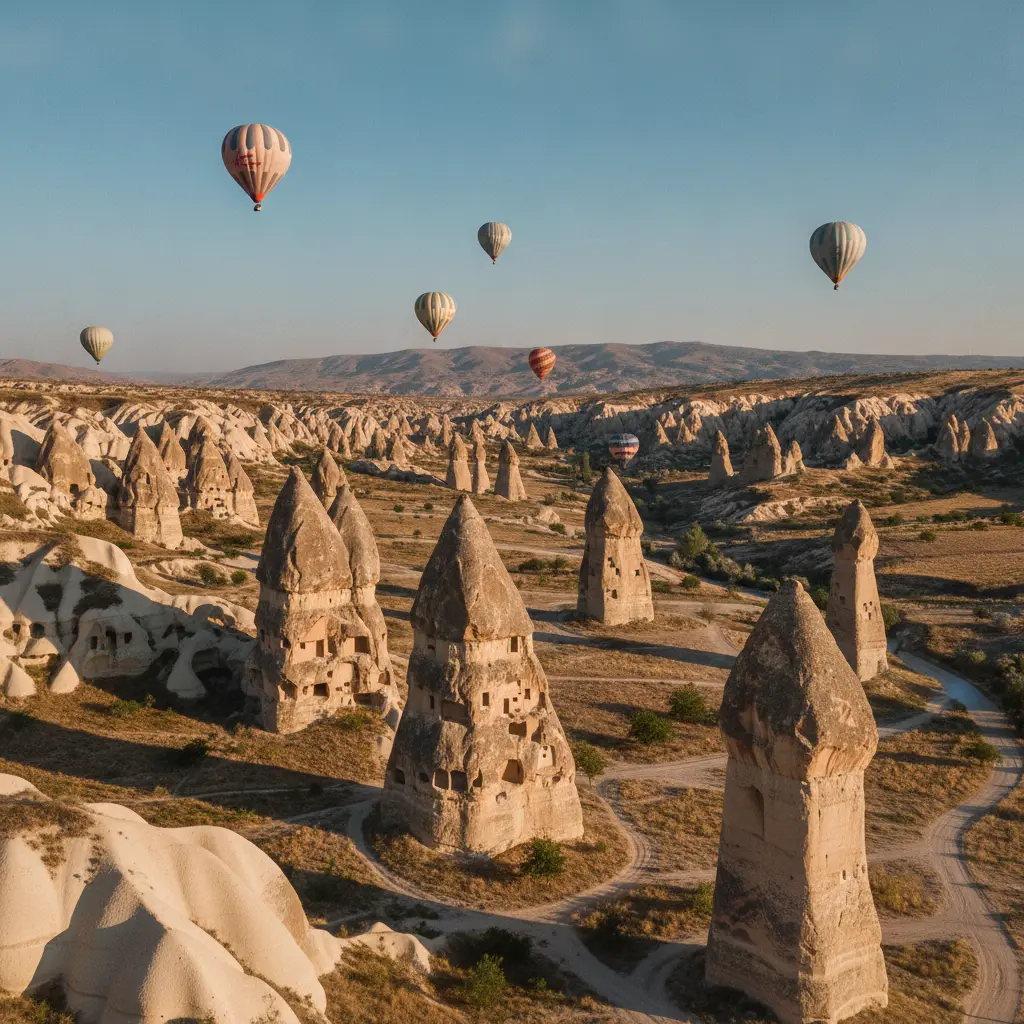
The third day is Cappadocia’s showcase. In the early morning, guests who chose it start with the Balloon Flight or the Balloon Watching Tour. On the flight you watch the balloons being prepared, then take a roughly one-hour flight over fairy chimneys at sunrise, followed by a champagne toast and a certificate after landing. On the watching tour, the group goes to Love Valley to see the balloons launch and watch them in the air.
Honesty matters here: balloon flights depend on weather and can be cancelled. The programme separates the two scenarios clearly — if the flight is cancelled at the launch site, no refund is given; if it is cancelled before leaving the hotel, the watching tour fee is refunded. The balloon budget is 100-350 EUR, paid on site, plus 450 TL for the balloon watching transfer. In other words, the balloon is the one item that can substantially change your total cost.
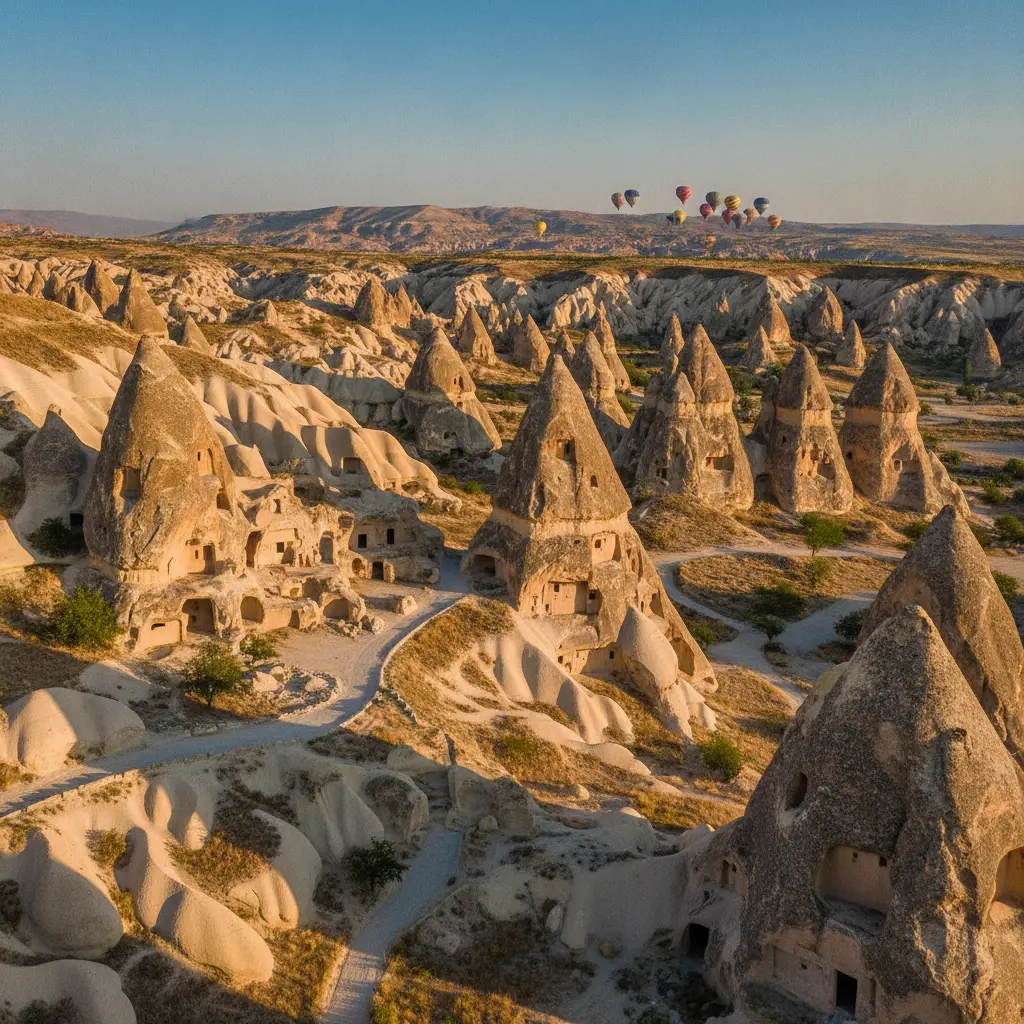
After breakfast the group visits a leather workshop to learn about Turkish leather craft and watch a fashion show, then moves to Ürgüp to see Asmalı Konak from outside, followed by a winery visit. Göreme Open Air Museum with its rock-cut churches is the strongest cultural stop of the day; in Bayram crowds, walking it with a guide adds real value, because looking at frescoes without knowing which period they belong to is just looking at stone. The programme also includes an ATV tour, Çavuşin village and an onyx stone workshop.
Night two at the hotel and dinner are included on day three. This is the fullest day of the trip: a morning activity, an afternoon of culture and dinner at the hotel.
Day four: Mustafapaşa, the Hacı Bektaş-ı Veli tomb and the return
Breakfast at the hotel is included on the final day. The group then drives to Sinassos – Mustafapaşa, an old Greek village, and walks streets that hold the finest examples of Greek stone masonry. Before leaving Nevşehir, the group visits the Hacı Bektaş-ı Veli tomb, with the guide explaining Üçler Fountain, the main courtyard (kitchen and meeting house) and the inner courtyard (Pir Evi and the tomb itself).
The return journey then begins and guests are dropped at their original pickup points. The critical detail of day four: lunch is taken at regional restaurants and dinner at a rest stop along the route, both extra, and there is no hotel night. You will likely reach Istanbul after midnight. If you have work the next morning, factor that in.
Mustafapaşa and the Hacı Bektaş-ı Veli tomb rarely make it into standard three-day Cappadocia tours. This is where the fourth day pays for itself: two genuine cultural stops folded into the return leg.
Where exactly does the three-day version differ?
Let me be blunt: in the four-day tour, day one is an overnight drive and day four is the return. The full sightseeing days are two (days two and three), while day four is a half day of sightseeing plus the drive back. Compared with the 3-day Cappadocia tour, the two-day core is identical; the difference lives at the edges.
- Duration and accommodation: the four-day programme includes two hotel nights, two breakfasts and two dinners. Three-day tours usually include one night, which means no second dinner and no second breakfast.
- Coverage: the distinctive stops of the four-day version are Narlıgöl crater lake, Mustafapaşa (Sinassos) and the Hacı Bektaş-ı Veli tomb. Shorter programmes usually skip them.
- Fatigue curve: on a three-day tour, the Ihlara walk and the return drive sit uncomfortably close together. On the four-day version, Ihlara lands on day two and the drive home on day four. That extra night creates a genuine recovery window.
- Bayram flexibility: if a stop is swapped because of crowding (Kaymaklı for Derinkuyu, for example), a longer programme has more room to compensate.
- Cost: the longer package looks pricier, but the per-day cost is usually lower, because transport and guiding are fixed costs spread across four days.
What 10,999 TL covers, and what it does not
The included list is short and clear: two hotel nights, two open-buffet breakfasts, two open-buffet or set-menu dinners, transport in luxury vehicles allocated by group size, the excursions listed in the programme, professional guiding, in-vehicle bottled water, agency coverage and compulsory travel insurance under Tourism Law 1618.
The exclusions are what actually determine your budget:
- Breakfast on the first morning
- All lunches
- Dinner on the final day
- Drinks with any meal
- Any extra organisation not listed, plus personal spending
- Museum and archaeological site entry fees (for municipal and private operators)
- The Museum Card (for museums under the Ministry of Culture and Tourism)
- Balloon watching transfer: 450 TL, paid on site
- Balloon flight: 100-350 EUR, paid on site
A realistic add-on calculation: three lunches, one dinner, drinks and museum entries per person. If you hold a Museum Card, that line shrinks considerably for ministry-affiliated museums, but municipal and private sites still charge, because the card does not apply there. Add the balloon and you have a second cost roughly comparable to the tour itself. My advice is to plan two scenarios, with and without the balloon, before you book.
The balloon: what to expect on a Bayram morning
Cappadocia balloon flights depend on the weather assessment made before launch time. The programme states this openly and separates the two cancellation scenarios. The practical translation is simple: treat the balloon as a high-probability extra, not a guaranteed programme item. You get one morning — day three — and one attempt. If flying is the reason you are going to Cappadocia at all, pinning that to a single window carries risk. The watching tour is the alternative: even if flights are grounded, watching launches in Love Valley is an experience in itself, and the fee is refunded if the cancellation happens before leaving the hotel.
Balloon capacity during Bayram is a separate race. If you book the tour and leave the balloon for on-site payment, finding capacity on a Bayram morning is far from guaranteed. Settle your budget in advance; the decision is yours, but uncertainty has a cost too.
Pickup points, luggage and overnight-coach practicalities
Overnight travel needs different preparation from daytime travel. Pack a thin pillow, an eye mask and a water bottle so you can actually sleep. Do not plan to open your suitcase at night; keep a toothbrush, moisturiser and a light layer in your hand luggage and leave the big case in the hold.
Among the pickup points, İzmit Halkevi at 00:15 is the latest. Joining there does not require a separate plan for day one, but remember what follows: you board after midnight and step off the coach at Lake Tuz in the morning, before descending 380 steps into Ihlara. Whether you are cold that night depends on whether Bayram falls in spring or late summer; a thermal base layer plus a light jacket covers both.
Who should choose the four-day tour?
- First-time visitors to Cappadocia who will not get another long Bayram break soon.
- Travellers for whom the Hacı Bektaş-ı Veli tomb and Mustafapaşa are the reason, not a bonus.
- People who do not mind giving one day to the road and consider two full sightseeing days enough.
- Anyone who wants room to absorb Bayram-season route changes without losing content.
- Families or larger groups who benefit from a programme that spreads the pace.
- Early bookers who can lock the pre-Bayram price.
Who should choose the three-day tour?
- Travellers satisfied with the core of Göreme, Ürgüp, Avanos and Ihlara.
- Anyone who would rather put the budget into a balloon flight — a short tour plus balloon can beat a long tour without one on satisfaction.
- People returning to work immediately after Bayram who want the homeward night to end earlier.
- Anyone whose travel companion cannot handle two overnight coach legs.
- Photographers and balloon-focused visitors on a quick escape.
Booking timing and Bayram crowding
In Bayram week, the real constraint in Cappadocia is not hotels — it is transport and balloon capacity. A 100-person tour is a size that fills quickly during the holiday; do not leave the decision to the last week. Confirming the tour and the balloon in one go is easier than managing two separate uncertainties. Weekday evenings before Bayram are the calmest window for boarding at the pickup points.
Then there is the return plan. The tour ends by dropping guests at their pickup points with no hotel night, so arranging a transfer in Istanbul for after midnight is a smart move. If you are thinking of an evening on the Bosphorus, do not place it on the return night; the Istanbul Bosphorus dinner and Turkish night with a private table fits far better the day after you are back.
The verdict: which package fits which traveller
The short answer: if you want to see Cappadocia, three days is enough; if you want to live it and need breathing room against Bayram crowds, take four. The four-day programme’s real value is not one extra sight — it is the way it spreads the pace. A day sits between the 14 km Ihlara Valley walk with its 380-step descent and the drive home. In a week as busy as Bayram, that day in between is what makes the holiday feel like rest rather than logistics.
Keep the budget honest. The 10,999 TL tour price sits alongside lunches, drinks, museum entries and an optional balloon. Without the balloon, costs stay predictable. With it, add 100-350 EUR plus 450 TL for the watching transfer. Write both scenarios down and put them side by side — for most people the right choice becomes obvious at that moment.
To review the programme, the included and excluded lists and current pricing in one place, view the Kurban Bayramı special 4-day Cappadocia tour on Turlago. If you have already decided to spend the holiday in Cappadocia, your next step is checking balloon availability — this itinerary ties the flight to a single morning, and in Bayram week that morning sells out fast.