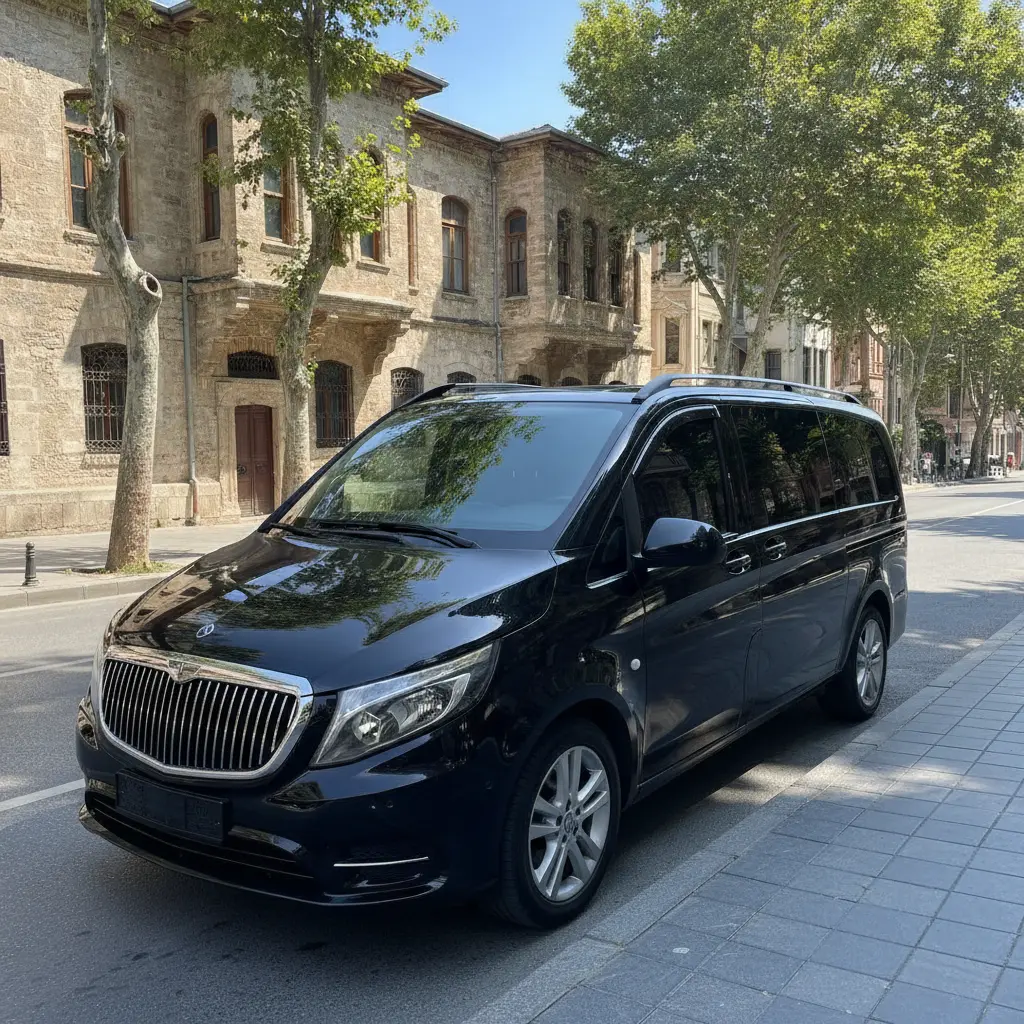
Chauffeur Car Rental Istanbul: Mercedes E 180 First-Timer's Guide

What you are actually buying when you book a chauffeured VIP car
Most people who hire a chauffeur-driven car for the first time ask the wrong question first. They ask "how much per day?" before they ask "what is included in that day?". That order matters, because the phrase "chauffeur car rental Istanbul" describes at least three different products, and they are priced on completely different logic even when the car is identical.
The Mercedes-Benz E 180 Exclusive chauffeured service can be sold to you as a daily hire, as an airport transfer, or as a long-term allocation. Your first job is to work out which of those three you need, because only then does a price become meaningful. You can view the Mercedes-Benz E 180 Exclusive chauffeured VIP car service on Turlago to see how the service scope is defined before you start comparing numbers.
- Chauffeured daily hire: You book the car together with a driver for a fixed window, usually 4, 8 or 10 hours. This is the right product when your day has several stops, meetings, or when you are showing a guest around the city. The price is built on hours, and mileage is normally capped.
- Transfer: A single point-to-point journey. Airport to hotel, hotel to a restaurant, hotel to the airport. The car does not wait for you; it drops you and leaves. The total is usually lower, but you buy no flexibility.
- Long-term allocation: A dedicated car and driver on a weekly or monthly arrangement. Built for companies hosting visiting executives, or for anyone who needs predictable city transport for weeks rather than hours. The per-day cost falls; the commitment rises.
- Half day: Usually a four to five hour block. Cheaper than a full day on paper, but many providers halve the mileage allowance at the same time. Always ask before you decide.
Once you can separate those four formats, you can compare quotes properly. Two providers may offer the same car on the same day, one priced as an eight-hour package and the other as a hundred-kilometre allowance. The headline numbers can look identical while the real cost is not.
Meet the car: what the E 180 Exclusive is, and what it is not
The E 180 Exclusive is a long-wheelbase version of the Mercedes E-Class saloon, trimmed with rear-seat comfort as the priority. In chauffeured service that distinction is the whole point: you are not buying the driver's seat, you are buying the rear bench.
Built around the rear seat
The long wheelbase adds noticeable legroom in the back compared with a standard saloon. A guest in a suit, a two-hour city loop, or a one-hour wait between two meetings will feel that difference directly. For a passenger picked up at the airport and dropped at a hotel, this is not simply "a nice car" — it is a quiet workspace with room for two adults in the back and luggage in the boot.
Boot and cabin reality check
An E-Class saloon boot comfortably takes two large suitcases and two cabin bags. If four people arrive with four large suitcases, a saloon body becomes the wrong tool and a van-class vehicle is the honest choice. Stating your luggage count and passenger count before booking prevents the single most common problem at handover.
What it is not
The E 180 Exclusive is not an S-Class. Do not expect massage seats, a reclining rear chair or a fully partitioned executive cabin. It is not a minibus; it will not carry six passengers. It is not an SUV; do not count on it in heavy snow. Knowing these limits in advance is how you avoid disappointment at the kerb rather than at the booking stage.
E 180, V-Class or S-Class: choosing a class against your budget
The most expensive mistake first-timers make is booking one class above their real need, or squeezing four people into a saloon. Here is how the classes actually compare on value:
- One to three passengers, city and airport: The E 180 Exclusive is the balanced choice. The ratio of price to comfort to perceived quality is at its most sensible in this class.
- Four to six passengers, or heavy luggage: A V-Class type minivan. The per-person cost is lower than the E 180 and everyone travels in one vehicle.
- Protocol, senior guests, weddings: S-Class territory. The daily rate rises clearly; what you are paying for is mostly rear-seat comfort and presence.
- Large teams, trade fairs, conferences: Sprinter-class vans. You are buying capacity, not comfort.
- One short hop, one stop: Whatever the car, a transfer package beats a daily hire on cost.
Do the comparison per person rather than per vehicle. Divide the total for the same day by the number of passengers carried. The result is often counter-intuitive: for larger groups the minivan quietly becomes the more economical option, while for a single executive the saloon is unbeatable.
The seven line items that build the quote
Chauffeur hire never comes down to one number. These seven items explain almost all of the gap between two quotes. Ask for each of them in writing.
- Time: How many hours the package covers, and how extra hours are charged. The overtime rate is frequently higher than the in-package hourly rate — know it before you start.
- Mileage allowance: The included kilometres and the per-kilometre rate beyond them. Within central Istanbul the allowance is usually enough; the moment you leave the city it becomes the deciding line.
- Waiting time: Is the car allowed to wait during a meeting, lunch or visit? Waiting is normally included inside the package, but waiting after the package has expired is often billed separately.
- Fuel: In chauffeured arrangements fuel is usually included, but confirm it. In self-drive rentals the car comes full and must return full.
- Tolls, tunnels, parking and hotel access: These are commonly billed as driver expenses on top. If your route crosses the Bosphorus, say so before the quote is issued.
- Tax and service charge: Is VAT included or excluded? A net-versus-gross difference will wreck any comparison you build.
- Night, weekend and public holiday rates: Journeys starting after midnight, Sunday work and national holidays often carry a separate tariff.
Getting these seven items in writing always beats a verbal understanding. A waiting fee that was "not a problem" on the phone can become a surprise at drop-off. Professional operators list these items unprompted; if yours does not, you now know exactly what to ask.
Nine things to check on any written quote
Treat this as a checklist. If a quote is missing one of these lines, the information is incomplete — and incomplete information usually reappears later as an extra charge.
- Total price and currency: If the quote is in a foreign currency, is the exchange rate fixed on the booking date or the payment date?
- Included hours and included kilometres: Stated separately, not bundled into one vague promise.
- Overtime and over-mileage rates: If they are absent, the quote is not finished.
- Waiting conditions: How many minutes are free, and from when does the meter start?
- Driver duty limits: Legal rest requirements affect long programmes more than you expect.
- Cancellation and amendment terms: How many hours before the booking can you cancel free of charge?
- Flight delay policy: Is the flight tracked, and is the wait chargeable?
- Insurance and liability: In chauffeured service liability sits with the operator, but see it written down.
- Invoicing: If a company is paying, confirm invoice type and VAT treatment in advance.
With all nine lines present, two quotes finally become comparable. Without them, you are comparing a package to a promise.
Hourly, half day, full day or transfer: matching the package to the day
One stop, one direction: the transfer
Airport to hotel, hotel to an event, one address to another. The driver drops you and leaves. This is the cheapest total because the car and driver are not tied to you for hours. If your programme has no waiting in it, a transfer is almost always the better buy.
Three or four stops across half a day
A morning meeting, lunch and a return to the airport can fit into a half-day package. Be careful though: half-day packages often halve the mileage allowance too. If your stops sit on opposite sides of the city, the half day can cover the time and fail on distance.
Full day: the most misunderstood package
A full-day package usually means an eight to ten hour window, not twenty-four hours. "The car is mine for the day" is the wrong expectation; "the car is mine from 09:00 to 18:00" is the right one. If your evening runs late, that is a separate conversation, because the night tariff does not automatically sit inside a full-day package. Full-day hire makes sense when you need four or five stops and the driver genuinely has to wait between them.
When long-term beats daily hire
If you need a car on more than ten days within a month, the sum of daily hires is rarely the best structure. A weekly or monthly allocation with a dedicated car and driver brings the unit cost down. In exchange you accept a longer commitment and less flexibility.
Plan the day in hours, not kilometres
The item that blows up a chauffeured-car budget in Istanbul is not fuel or the car itself. It is traffic, because most packages are sold by the hour and traffic consumes hours directly. The same distance at 08:30 and at 13:00 are two different journeys.
Build your plan around time, not distance:
- An airport-to-centre run varies enormously by time of day; during the morning and evening peaks, a two-hour band should be treated as normal rather than exceptional.
- Any programme that crosses between the European and Asian sides needs a wider window than one that stays on a single side.
- Clustering stops within walking distance of each other in the historic peninsula is more efficient than moving the car repeatedly.
- The Nişantaşı, Beşiktaş and Karaköy corridor covers short distances slowly; three stops there can easily consume more than an hour.
- Dinner or event pickups require the driver to wait, and that wait has to sit inside the package hours.
A practical rule: add a twenty to thirty percent buffer to any programme. Traffic, hotel security checks, valet queues and car park waits all dissolve into that buffer. A programme without a buffer ends either with overtime charges or with something cancelled.
A worked method for comparing three packages on the same day
Because prices shift with provider, season and route, quoting a fixed figure here would be misleading. Instead, here is the method that puts any set of quotes on the same footing. Four steps:
- Total your hours. Door-to-door, including waiting and breaks, not just driving time.
- Estimate your kilometres. Plot your stops on a map and take the real route total, not the straight line.
- Compare against the included hours and kilometres. Multiply any shortfall by the quoted overtime and over-mileage rates.
- Add the fixed extras. Bridge and tunnel crossings, parking, out-of-city supplements, night tariff and VAT where applicable.
The figure you reach is the true cost of the day. The package with the lowest headline price very often turns out to be the most expensive on this total, because a low base rate is typically recovered through a tight mileage allowance and short included hours. Decide on the fourth number, never the first.
Eight pricing mistakes first-timers make
- Comparing hourly rates only. Without included kilometres, waiting rules and extras, the comparison means nothing.
- Never asking about the mileage cap. Fine within the city, fatal if your day includes two airports or a trip outside Istanbul.
- Leaving waiting time out of the plan. Lunch, meetings, shopping and hospital visits all keep the car and driver tied to you.
- Ignoring traffic. Planning distance without planning duration is the most expensive kind of optimism.
- Forgetting VAT. A comparison built on net prices collapses when the invoice arrives.
- Overlooking the night tariff. A programme starting at 22:00 does not fit a daytime rate.
- Not reading the cancellation clause. Plans change often; a slightly higher quote with flexible cancellation is frequently the cheaper option in practice.
- Understating passengers and luggage. If the vehicle class has to change at handover, you pay the difference.
All eight share one feature: each can be resolved in a single phone call before booking. Resolving them afterwards always costs more.
The first ten minutes with your chauffeur
The quality of a chauffeured day is decided less by the car's badge than by the first ten minutes of communication. When you get in, cover these points:
- Today's programme: Give the stops in order and share the total hours. Your driver knows the traffic better than you do and may suggest a more efficient sequence.
- Waiting signals: "I'll be about forty minutes, please wait here" removes a lot of unnecessary phone calls.
- Discretion: If you do not want a third person present during calls, say so at the start. Professional drivers keep their distance anyway; confirming it is your right.
- Breaks and smoking: Confirm the in-car smoking policy and agree rest stops on longer programmes.
- Photo stops: If you want a short stop for photographs along the route, mention it; an unplanned stop comes out of your package hours.
- Extra stops: If you add a stop during the day, confirm the cost impact with the booking channel, not with the driver.
Those six sentences cost you a minute and remove every "I wish I had said something" moment at the end of the day.
Luggage, child seats, pets and smoking: the practical details
These look minor until something goes wrong at handover and the whole schedule slips.
- Luggage: State the number and size of cases in writing. A saloon boot is comfortable for two large and two cabin bags; add a folded stroller or a golf bag and it needs mentioning separately.
- Child seats: Usually available on request and often at no extra charge, but you must supply the child's age and weight in advance. Late requests may simply be refused.
- Pets: A carrier may be required and a cleaning fee may apply. Declaring it early avoids an argument at the kerb.
- Smoking and food: Corporate fleets almost always prohibit smoking in the car. On long programmes, plan a meal stop for both you and the driver.
- Charging and connectivity: Ask about phone charging and, if you need it, connectivity. On a journey where you are preparing for a meeting, this matters more than the upholstery.
Flight delays, cancellations and the four clauses to look for
On any airport pickup, the most likely scenario is a delayed flight. What happens then is the single most important part of your quote:
- Flight tracking: Does the operator take your flight number and work to the actual landing time, or hold you to the booked hour?
- Free waiting window: How many minutes after landing are free, and does baggage reclaim and passport control count inside that window?
- Cancellation terms: How many hours before the booking can you cancel free of charge, and is there a partial refund?
- Amendment rights: Is changing the date or time chargeable?
If these four are not written down, a phone promise carries no weight. They matter most on late-night arrivals and during high season, which is exactly when they are least likely to be volunteered.
When long-term rental actually saves money
One threshold decides it: how many days in a month do you need the car? Beyond roughly ten days of use in a single month, a weekly or monthly allocation almost always beats the sum of daily hires, because every daily package carries a setup cost — vehicle preparation, driver scheduling, route briefing.
The advantages of long-term allocation:
- The per-day cost falls and the budget becomes predictable.
- Working with the same driver makes programme tracking far easier.
- Teams running a regular airport-transfer cycle lose most of the planning overhead.
The trade-off is flexibility: moving the car to a different day, or narrowing the scope mid-term, may not be straightforward. Sign the long-term agreement once your actual usage calendar is settled, not before.
Chauffeured or self-drive? The hidden side of the comparison
Self-drive rental looks cheaper on paper: the daily rate, fuel and insurance. But when you compare it with a chauffeured service, remember three items people leave out — the time spent finding parking in Istanbul, the stress of traffic, and the working hours lost because you are the one driving.
A simple decision frame:
- Self-drive wins when: you are leaving the city, you want full route flexibility, you are planning your own schedule over several days, and you already know Istanbul traffic.
- Chauffeur wins when: your day has many stops inside the city, you need to work in the car, you do not know the parking and routing landscape, you are hosting a guest, or you will be on calls all day.
Part of what you pay a chauffeur for is local knowledge and parking solved. For a first-time Istanbul visitor, that is a real cost saving that never shows up on the quotation.
Season, weekends and the congress calendar: when to book
Chauffeur hire is not priced like an airline seat, but cars and drivers are finite. Demand spikes during major congress and trade-fair weeks, public holidays, the year-end period, wedding season and large sporting events.
- An ordinary weekday: a few days' notice is usually enough.
- Weekends and evening programmes: book about a week ahead to keep your choice of vehicle class.
- Peak season and holidays: two to three weeks ahead is the difference between the car you want and the car that is left.
- Long-term allocation: a month of notice makes driver and vehicle planning comfortable.
Add weather to the plan as well. Winter rain extends journey times, which creates extra-hour requirements; summer evenings start late enough to trigger the night tariff.
Invoicing, VAT and corporate accounts
If a company is paying, three things differ from a private booking: invoice type, payment terms and scope flexibility.
- Invoice: A corporate invoice makes travel expenses straightforward to account for. Confirm the invoice type and VAT treatment upfront.
- Payment: Some operators offer account terms to corporate clients; private bookings are usually paid at reservation or before service.
- Scope: When hosting a guest, you may want the invoice addressed to your own company rather than theirs. Say so at booking.
- Reporting: For teams with regular transfer needs, a monthly usage statement makes budget tracking much easier.
If your evening is planned: hold the car or release it?
A large share of chauffeured bookings in Istanbul are made for the evening rather than the working day, and the budget decision here is clear. Holding the car through the evening is usually cheaper than releasing it and calling another one later, because a second dispatch creates a second transfer charge.
Build the evening around the flow, not around the vehicle. If you plan to spend the evening on the water, pairing a Bosphorus dinner cruise with your chauffeured car programme means you solve transport once instead of twice in the same night. For something more private, a private-table Bosphorus dinner experience requires you to fix a finish time before you book the car.
Practical rule: agree the end time of the evening before you reserve, not afterwards. The driver's waiting time runs on the package, not on your estimate of when you might leave.
Frequently asked questions
Are fuel and tolls included in a chauffeured rental?
Fuel is normally included in chauffeured arrangements. Bridge, tunnel and car park charges are often billed as driver expenses on top. Asking about the two separately prevents an end-of-day surprise.
How far in advance should I book?
A few days is fine for an ordinary weekday. For weekends, public holidays and congress periods, two to three weeks ahead protects both your choice of vehicle and the price.
How many passengers fit in the E 180 Exclusive?
It is a saloon, so comfortable use is three adults plus the driver; three adults abreast in the rear over a long journey is a stretch. For four or more passengers, minivan class is the honest choice.
What happens if my flight is delayed?
It depends entirely on the contract. Confirm in writing whether the flight is tracked and how many minutes of waiting after landing are free before you book.
Do I need a driving licence for a chauffeured rental?
No. A professional driver operates the vehicle. Licence and ID requirements apply to self-drive rentals, not to chauffeured service.
Conclusion: a five-step checklist for your first booking
Hiring a chauffeured VIP car for the first time is really a decision problem with five parts: need, package, scope, extras and flexibility.
- Define the need: how many people, how much luggage, how many stops, which hours.
- Pick the package: transfer for a single hop, full day for a multi-stop day, long-term for regular use.
- Get the scope in writing: included hours, included kilometres, waiting rules, fuel, tolls and parking.
- Cost the extras: overtime and over-mileage rates, night tariff, VAT.
- Check flexibility: cancellation, amendment and flight-delay clauses.
Once those five are done, your quotes become genuinely comparable and the budget surprise disappears. To start with the specifics, see the Mercedes-Benz E 180 Exclusive chauffeured VIP car rental details on Turlago, where the vehicle class, service format and inclusions sit on one page so you can build your own calculation from real terms.