Corporate Team Airport-to-Hotel Transfer in Istanbul: Step by Step
Nine people. Two flights. One hotel in Levent. A two-day dealer summit, a dinner in Ortaköy, and a 09.00 keynote on day two. Every booking is confirmed: flights, rooms, meeting space. Then someone asks the question nobody has answered yet — who actually moves nine people and their luggage from the airport to the hotel, given that half of them land at 06.40 and the other half at 14.20?
Corporate travel rarely breaks because of the flight or the hotel. It breaks in the gap between the curb and the lobby. A corporate team airport-to-hotel transfer plan is not a single booking; it is five linked processes — flight tracking, meet and greet, vehicle capacity, traffic buffers and departure logistics — running on one calendar. Below is how we built that plan for a real team scenario, step by step, including the parts that went wrong the first time. If you would rather hand the operation to a provider, Turlago's chauffeur-driven vehicle rental options are a sensible starting point.
The brief: what the team actually needed
On paper it looked routine. A sales director, three regional managers, two technical specialists and a three-person support group. Three nights in a Levent hotel, two days of meetings, one evening programme. The transfer complications were less obvious:
- Two arrival waves. The Frankfurt flight lands at 06.40; the Ankara flight lands at 14.20. Roughly eight hours apart. One vehicle doing both runs means eight hours of paid idling.
- Uneven luggage. The European group carried demo kits and sample cases. The domestic group travelled light. Passenger count alone would have produced the wrong vehicle.
- A brutal check-in window. The early group would reach the hotel around 08.00, hours before standard check-in. Without a plan, they would sit in a lobby, jet-lagged, an hour before a rehearsal.
- Split departures. Two people had to leave early for a 15.00 flight; the rest flew out in the evening.
None of these are exotic problems. They are simply invisible until you list them. So we listed them before we looked at a single vehicle.
Step one: build a flight sheet before you build a quote
The most commonly skipped step in transfer planning is data collection. People think in terms of “airport to hotel”; operations think in terms of flight numbers, terminals and bag counts. We asked the team coordinator for the following, in one sheet:
- Passenger names exactly as they appear on passports (for the welcome board)
- Flight number, airline and arrival airport — Istanbul Airport or Sabiha Gökçen
- Scheduled arrival time and any known history of delays on that route
- Number of checked bags, plus any oversized item such as a sample case or display stand
- Mobile number, and one shared communication channel for the whole group
- Hotel reservation name and the status of any early check-in request
Filling this sheet answers half the planning questions by itself. In our case, both flights landed at Istanbul Airport, which meant one meet-and-greet protocol, one set of meeting points and one supplier. Had one flight landed at Sabiha Gökçen on the Anatolian side, the whole operation would have doubled: two greeting teams, two routes, and a group split by a cross-city journey that nobody had budgeted for.
Flight tracking is not a nice-to-have
A serious provider dispatches on actual arrival time, not scheduled arrival time. Passport queues and delayed baggage are normal, not exceptional. When you compare quotes, ask directly: who monitors the flight, and how many minutes of waiting are included? Sixty minutes for international arrivals and forty-five for domestic is a common standard — but it only counts if it is written down.
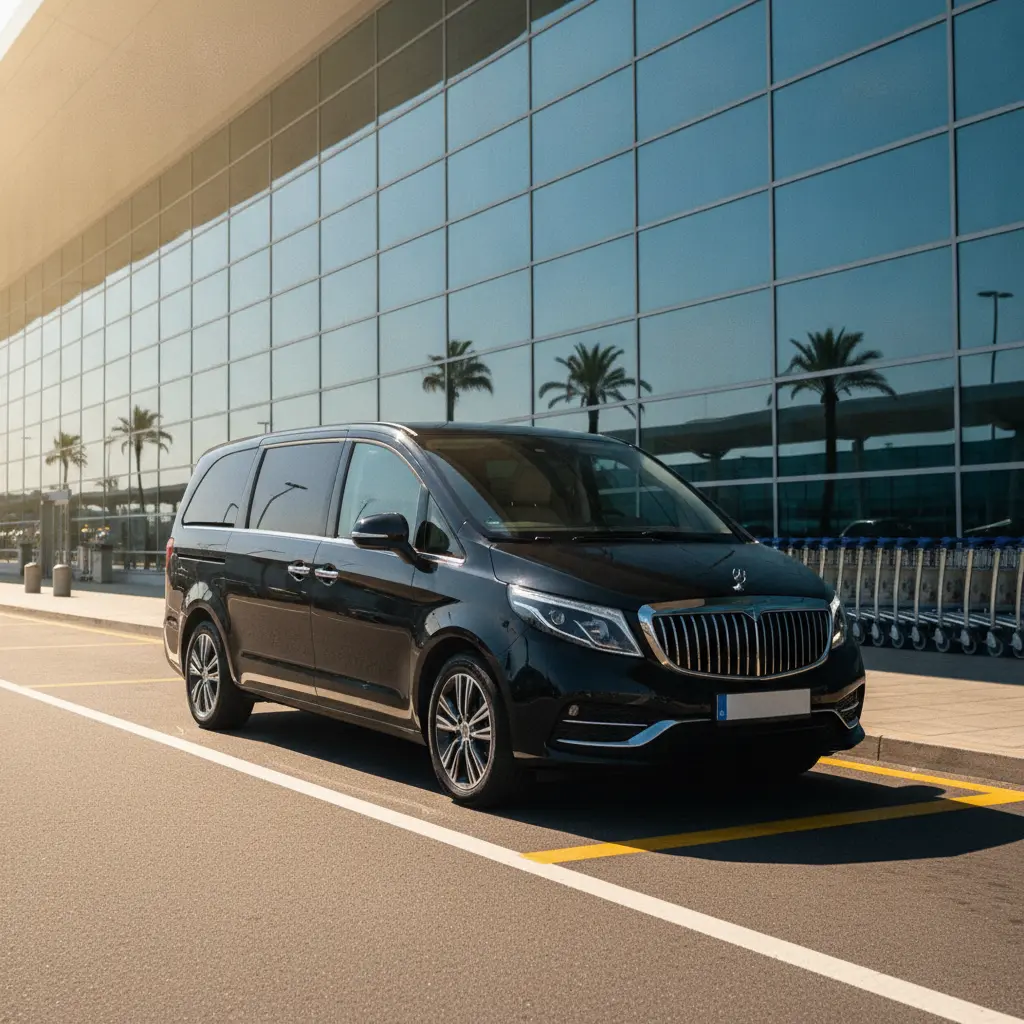
Suggested image alt text: “Black premium minibus waiting at the Istanbul Airport arrivals curb with luggage trolleys beside it.”
Step two: size the vehicle around people plus bags plus comfort
Vehicle selection is not a headcount exercise. Nine passengers can mean a seven-seat premium van, two of them, or one large minibus — and the right answer depends on luggage volume, arrival waves and how much recovery time the team needs after a flight.
Premium six-to-seven seat class
The default for executive transfers. Four or five passengers with matching luggage travel comfortably. Quiet cabin, climate control and generous legroom make it function as a decompression room on wheels. For a nine-person team with light bags, two of these can actually beat one large vehicle: one runs directly to the hotel while the second absorbs a delayed arrival without holding up the group.
Large minibus, thirteen to sixteen seats
This is the realistic choice for nine people, twelve or more pieces of luggage and demo equipment. One vehicle means one greeting, one invoice and one point of contact. In a crowded arrivals hall, directing nine tired people into a single vehicle is dramatically simpler than splitting them across two. The trade-off: if part of the group leaves at a different time, you are paying for empty seats.
Midibus, nineteen to twenty-seven seats
This becomes relevant once a summit passes twenty attendees. A single midibus keeps the group together through city traffic, but struggles with narrow streets and hotel forecourts. Confirm in advance that the vehicle can physically pull up at your hotel entrance — this one detail derails more group plans than any other.
The luggage arithmetic
A workable rule: one large suitcase plus one cabin bag per person. For nine people, plan for twelve to fourteen pieces. Add two or three cases if the team carries samples, demo units or event materials. Match the boot volume to the number of pieces, not the number of people, and the classic “the bags didn't fit” scene at the curb simply stops happening.
Step three: design the first twenty minutes at the airport
The entire experience of a transfer is decided in the first twenty minutes after the arrivals door. For a tired team, that is the moment when “someone is waiting for me” matters most. We wrote the protocol down rather than leaving it to improvisation:
- A name board, not a phone call. One fixed meeting point with the company name and the team lead's surname, rather than nine people scanning a crowd while calling a driver.
- One channel. The driver posts the plate number and live location into a WhatsApp group that includes the coordinator.
- A delay scenario. If baggage is slow, the team lead messages the driver, the rest of the group boards, and a secondary pickup point is pre-agreed in case the vehicle has to move.
- A confirmed first stop. Straight to the hotel, or a short stop for a SIM card or currency? That single sentence determines the route and the arrival time.
Istanbul Airport is a very large terminal, and the most common cause of lost time is a vague meeting instruction. Agree on a specific level and door number, not “the terminal exit”.
Step four: fit two arrival waves into one plan
This was the crux of the case. The morning group could be at the hotel by about 08.00. The afternoon group would land at 14.20 and reach the hotel around 15.45. There are three ways to handle the gap:
- Two separate transfers. The cleanest option. The vehicle comes once and leaves once, no waiting charges. The cost is two separate greeting operations.
- Keep the vehicle at the hotel. Convenient if the group moves around a lot, but eight hours of standby behaves like a full-day hire, and driver rest and shift rules come into play.
- A hybrid plan. One-way transfer for the morning group, a second dispatch for the afternoon group. This is what most corporate teams end up doing.
We chose the hybrid. A large minibus collected the morning arrivals; a premium vehicle collected the five afternoon arrivals. Capacity was matched to each wave, and no one waited in a terminal for a vehicle that was parked eight kilometres away.
Step five: sync the transfer with check-in
Arriving at the hotel at 08.00 raises a different problem: getting into a room. The transfer plan has to be built together with the hotel operation, not separately:
- Request early check-in in writing at least a week before arrival. Verbal reassurances are not a plan.
- If early check-in is not guaranteed, ask for a designated group seating area in the lobby and a secure luggage room.
- Prepare the rooming list in advance so the group can be processed as one block instead of nine individual check-ins.
- Ask whether breakfast is still being served. After a dawn flight, this is the single most useful detail you can secure.
The purpose of a corporate transfer is not transportation. It is getting a team into the right state for the meeting.
Step six: the morning rhythm on meeting days
During the summit, the requirement changes completely. No airport, just a short but critical line between hotel and venue. Set the departure time against the worst realistic traffic, not the average. On Istanbul weekdays, inbound flow toward business districts tightens noticeably between 07.30 and 10.00; a 09.00 start does not guarantee that leaving at 08.15 gets you there by 08.40.
Three habits that consistently work:
- A fixed lobby call. Everyone present at the same time turns the transfer into a team ritual rather than a logistics task.
- A flexible evening return. Meetings never end simultaneously. A vehicle holding a one-hour window costs less than dispatching twice.
- Location sharing. The driver posts plate and position to the group, and “where is the car” stops being a question.
Step seven: evening transfers are a different discipline
Corporate evening programmes are harder to run than meetings, because schedules loosen, venues change and the group relaxes. If you are planning dinner in Ortaköy followed by a short Bosphorus cruise, settle two things early: leave at least thirty minutes between the reservation time and the vehicle departure, and confirm the return time with the driver before dinner begins.
Even over short distances, pulling a large vehicle up to a hotel entrance at night can be difficult. Agreeing on a pickup point on a main road, a two-minute walk away, is less stressful for everyone than a driver circling narrow streets. Also confirm late-night surcharges in advance — an unexplained line item is the fastest way to turn a smooth operation into a finance query.
Step eight: departure day is the highest-risk window
If there is one thing worth remembering from this case, it is that corporate transfers fail on the way out, not on the way in. Delays on arrival are forgiven. A missed flight is not.
- Count backwards from the flight, not forwards from checkout. Checkout at 12.00 and an 18.30 flight may look like a comfortable gap, but add baggage collection, group check-in and security queues.
- Split the early leavers. A separate car for the two people catching a 15.00 flight protects the comfort of everyone else.
- Build a traffic buffer. Forty-five minutes of slack on the airport run absorbs most surprises.
- Load luggage early. Have bags staged in the lobby before the vehicle arrives, rather than moving nine suitcases at once.
Twelve questions to ask before you sign
This list separates a good-looking quote from an operation that works on the day:
- Is the price per vehicle or per passenger?
- Who tracks the flight, and how many waiting minutes are included?
- At what point does a delay start incurring extra charges?
- Can the vehicle class and luggage capacity be confirmed in writing?
- Which languages does the driver speak?
- Is the greeting done with a name board or by phone?
- Does the vehicle have Wi-Fi, charging and water?
- Is an extra stop within the route possible, and is it chargeable?
- When does the night tariff apply?
- Is corporate invoicing available, with clear VAT details?
- What does a second dispatch on the same day cost?
- What are the cancellation and amendment terms?
Written answers to these twelve questions often matter more than the contract itself. Anything agreed verbally will be renegotiated on the day of the operation.
How the budget actually works
Transfer prices vary with season, vehicle class, waiting time and route, and I am not going to invent numbers here — the right figure only appears in a proper quote. What is genuinely useful is knowing which components drive that figure:
- Vehicle class and capacity. Stepping up one class is usually cheaper than booking two vehicles.
- Waiting time. Airport standby, parking and driver hours all feed into the price.
- Extra stops. Any deviation before the hotel changes both route and duration.
- Time of day. Hours after midnight are typically priced separately.
- Invoicing. Corporate accounts, single-invoice billing and exchange-rate handling all affect the total.
The same logic resolves the two-small-versus-one-large debate. One large vehicle lowers coordination overhead; two smaller ones buy flexibility. For a nine-person team arriving in two waves, a hybrid plan tends to land in the most sensible place.
Seven mistakes corporate teams keep making
- Sizing the vehicle by headcount and ignoring luggage.
- Accepting a quote that does not include flight monitoring.
- Forcing the entire group onto a single flight and losing all flexibility.
- Planning the transfer without checking hotel check-in times.
- Leaving no traffic buffer on the morning of the meeting.
- Treating departure day as a last-minute detail.
- Not naming one point of contact, so everyone contacts the driver separately.
Short variations for different team sizes
Three or four executives: a single premium van is enough. Here comfort and privacy matter more than capacity; a quiet cabin, charging points and the ability to take a call in transit are genuine differentiators.
A twenty-person dealer group: a midibus plus a separate luggage vehicle. Keeping a large group moving as one block is a safety and timing advantage, not just a comfort one.
Trade fair weeks: traffic and hotel capacity tighten around major exhibition dates. Book earlier and discuss alternative routes rather than assuming the usual timings.
If the group splits across airports: Sabiha Gökçen suits hotels on the Anatolian side, Istanbul Airport suits the European side. Do not create a cross-city transfer to save on a ticket.
The takeaway: the plan comes before the vehicle
Nobody praised the transfer when it was over. That is the point. A good operation is invisible: no one waited at the curb, no one carried a suitcase on their knees, and the keynote started on time. Planning a corporate team's airport-to-hotel transfer in Istanbul is a scheduling problem long before it is a vehicle problem.
If you are building the same plan, start with the flight sheet, then count the bags, then choose the vehicle. To run it through a professional operation, compare vehicle classes for your group size via Turlago's chauffeur-driven vehicle rental options and set up an airport meet-and-greet transfer directly. Ask the right questions, and a case like this becomes as predictable as an ordinary working day.