Spain & Andalusia Tour 2026: Picking Dates That Fit
There is a version of Córdoba where you walk at three in the afternoon and every step is a negotiation with the sun. There is another version where the same square is cold enough that you keep moving to stay warm. Both are the same eight-day itinerary, sold under the same name. The only thing that changes is the departure date, and that variable does more to shape your trip than any other decision you will make.
The product on the table is a seven-night, eight-day loop operated with Turkish Airlines scheduled flights, entering through Madrid and leaving from Barcelona: Madrid (2 nights), Seville (1), Granada (1), Valencia (1), Barcelona (2). You can read the full day-by-day flow, inclusions and exclusions, and current pricing when you view the Comfort Spain & Andalusia Tour on Turlago. What follows is narrower: given the six published 2026 departures, which one actually suits you?
I am keeping this grounded in the real route and the real seasonal conditions along it. Heat, crowds, daylight hours, public holidays and timed-entry quotas all behave differently across these six dates, and each one produces a genuinely different holiday.
The 2026 departure calendar, read properly
Six dates are on sale for the 2026 season:
- 24 January 2026 — midwinter, low season
- 28 June 2026 — early summer, longest days of the year
- 04 July 2026 — early summer, weekend departure
- 18 July 2026 — high season, heat approaching its peak
- 01 August 2026 — peak European holiday period
- 15 August 2026 — a Spanish national public holiday
Notice the shape of the calendar: one winter date, five summer dates. That immediately rules out the usual spring-or-autumn question. The real choice here is between a quiet, cool Spain and a crowded, hot Spain. The trade-offs between those two are far sharper than most travellers expect.
Heat is a logistics problem, not a mood
Andalusia in summer does not match the brochure phrase "Mediterranean climate." Seville and Córdoba run some of the hottest summers in Europe, with July and August afternoons regularly sitting in the 38–40°C band. Madrid lands around 33–36°C, Granada is slightly tempered by altitude, and Valencia and Barcelona stay closer to 29–31°C thanks to the coast. Within a single week you can have a punishing day and a genuinely pleasant one, two days apart.
That matters because of how the itinerary is built. Day three starts in Toledo in the morning, reaches Córdoba in the afternoon and ends in Seville in the evening. In summer, all three stops land in the hottest part of the day. In January, the exact same sequence becomes a walk you take to find sunlight rather than escape it.
How to salvage the afternoon
On summer departures, understanding the Spanish rhythm is half the battle. Many small shops close between roughly 14:00 and 17:00, dinner rarely starts before 21:00, and in July the sun does not set until around 21:30–22:00. That late daylight is a gift in hot weather: you can retreat during the worst hours and re-enter the city in the evening when the stone has cooled.
The free-time blocks in the programme become considerably more valuable in summer. After checking into the Seville hotel, spending that free block in an air-conditioned room is not romantic, but it is smart. In January, spending the same block at an outdoor café on a square is one of the best parts of the trip.
Granada gets a natural advantage
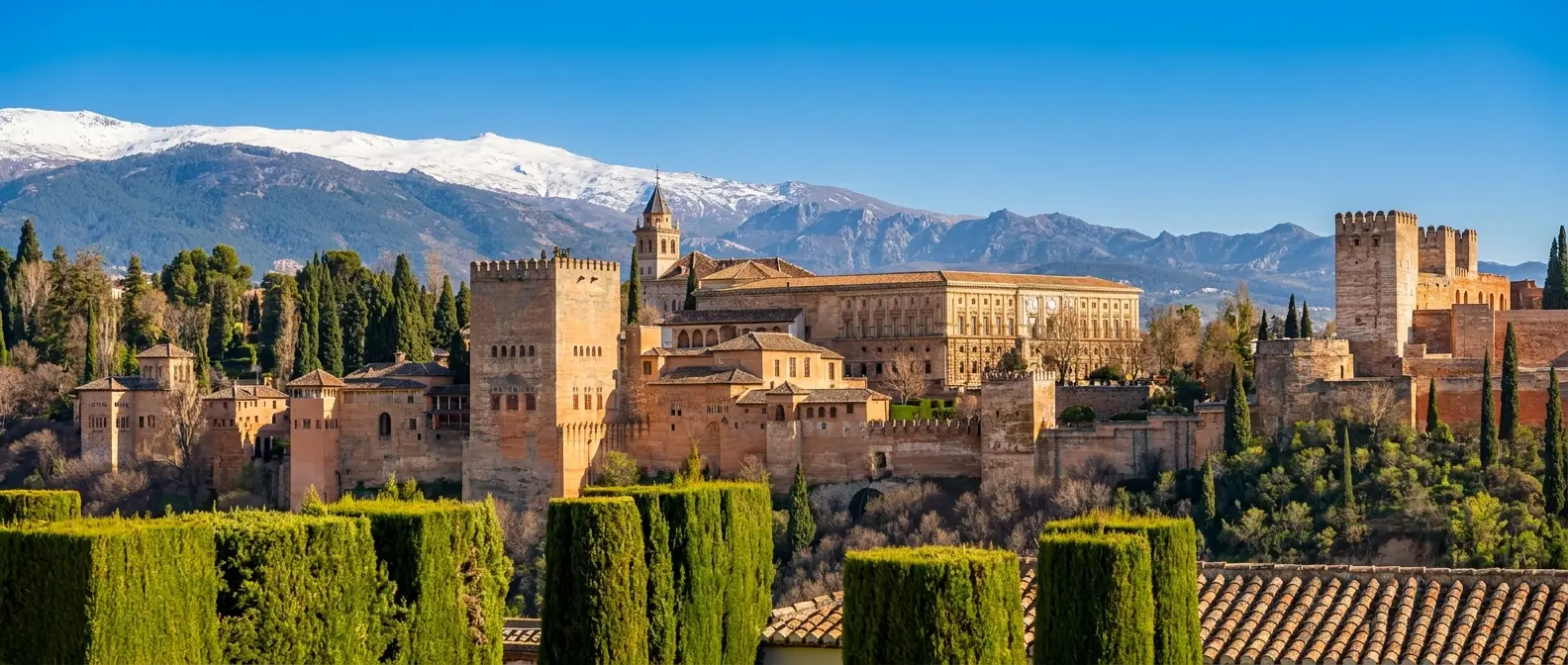
Day four belongs to the Alhambra, and in summer this is the luckiest day on the route. Sitting on the slopes of the Sierra Nevada, the complex is wrapped in the pools and cypress shade of the Generalife gardens. Even so, aiming for a morning visit reduces the time you spend in open, unshaded areas. In winter the logic flips: mornings can be cold and hazy, and the courtyards become far more inviting once the midday sun arrives.
24 January: Spain without the queue
The winter option is a single date, and it is the most misunderstood one on the calendar. Madrid in January runs roughly 8–12°C by day and drops to around 1–3°C at night, while Granada can hover near freezing after dark. Seville and Valencia, by contrast, stay mild, and a sunny Córdoba afternoon may let you take your coat off entirely.
The real gain is on the crowd side. January is low season for both Spanish domestic travel and European city breaks, which produces three concrete benefits: shorter lines at museums and monuments, actual room to take photographs in narrow streets, and quieter hotel floors. Walking Toledo's alleyways at your own pace versus shuffling through them in mid-August is not a small difference — it changes the character of the trip.
Two things to watch. First, some seasonal and tourist-facing businesses run shorter hours, so plan free time accordingly. Second, pack for two climates: Madrid and Granada need a genuine winter layer, while Seville and Valencia call for something much lighter. A single-season wardrobe does not work on this route in January.
28 June and 4 July: the balanced window
These two departures strike the best overall balance. Daylight is at its annual maximum, with light until roughly 22:00 in Spain, so evening exploration is easy and the heat has not yet locked into the 40°C range. Seville and Córdoba are warm in the afternoon but manageable.
Crowds sit at a reasonable threshold too. European school holidays are beginning, so movement is picking up, but it is not yet the August crush. For timed-entry sites such as the Alhambra, your odds of securing tickets are noticeably better than on the August departures.
18 July and 1 August: negotiating with the heat
From mid-July, Andalusia gets serious. Choosing these dates means planning around the route rather than simply touring it. In practice:
- Push outdoor sightseeing into the morning and shift cathedral and museum visits to the afternoon.
- Carry at least 1.5 litres of water per person per day; resupply on the coach or at the hotel is not guaranteed.
- A hat and sunscreen are non-negotiable — twenty minutes in an exposed Córdoba square without them is unpleasant.
- During free time, an air-conditioned museum or a shaded courtyard often beats an open-air walk.
The 1 August departure lands squarely in the middle of Europe's collective holiday season, which is also when Spanish domestic tourism peaks. Restaurants in city centres get harder to walk into without a reservation, and the coastal sections in Valencia and Barcelona feel busier. The compensation is real, though: in Barcelona the sea season is fully open and the evenings are at their most alive.
15 August: the date that needs a footnote
15 August is a Spanish national public holiday (Asunción / Fiesta Nacional), and this departure arrives in the country on that exact day. In practical terms: some shops and small businesses may be closed, traffic arrangements can change around celebrations, and opening hours at certain museums may shift.
This is not a reason to panic. Day one is already built as an arrival plus panoramic city tour in Madrid, so the main impact falls on your shopping and free-time plans rather than the sightseeing programme. Ask your guide about the day in advance and set expectations accordingly. Ending the trip in Barcelona is a small stroke of luck — around this date Catalonia tends to have street events and a livelier evening atmosphere.
Day by day, with seasonal eyes
Reading the real programme alongside seasonal conditions is what makes the date decision concrete.
Day 1 — Istanbul to Madrid
Meeting at Istanbul Airport international departures three hours before the flight, then a Turkish Airlines scheduled service to Madrid (roughly 4.5 hours). On arrival, a panoramic city tour by private coach begins: the Royal Palace seen from outside, then the capital's main avenues. Because it follows a flight, this day is deliberately light. On a January departure, expect Madrid to be cold; on a summer departure, expect a long, walkable evening.
Day 2 — Madrid city tour
After breakfast, a panoramic route through Plaza Mayor, Puerta del Sol and Gran Vía, then free time before returning to the hotel. This is the most flexible day of the trip. In January, indoor options take priority; in June and July, open spaces and long pre-dinner walks are far more appealing.
Day 3 — Toledo, Córdoba and Seville
The heaviest day on the route. Morning in Toledo among the narrow streets and the cathedral, then Córdoba's old town, the Roman Bridge and a visit to the Mosque-Cathedral, and finally arrival in Seville in the evening — well over 500 kilometres of ground covered. In summer, the walking portion in Córdoba is the toughest stretch of the day; in winter, it is the wind on Toledo's hills that greets you. Comfortable shoes alone are not enough here — dress in layers.
Day 4 — The Alhambra and Granada
Departure towards the Alhambra, widely regarded as the most important monument in Andalusia: the Alcazaba seen from outside, the Generalife gardens and the palace sections. Overnight in Granada. This day is the historic and physical high point of the tour, and starting early is the right strategy for both heat and crowds.
Day 5 — Granada to Valencia
Hotel check-out and transfer to Valencia, another long coach day of roughly 500 kilometres. On arrival: Plaza del Ayuntamiento, La Lonja de la Seda, Valencia Cathedral with the El Miguelete bell tower, and modern landmarks such as the City of Arts and Sciences. This is the most architecturally varied day. The coastal influence keeps Valencia's summer milder than Andalusia's, while winter can be breezy.
Day 6 — Transfer to Barcelona
Departure for Barcelona and a panoramic city tour covering the Plaça d'Espanya arena, Montjuïc, the port, the Columbus Monument, Plaça de Catalunya, Gaudí's Casa Batlló and Casa Milà, and La Rambla. Overnight in Barcelona. With a roughly 350-kilometre transfer plus a city tour, the pace is high — spend your free time wisely.
Day 7 — Full day in Barcelona
A walking-focused day through the Gothic Quarter, La Rambla and Old Barcelona, with the Sagrada Família seen panoramically from outside. This is the last full day and the widest free-time block of the trip. On August departures it is your only realistic chance to swim; in January, indoor plans are the safer bet.
Day 8 — Barcelona to Istanbul
Breakfast, check-out and transfer to Barcelona airport, then the Turkish Airlines scheduled service back to Istanbul (roughly 3.5 hours). On early flights you may need to plan breakfast timing carefully around the hotel's service hours.
The Alhambra ticket is the real bottleneck
The Alhambra gets the most attention on this route for a good reason: daily visitor numbers are capped and the palace sections operate on timed entry. That makes it the single element most sensitive to your choice of date. In mid-August, same-day availability is unlikely; in January or late June, there is far more room to manoeuvre.
The product listing is transparent about one cost you should not miss: an additional €150 per person for the Alhambra, the Mosque-Cathedral of Córdoba, the headset system, tourist city taxes and local guiding, payable to your guide during the tour. Build that into your budget from the start. Likewise note that museum and monument entrance fees, tourist city taxes and the Turkish overseas departure fee are not included in the headline price.
City by city, season by season
Madrid
January days sit around 8–12°C; summer runs 33–36°C. Winter means shorter queues and a calmer city, while summer brings daylight until roughly 22:00, which makes late walks genuinely pleasant.
Toledo
Built on a hill and exposed to wind. Genuinely cold in January, and the stone streets hold heat in July. Morning visits work best in both seasons.
Córdoba
The hottest stop on the route in summer — the interior of the Mosque-Cathedral functions as welcome shelter. In January, sunny afternoons are mild and easy.
Seville
Summer averages can push towards 38–40°C, making open-air activity in the afternoon a genuine risk. In January it becomes one of the most comfortable stops on the itinerary at around 15–16°C.
Granada
Altitude means cold winter nights and summer days that are more tolerable than Seville's. Mornings remain the right choice for the Alhambra in every season.
Valencia
The sea keeps summer in the 29–31°C range and winters mild. Time here is short on this itinerary, so adapting to conditions is easy.
Barcelona
Summer means an open sea season and very lively evenings, with August at its busiest. January strips the crowds back dramatically — you can photograph around the Sagrada Família without fighting for space.
Packing for two climates in one suitcase
Because this route crosses two climate zones in eight days, packing deserves as much thought as the itinerary.
- January departure: a proper outer layer, several mid-layers you can stack, a scarf, comfortable walking shoes and an umbrella. Gloves for Madrid and Granada; a lighter jacket for Seville and Valencia.
- June to August departures: light cotton clothing in pale colours, a wide-brimmed hat, high-factor sunscreen, a refillable water bottle and very comfortable walking shoes. A light wrap for churches and religious sites that require covered shoulders and knees.
- Either scenario: a second pair of shoes given the daily walking distances, a small daypack, and an EU plug adapter.
What four stars means on this route
The tour includes seven nights bed and breakfast in a 4-star hotel category. Do not carry Turkish four-star expectations into Spain: European rooms are generally smaller, bathrooms more compact and breakfasts simpler. What is usually reliable is location and transport access. Because stays are in city areas, evening walks and free-time exploration are easy to organise.
Budget beyond the headline price
The listed price currently sits at 64,227 TRY for a tour with a 100-person capacity, covering flights, seven nights in 4-star accommodation with breakfast, airport and city transfers, the tours specified in the programme, and professional Turkish-speaking guiding. When you calculate the true total, add these:
- €150 per person for the Alhambra, the Mosque-Cathedral, headsets, tourist city taxes and local guiding.
- Visa fee and service charge for standard passport holders.
- Travel health insurance — explicitly excluded.
- Lunches and dinners outside the programme — over eight days this is a significant line item, and it varies by city and neighbourhood.
- Museum and monument entrance fees plus personal spending.
- The Turkish overseas departure fee and driver tips.
An honest rule of thumb: budget 20–30% above the advertised price so nothing catches you out. The January departure generally offers more flexibility on flights and hotels, while August sits at the most expensive point of the year on both the tour and the extras.
Visa and passport timing
The most common mistake is booking the tour and only then thinking about a Schengen appointment. Applications can be lodged only within a defined window before travel, and appointments become scarce in summer. For the 28 June departure and everything after it, plan your application as early as the rules allow. The January departure is far more forgiving on this front.
The tour is also marketed as a visa-free option for Turkish green passport holders. Even so, verify your specific passport category's current Schengen exemption conditions with official sources before you travel — the rules are periodically updated.
Who should skip this tour
Honestly, this programme is not for everyone. It moves fast, packing Toledo, Córdoba and Seville into a single day, and the coach transfers are long. Anyone who dislikes walking for hours, avoids crowds, or struggles physically in heat will find a summer departure tiring. The same traveller may love the January version. In other words, the date choice determines fit more than the itinerary does.
Frequently asked questions
Will I be cold on the January departure?
In Madrid and Granada, yes — it is genuine winter. Seville, Córdoba and Valencia are mild by day. Layering solves it; a single coat for the whole week does not.
Which date is least crowded?
24 January. Among the summer departures, 28 June is noticeably calmer than the August dates.
Is the Alhambra ticket included?
No. The Alhambra, the Mosque-Cathedral of Córdoba, headsets, tourist city taxes and local guiding carry an extra €150 per person, payable to your guide during the tour.
Which date works best for families?
Given the walking volume and temperatures, January or late June make most sense. Mid-August combines peak heat with peak crowds.
Which airline operates the flights?
Turkish Airlines scheduled services: Istanbul (IST) to Madrid (MAD) on arrival and Barcelona (BCN) to Istanbul (IST) on return, economy class, included in the package.
The right date gives you a different country
For anyone considering a Spain and Andalusia tour, the real decision is not the route but the season in which you experience it. If you want quiet, cool and unhurried, 24 January is the only genuine option. If you want long days, outdoor evenings and moderate crowds, 28 June and 4 July stand out. If heat is not a concern and you want Barcelona's sea season fully open, the August dates deliver — just plan around the 15 August public holiday.
To see the full programme, inclusions and exclusions, and current pricing in one place, view the 7-night Comfort Spain & Andalusia Tour with Turkish Airlines on Turlago. Do not leave the date decision until the last minute: the Alhambra quota and the visa calendar both reward people who decide early.