170-Person Charter Boat from Eminönü: Golden Horn & Bosphorus
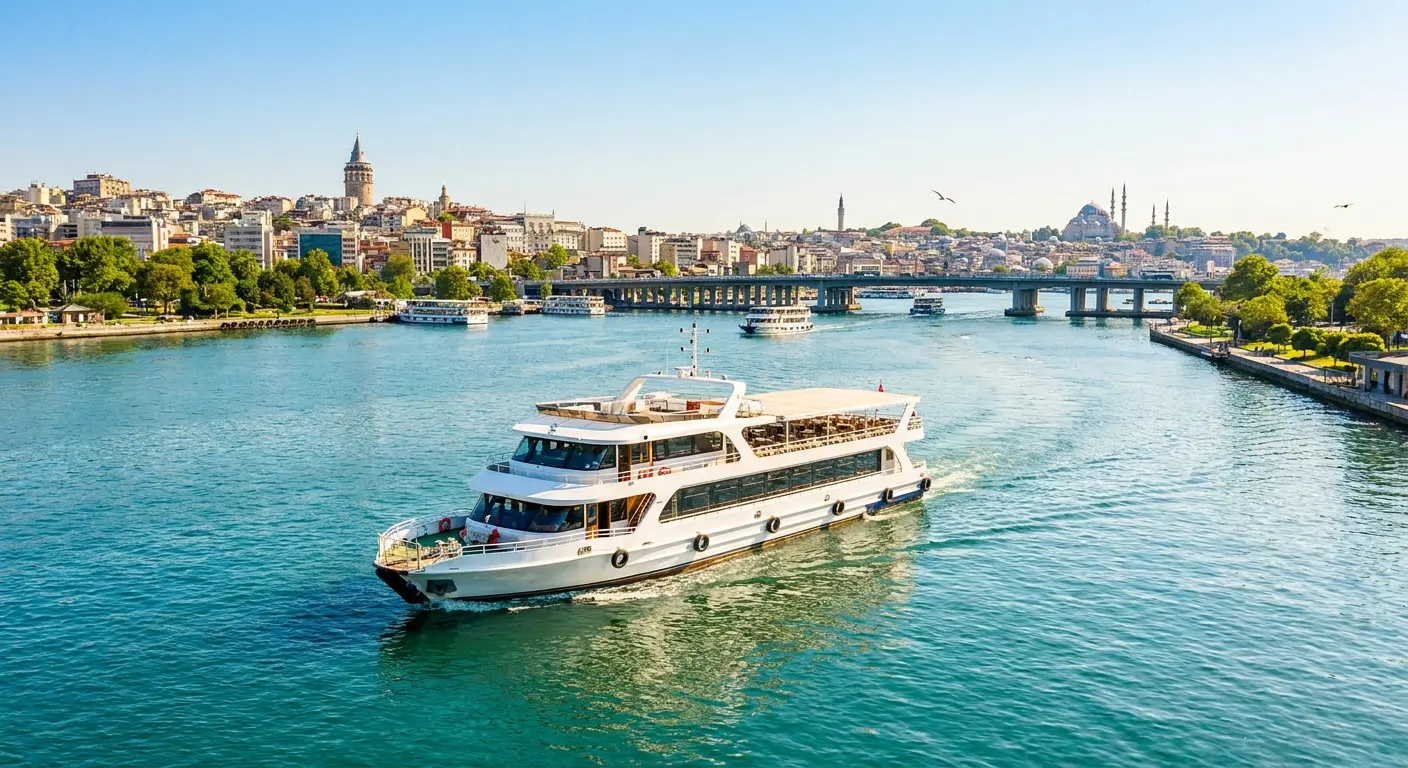
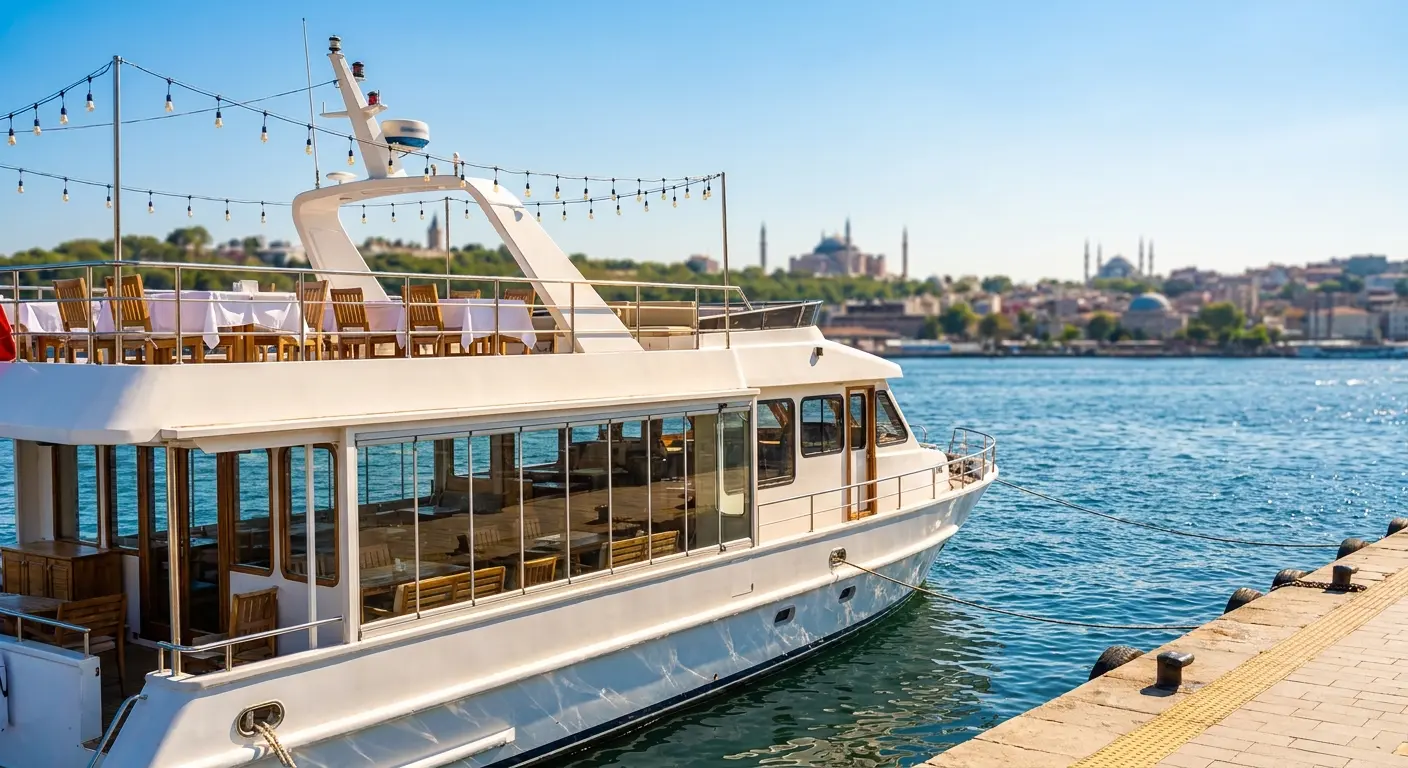
Organising anything for 170 people on the water is not really a boat problem. It is a routing problem, a timing problem and a per-head budget problem. The 36-metre charter boat that departs from Eminönü solves the first of those unusually well, because it can cover two completely different bodies of water in one itinerary: the sheltered, glassy Golden Horn and the fast, crowded, monumental Bosphorus. See the 170-person charter boat on Turlago, and use this guide as the planning document you hand to your committee.
Eminönü: Why This Pier Wins Before the Boat Even Moves
Eminönü sits exactly where the Golden Horn meets the Bosphorus. That single geographic fact shapes everything about the guest experience. From the quay, you can look north to the Galata Bridge, east to the Sarayburnu headland and the Topkapı ridge, and southeast to the Maiden's Tower off Salacak — all before boarding. For a large celebration, that matters more than it sounds: your guests arrive already inside the postcard.
The neighbourhood itself has been a commercial and transport hub for centuries. The New Mosque (1663) and the Spice Bazaar (1664) still operate in their original street pattern, and the current Galata Bridge — restaurants below, tram line above — continues a bridge tradition on this spot that reaches back to Byzantine times. The simit vendors, the grilled-fish boats and the commuter ferries are part of the scenery, not an interruption of it.
Getting 170 Guests to the Quay Without Chaos
This is where most large events fail. Eminönü is one of Istanbul's densest public transport nodes and also one of its hardest places to park. Practical guidance:
- Tram (T1): Two stops from Sultanahmet, three from Beyazıt. Most guests can use this line with no instructions beyond a screenshot.
- Marmaray: The most predictable option for anyone coming from the Asian side. Sirkeci is a short walk to the piers.
- Ferry: A pleasant arrival from Kadıköy or Üsküdar, but confirm the final departure times for the evening.
- Private cars: The Eminönü corridor jams between roughly 17:00 and 20:00 on weekdays. Define a drop-off point rather than a parking plan — the Sirkeci side works better for this.
Appoint one transport coordinator. With 170 people, a single unanswered question about where to stand can cost you an hour. Ask guests to be at the quay 45 minutes before departure. The captain will sail to the current, the wind and the traffic schedule — not to your guest list.
The Golden Horn Leg: Istanbul's Sheltered Inner Waterway
Most Bosphorus cruises skip the Golden Horn entirely. For large groups, that is a mistake. The reason is purely physical: the Golden Horn is an estuary roughly eight kilometres long, largely protected from the Bosphorus current and from the prevailing wind. The surface is usually flat. That means everything requiring people to stand still and pay attention — the welcome speech, dinner service, a presentation, an award ceremony, a henna-night entrance — can happen on water that is not moving under their feet.
That calm is recent. For most of the twentieth century this was an industrial bay known for shipyards, factories and pollution. Clean-up work that began in the 1980s gradually brought the water back, the fish returned, and the promenades reappeared. Telling your guests this story is far more interesting than a generic "Bosphorus cruise" script, and it explains why the reflections here look different.
What You Pass, in Order
- Galata Bridge: On evening sailings, the lights of the restaurants on the lower deck bounce off the water. Passing underneath it is reliably one of the most photographed moments of the night.
- Kasımpaşa and the Haliç Shipyard: The site of the Ottoman imperial shipyard founded in the fifteenth century, currently being restored. The large historic structures are clearly visible from the water.
- The Golden Horn Metro Bridge: Opened in 2014, this cable-stayed bridge carries the M2 metro line. Sailing under it gives a completely different perspective on the city's newer skyline.
- Fener: The red-brick Greek Orthodox high school (1881) rising above the shore, and the Greek Orthodox Patriarchate nearby.
- Balat: Colourful restored bay-windowed houses, the Ahrida Synagogue, and the Bulgarian St. Stephen Church (1898), a church cast in iron. Architecturally, this is the densest stretch of the route.
- Eyüp and Pierre Loti: The Eyüp Sultan Mosque and the hill named after the French writer, reached by a cable car that has run since 2005.
- Hasköy and Sütlüce: The Rahmi M. Koç Museum on the Hasköy shore, then the Aynalıkavak Pavilion area. This is the far end of a typical Golden Horn leg.
There is a photographic advantage here too. Because the water is enclosed, reflections are cleaner: the Galata Tower, the minarets and the bay windows fall onto the surface almost undistorted. With more than a hundred guests on a wide deck, that forgiving backdrop is worth more than a wider view with moving ferry traffic in it.
Out Into the Strait: From the Maiden's Tower to the Second Bridge
The moment you clear the Galata Bridge and turn into the Bosphorus, the water changes character. The strait runs on a strong surface current from the Black Sea towards the Marmara, with a denser saline undercurrent moving back north. Boats manoeuvre more, hug the shore more closely, and widen their line at certain points. A captain will build the route around the current rather than the clock — do not expect a minute-by-minute schedule.
The Entrance and the European Shore
The first major reference point is the Maiden's Tower off Salacak. After a comprehensive restoration completed in 2023, it reopened as a monument-museum and remains the single most discussed sight on both day and evening sailings. Heading north along the European side you pass Karaköy with the Galata Tower behind it, the Kılıç Ali Paşa Mosque, then Kabataş and Beşiktaş.
From Beşiktaş onwards, the Bosphorus puts on its ceremonial face. Dolmabahçe Palace runs parallel to the water with its clock tower, followed by the Dolmabahçe Mosque. Then Çırağan Palace (1871), now a hotel, and Ortaköy Mosque (1856) sitting directly beneath the 15 July Martyrs Bridge. Passing under that bridge is the loudest moment of any large party — time your music cue accordingly.
Beyond it come Kuruçeşme, the historic timber mansions of Arnavutköy, and Bebek Bay. Then the narrowest section of the entire strait: roughly 700 metres between Rumeli Fortress (1452), built by Mehmed II in the run-up to the conquest, and Anadolu Fortress on the opposite shore. Immediately after comes the Fatih Sultan Mehmet Bridge (1988), which is where most classic European-shore routes turn around.
The Asian Shore and How Deep You Want to Go
Routing the return leg close to the Asian shore adds a second layer of scenery to the same sailing:
- Kuzguncuk: A neighbourhood where a mosque, a church and a synagogue stand on the same street. The colourful facades are easy to pick out from the water.
- Beylerbeyi Palace (1865): Built for Sultan Abdülaziz and used to host foreign dignitaries; from the water you see the full waterfront elevation including its landing stage.
- Çengelköy and Vaniköy: A continuous line of timber yalıs, waterfront mansions. The Amcazade Hüseyin Paşa Yalı, surviving from the late seventeenth century, is the oldest still standing and a genuine stop for architecture enthusiasts.
- Kandilli and Anadolu Fortress: The observatory buildings on the Kandilli ridge sit in the same frame as the fifteenth-century fortress below.
- Kanlıca: The historic yoghurt district, and the natural turning point if you want a longer route.
Push further north past Sarıyer, Tarabya Bay and Yeniköy and you reach the point where the Rumeli Lighthouse and the Anadolu Lighthouse face each other at the Black Sea entrance. From there conditions become open-sea. The Yavuz Sultan Selim Bridge lies north of that entrance and is not normally included in a three or four hour itinerary. With 170 guests aboard, extending that far changes both your timings and your sea-state risk. Do not plan it without the captain's agreement.
Evening sailings transform the strait again: the bridge lighting systems, the lit windows of the yalıs, and the continuous band of light along both shores. The return leg is usually the same route in reverse, with the Ortaköy to Maiden's Tower stretch becoming the photographic finale.
A Realistic Four-Hour Route Plan
On a boat this size, time management is the whole game. This sequence causes the fewest problems with large groups. Times are relative to departure and will shift with current and traffic.
- 0:00 - 0:20 | Boarding at Eminönü: Welcome, name-list check, safety briefing, life jacket locations. Never skip this block.
- 0:20 - 1:20 | Golden Horn: Galata Bridge, Kasımpaşa, the metro bridge, Fener, Balat. Welcome speech and opening service happen on this flat water.
- 1:20 - 1:30 | Exit into the strait: Under the Galata Bridge, manoeuvre at the Maiden's Tower.
- 1:30 - 2:45 | Bosphorus northbound: Dolmabahçe, Çırağan, Ortaköy, under the first bridge, Arnavutköy, Bebek, Rumeli Fortress, second bridge. Main course or main programme segment.
- 2:45 - 3:45 | Return along the Asian shore: Beylerbeyi, Kuzguncuk, Üsküdar, Maiden's Tower. Cake, speeches, and the point where the music comes up.
- 3:45 - 4:00 | Berthing at Eminönü: Farewells, belongings check, disembarkation. Disembarking 170 people takes longer than boarding them.
Who Actually Fits a 170-Person Boat
Capacity is not a capability, it is a management question. A boat this size only makes sense if your crowd is genuinely large. Based on how these bookings usually break down, here is the honest breakdown.
Corporate Groups
Companies are the most natural fit. Year-end dinners, dealer and distributor meetings, product launches, incentive trips, sales award ceremonies, team-building days. The advantages are concrete: the venue is entirely yours, no outside guests wander in, the audio environment can be controlled for speeches and presentations, and on a daytime sailing your team does not have to travel anywhere afterwards. For large companies, attendance of 150 to 170 is realistic, so you are not fighting the capacity limit.
Weddings, Engagements and Henna Nights
When two extended families come together, 120 to 170 guests fills quickly. The main advantage is that there is nothing to decorate and then dismantle, and ceremonial moments flow without interruption. The calm water of the Golden Horn reduces balance problems during the standing parts of a henna night, and the backdrop keeps changing for photographs, so you are never stuck with a single set.
Graduation Balls and University Events
For schools and universities, a 170-person capacity maps almost exactly onto one class, one department or one society. The technical challenge here is different: young groups need dance floor, not seating. Decide the seating-to-floor ratio before you book. If minors are attending, put the chaperone plan and the boarding and disembarking supervision in writing.
Extended Families, Associations and Clubs
Large family reunions, chamber and association dinners, sports club end-of-season events, hometown associations. Ramadan iftar programmes work particularly well in this format: departure is timed to the call to prayer, iftar is opened on the still water of the Golden Horn, and the Bosphorus leg follows. New Year's Eve follows the same logic.
Who Should Look Elsewhere
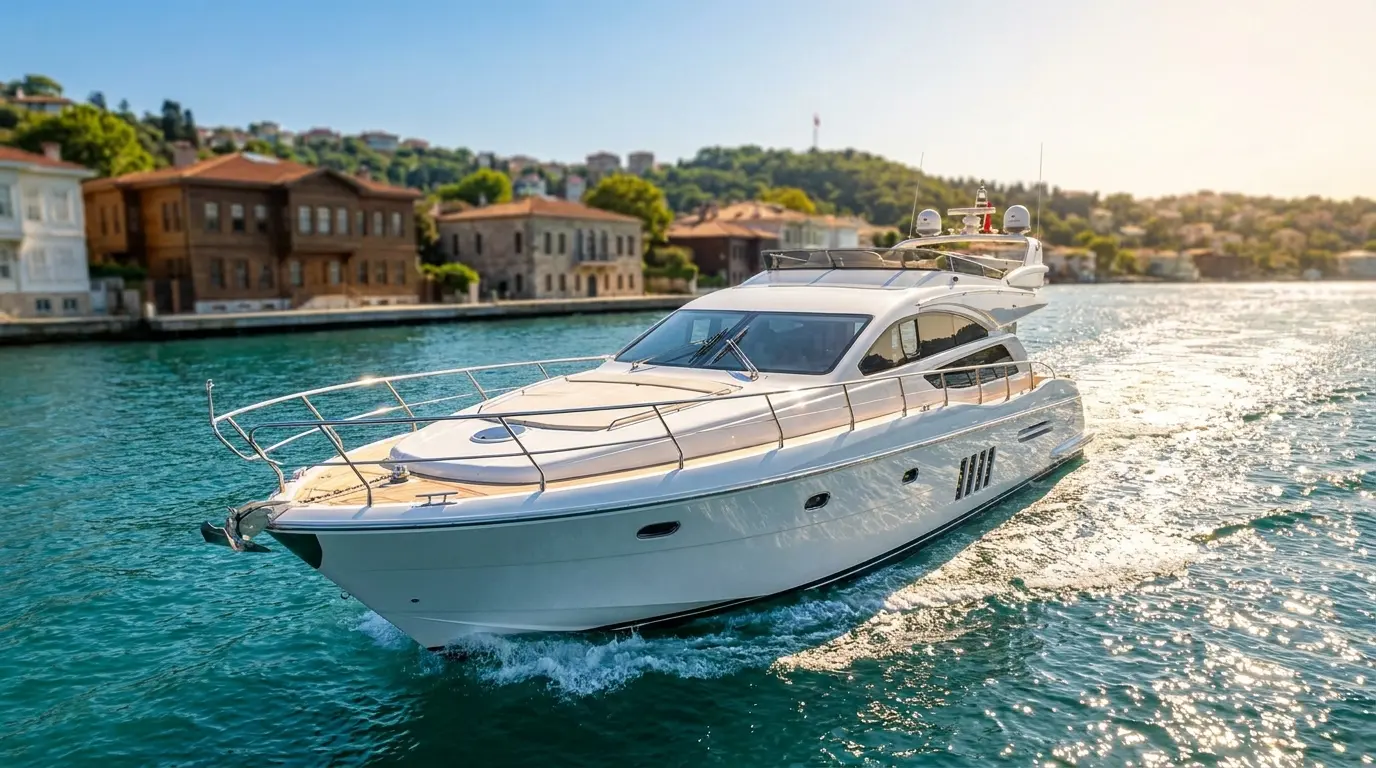
This boat is not for everyone. Honeymooners, families of six to ten, people who want a quiet romantic dinner, or anyone planning a marriage proposal will be lost at this scale. For those, the Özel Gün Davet Teknesi for smaller groups or the 23-metre Bosphorus yacht equipped for parties is a far better decision. It is also not a swimming, diving or fishing platform — swimming in the Bosphorus is not viable because of the current, regardless of the boat. If you want a fundamentally different itinerary, raise it before booking, not on the day.
If what you actually want is a mixed, individual-participation dinner cruise rather than a private charter, look at the Bosphorus evening dinner and entertainment cruise on Turlago; for two people or a small group it is far more economical.
The Cost Math at 170 People
The listed charter rate is 18,750 TL per hour. Spread across your group, the picture looks like this — charter only, excluding catering, music, decoration, staff and transfers:
- 2 hours: 37,500 TL — roughly 220 TL per head at 170 guests, about 250 TL at 150.
- 3 hours: 56,250 TL — roughly 331 TL per head at 170 guests, about 375 TL at 150, about 469 TL at 120.
- 4 hours: 75,000 TL — roughly 441 TL per head at 170 guests, 500 TL at 150.
The real lesson is this: the fuller the boat, the lower the per-head charter cost, but the side costs do not stay fixed. Catering, music, decoration and service are usually priced per person, so on a 170-person event the charter line is often the smaller half of the budget. When you book, ask for a single turnkey quote covering boat, catering, music, decoration and service. Otherwise the budget drifts upward well beyond what you presented internally.
Watch the minimum charter duration too. Two hours rarely works for a large event: boarding and disembarking alone consume 30 to 40 minutes. Treat three hours as the realistic floor and four hours as the comfortable standard.
Season, Wind and Sea State
Planning a boat event in Istanbul is a question of wind more than calendar. Two prevailing winds dominate: the poyraz from the northeast and the lodos from the southwest. The poyraz is cold and hard and builds seas in the northern Bosphorus; the lodos churns the Marmara and roughens exposed water. The Golden Horn, by contrast, is largely protected from both — which is exactly why keeping the Golden Horn leg flexible is valuable.
- May to June: The most balanced window. Long days, clean late-afternoon light on the strait, generally calm water. Safest choice for corporate events and weddings.
- July to August: Hot and humid, but evening sailings are excellent. Demand peaks, so lock Friday and Saturday dates weeks ahead.
- September to October: Water still warm, air cooling, crowds thinning. Also the strongest months for photography.
- November to March: Indoor space becomes the deciding factor. For a 170-person event, ask to see the interior layout before you commit, because most of the programme will happen inside. New Year's Eve and Ramadan are the busiest dates of this season; fix them months in advance.
April deserves its own note. Emirgan Park's tulip season and the general spring activity increase Bosphorus traffic, but the shoreline is at its most colourful of the year.
Twelve Questions to Ask Before You Sign
- Is this date and time definitely available, and what deposit is required?
- What is the minimum charter duration?
- What is included in the price and what is not: catering, service staff, sound system, decoration?
- How many guests can be seated for a meal, and how many standing? With 170 people, how many actually sit?
- Is there a working galley, or does catering come from outside?
- Can we bring our own caterer, and is there a service fee for that?
- Can we bring our own band or DJ, and is there a sound level limit?
- Which points on the route are fixed, and can the itinerary be customised?
- What is the policy in bad weather: rescheduling, refund, or an alternative Golden Horn-only programme?
- What is the gap between boarding time and departure, and will the boat wait for late guests?
- How does boarding work for wheelchair users, prams and elderly guests?
- Is there heating and air conditioning inside, and how many people does the indoor area hold in winter?
Get written answers to these. On large events, verbal agreements are the weakest link in the chain.
Onboard Practicalities That Save the Day
- Motion sickness: The strait's current and ferry traffic can unsettle sensitive guests. If they are taking medication, it should be taken at least an hour before departure. The best position on board is the upper deck or open air, looking at the horizon. The Golden Horn leg is a genuine relief window for these guests.
- Clothing: It is always a few degrees cooler and windier on the water than on shore. Even on summer evenings, plenty of guests will want a light jacket. Heels are both unsafe on deck and banned on some boats — put this on the invitation.
- Shoes: Many event boats ask guests to remove shoes indoors. If you do not tell a large group in advance, the boarding area becomes chaos.
- Children: Tell the operator how many children are coming and their age range in advance. Life jacket sizes are limited.
- Communication: On a 170-person boat, phones may not work or may not be heard over the noise. Exchange numbers between two responsible people on each side.
- Photography: The European shore reads clearly in daylight; on evening sailings the bridge lighting lifts the background after dark. The best moment for a full group photo is when the boat exits the Golden Horn near the Maiden's Tower.
- Hard rules: Jumping into the water, sitting on the deck edge near shore and ignoring the captain's instructions are both illegal and dangerous. State these explicitly in the briefing.
Seven Mistakes That Sink Large Boat Events
- Confusing capacity with attendance. A 170-person boat does not require 170 guests. If your core group is 60, this is the wrong scale.
- Not budgeting boarding time. Loading 170 people takes 30 to 40 minutes. Subtract it from your programme.
- Leaving side costs out of the budget. Events that do not price catering, music and decoration upfront typically overrun by 30 to 40 percent.
- Overlapping speeches and music. If there is a DJ, carve out separate windows for announcements and toasts.
- Relying on one coordinator. Boarding, reception, stage flow and disembarkation need at least three people.
- Leaving dietary requirements to the last day. Get written confirmation for vegetarian, vegan, gluten-free and children's menus.
- Having no weather plan. If wind forces a shorter route, what happens to your programme? Settle it in writing beforehand.
The Bottom Line: Route First, Then Boat
The real value of this Eminönü departure is not a single view. It is that two different kinds of water can be folded into one programme. The protected calm of the Golden Horn gives you a stable platform for ceremony, speeches and service, while the current-driven, monumental Bosphorus line is the showcase. The hardest problem in hosting a crowd — making everyone experience the same thing at the same time — is solved structurally: one deck, one route, one moment.
Use this decision order: settle the guest count first, then the duration, then the route. Once those three are fixed, the boat choice makes itself. This 36-metre, tourism-licensed vessel is designed to host a group of this size both on its wide open deck and in its spacious interior, and operates hourly, daily and custom programmes in Marmara and Bosphorus waters.
For live availability, exact dates and current pricing, view the 170-person charter boat on Turlago and lock your date early. Friday and Saturday evenings, plus the Ramadan and New Year periods, are the dates that close fastest at this capacity. If your group turns out to be smaller, look instead at the Özel Gün Davet Teknesi for private occasions, or for an individual booking consider the Bosphorus evening dinner and entertainment cruise.