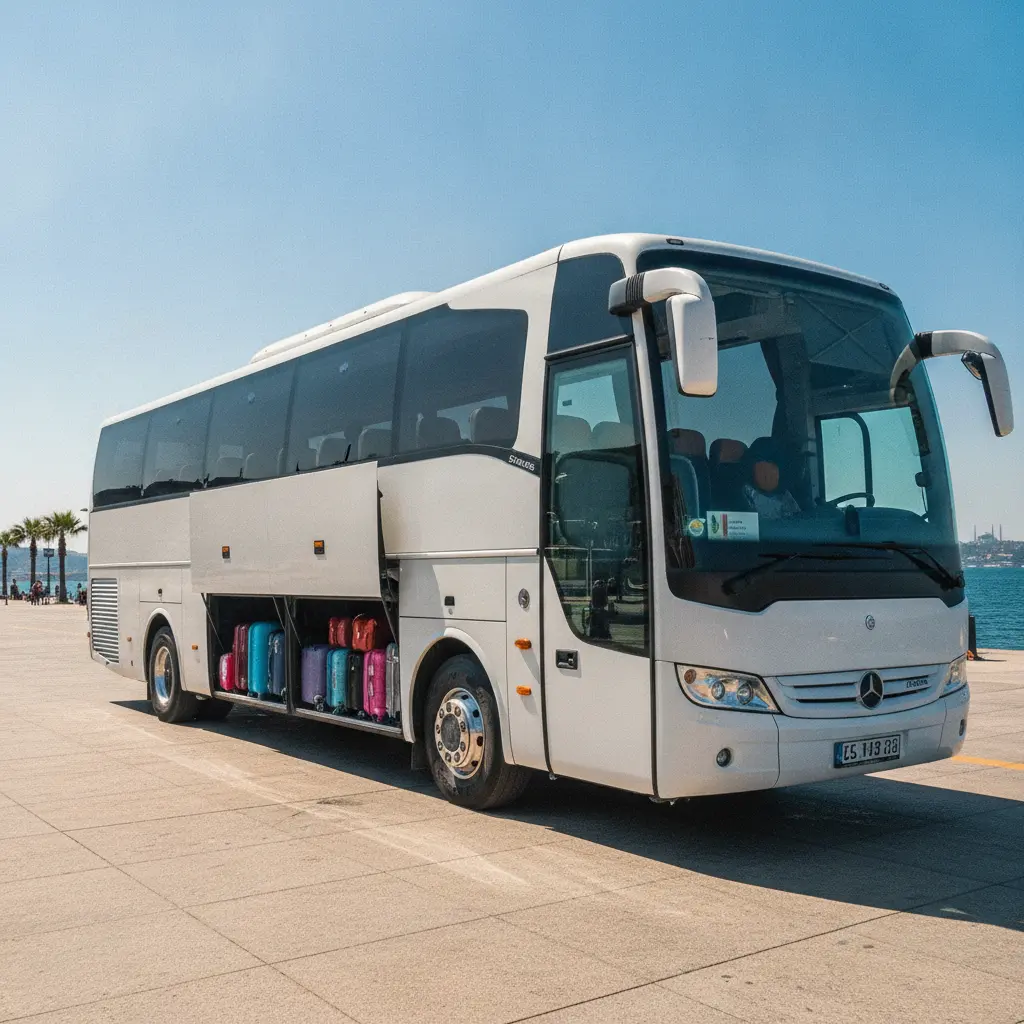
27+1 Chauffeur-Driven Midibus Hire Istanbul: Route & Cost Guide
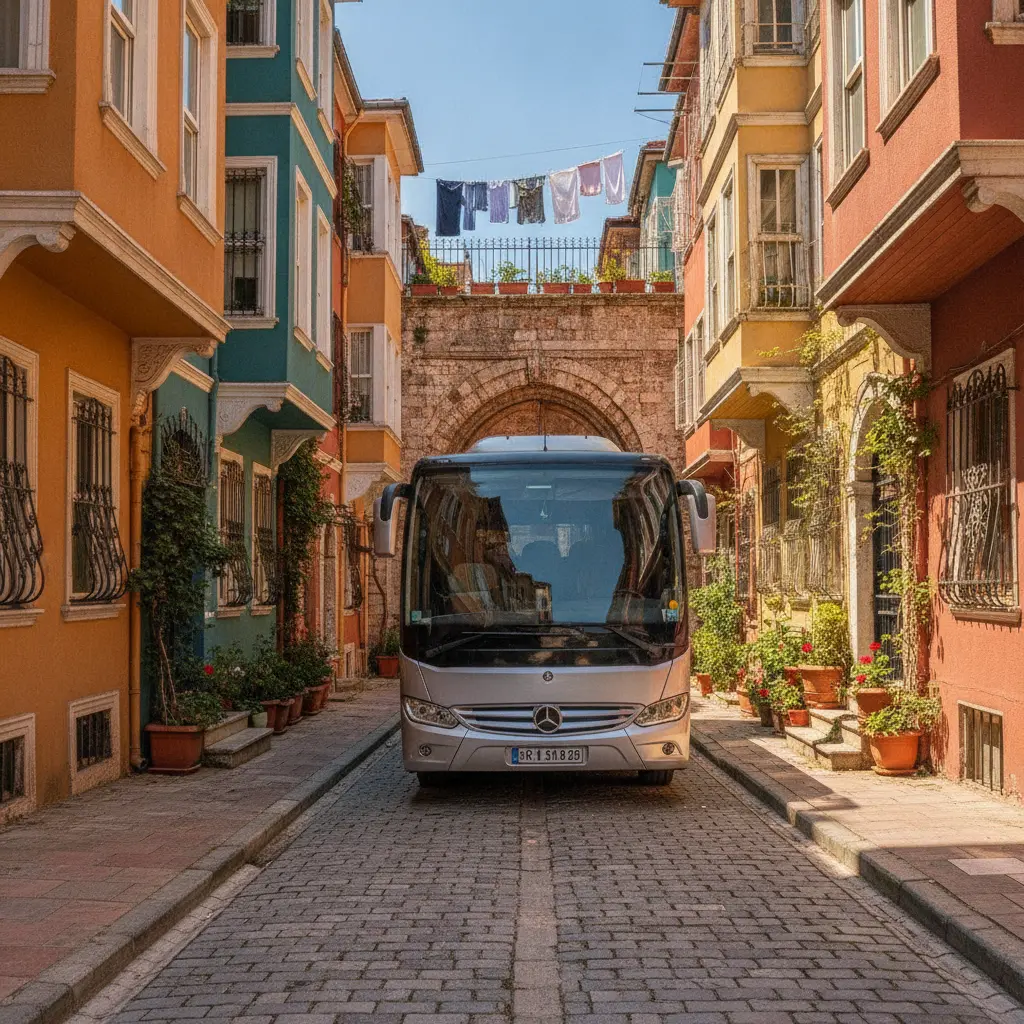
Ask anyone who has tried to move twenty-four people around Istanbul and they will tell you the same thing: the problem is never the headcount, it is the corner. A 35+1 coach solves the headcount and creates three new problems — a turning circle that does not exist, a parking bay that has to be booked in advance, and a group that ends up walking further than it would have from a smaller vehicle. Split the same party into two vans and you get a convoy that waits for itself at every stop. The 27+1 midibus sits precisely in that gap: one vehicle, one driver, one parking space, and a body short enough to work the side streets of the old city where the itinerary actually happens.
If you want a concrete starting point, view the Isuzu Novo Lux 27+1 chauffeured midibus rental listing on Turlago. Everything below is about how to use that vehicle well — which lanes it can take, where it should wait, and what each of those decisions costs.
What 27+1 actually means in practice
On a listing, 27+1 reads as twenty-seven passenger seats plus one seat for a guide or escort. Twenty-eight people in total. On paper it looks like it would comfortably absorb a party of thirty. It will not, and the reason has nothing to do with seats.
The luggage ceiling nobody mentions
Picture a group of twenty-eight arriving from the airport: one large suitcase and one cabin bag each, which is roughly forty to forty-five pieces of luggage. The rear compartment of a midibus-class vehicle takes about half of that. This is why the same bus should be planned two different ways for two different jobs. On a city day trip with no luggage, twenty-seven passengers travel in complete comfort. On an airport run or a two-day out-of-town programme, the realistic capacity drops to eighteen or twenty. Same vehicle, twice the difference in usefulness — and the variable is baggage, not people.
Standing passengers and seat belts
Short city hops make standing passengers look like a workaround. In chauffeured hire agreements they are almost always outside the scope of the contract. The seating configuration and the number of seat belts are fixed; exceeding them creates insurance and inspection exposure that no operator wants to carry for a group booking. Treating the seat count as a hard limit, rather than an aspiration, removes an argument that would otherwise surface at the worst possible moment of the day.
Where this vehicle is genuinely at its best
In my experience the sweet spot for a 27+1 midibus is a party of twenty to twenty-six. Everyone sits down, luggage fits without a puzzle, and the vehicle keeps the manoeuvrability that made you choose it. At twenty-seven or twenty-eight the bus still works — but only on a luggage-free itinerary.
Street-level Istanbul: where a midibus fits and where it does not
Street widths in the historic districts are far more unforgiving than a map suggests. Once you account for parked cars, signage spilling off the pavement and refuse containers, usable clearance in many lanes falls to around three metres. A twelve-metre coach has no business being there. A seven-to-eight-metre midibus can get through when the route is planned properly — but the gap between can get through and can stop comfortably is exactly what separates a good itinerary from a frustrating one.
Balat, Fener, Ayvansaray: the painted houses route
The lanes between Balat's restored bay-windowed houses are superb for photographs and punishing for vehicles. Two rules apply if you want to bring a midibus close. First, arrive before 10.00. Second, leave the vehicle on the main road and walk the group in. Vodina Caddesi and its immediate surroundings offer the most dependable drop-and-reboard points in the area. The most common mistake with guided groups is pushing the bus into the lane itself, then spending fifteen minutes hunting for a reverse angle — which quietly becomes the slowest part of the day.
Galata and Karaköy: gradient, one-way streets and footfall
Getting a vehicle near Galata Tower is close to impossible. Most drivers drop at Şişhane or down on the Karaköy waterfront and let the group walk up. The decisive detail here is gradient: collecting a group at the same point they climbed from wastes both fuel and time, so plan a lower pick-up on the return. One-way systems also change between morning and evening, which is why telling a driver where to drop and where to collect is always safer than telling them which street to enter.
Kuzguncuk and Üsküdar: the forgiving side
The waterfront neighbourhoods on the Anatolian side are noticeably more generous with narrow lanes. Kuzguncuk's İcadiye Caddesi spine, the Beylerbeyi waterfront and the Üsküdar shoreline are all comfortable for a midibus. Inner Çengelköy still demands the same care. The real advantage on this side is that a single midibus can collect a group from a hotel, run the Bosphorus line and return them without ever needing a second vehicle.
The Bosphorus line: easiest driving, hardest scheduling
The coastal roads along the Bosphorus are genuinely comfortable for a midibus. The difficulty is time, not space. Between Ortaköy, Kuruçeşme, Bebek and İstinye, evening congestion can stretch an eight-kilometre stretch into forty-five minutes without warning. Failing to account for that in a midibus hire plan shows up later as extra driver hours on the invoice.
The practical fix is to run the Bosphorus in the morning or early afternoon and, for the evening, anchor the programme around a single fixed venue rather than keeping the vehicle circling. If dinner is on the agenda, a fixed-venue arrangement such as a private-table Bosphorus dinner and Turkish night means the midibus drops you, disappears, and returns once — no wasted kilometres, no meter running in traffic.
One more local detail worth knowing: designated coach and midibus parking pockets along the Bosphorus are genuinely limited. The spot your driver offers to wait in may well be a prohibited stand. Defining drop-off and pick-up points rather than a waiting point removes both the penalty risk and the unnecessary waiting charge from the quote.
An hour-by-hour day: crossing both sides on one midibus
The plan below is built for a party of twenty-four and a single midibus. The point is not to list attractions but to show where the vehicle waits, where the group walks, and where traffic will bite.
- 08.30 — Hotel pick-up. Departure from the Şişli–Beşiktaş hotel cluster. The coastal road is clear at this hour; twenty minutes saved here becomes forty minutes saved later.
- 09.00 — Beşiktaş to Ortaköy. Approach along the waterfront, drop behind the square. Do not take the vehicle into the square itself.
- 09.45 — Bosphorus bridge. In the morning the first bridge is measurably faster than the second. Build in ten to fifteen minutes for the toll plaza.
- 10.15 — Kuzguncuk. A short walk down İcadiye Caddesi while the vehicle waits on the shore road.
- 11.30 — Üsküdar waterfront. A brief stop for the Maiden's Tower view. Midibus parking here means using the back streets off the coastal road.
- 12.30 — Lunch. A fixed venue; the vehicle does not idle at the door, and the driver takes the break here. This single decision saves more on the hourly calculation than any other.
- 14.00 — Historic peninsula. Entry to Sultanahmet via Sirkeci. The bus waits in a proper car park; entering the lanes is both prohibited and pointless.
- 16.00 — Balat. Drop on Vodina Caddesi, walk in. Sixty to seventy-five minutes on foot while the vehicle stays put.
- 17.30 — Fener and Ayvansaray. Down to the shore road and back along the Golden Horn.
- 18.30 — Return. The hour traffic begins. Closing the programme here avoids an overtime line on the invoice.
Total duration is roughly ten hours, and the distance covered is surprisingly small: fifty-five to sixty-five kilometres. It is a textbook illustration of something worth internalising before you compare quotes — in midibus hire, you are paying for time, not distance.
Five line items that quietly inflate a quote
A chauffeured midibus price is not a single number; it is a sum. To compare two offers honestly, ask about each of these separately.
1. Driver hours and mandatory rest
A standard daily hire usually defines an eight-to-ten-hour window. Anything beyond it is billed as extra. The detail most people overlook is the driver's legal rest requirement: a programme stretching past ten hours may need a relief driver or an additional break. Keeping the itinerary under ten hours reduces both the invoice and the fatigue of everyone on board.
2. Mileage and fuel
Some quotes are flat-rate with unlimited kilometres; others cap the daily distance. A city day in Istanbul typically lands between sixty and ninety kilometres, so the cap rarely bites — until you add Sapanca, Bursa or Edirne, where excess mileage becomes a serious line item. Insist that both the included distance and the per-kilometre excess rate appear in writing.
3. Parking and waiting
Midibus parking in Istanbul is priced differently from car parking, and in the historic peninsula it takes time to find. Who pays for it should be explicit in the contract. Waiting time is a separate matter again: some operators include the first thirty minutes and bill hourly thereafter.
4. Bridge, tunnel and motorway crossings
Any programme crossing between the two sides accumulates toll charges billed to the vehicle. Individually trivial, cumulatively noticeable over a full day. Ask directly whether crossings are included.
5. Season, weekday and demand
Same vehicle, same route, different price. Weekend wedding season, congress weeks and public holidays push midibus demand up; midweek morning departures sit at the most flexible end of the range. If your date can move by a day in either direction, the quote can move with it.
27+1 versus 35+1 versus two vans: the honest comparison
The most common mistake groups make is rounding capacity upwards and taking the bigger vehicle. The right question is not how many of us are there, but which streets are we entering.
- 27+1 midibus: one vehicle, one driver, one parking space for parties of twenty to twenty-eight. It can enter narrow lanes and is completely at home on the Bosphorus line. Luggage capacity is the constraint, so realistic capacity falls on any itinerary with suitcases.
- 35+1 coach: unavoidable above thirty passengers. It cannot enter the back streets of the historic peninsula, struggles to park, and is inefficient on short city hops. Running the same itinerary by coach usually means more walking and more waiting, not less.
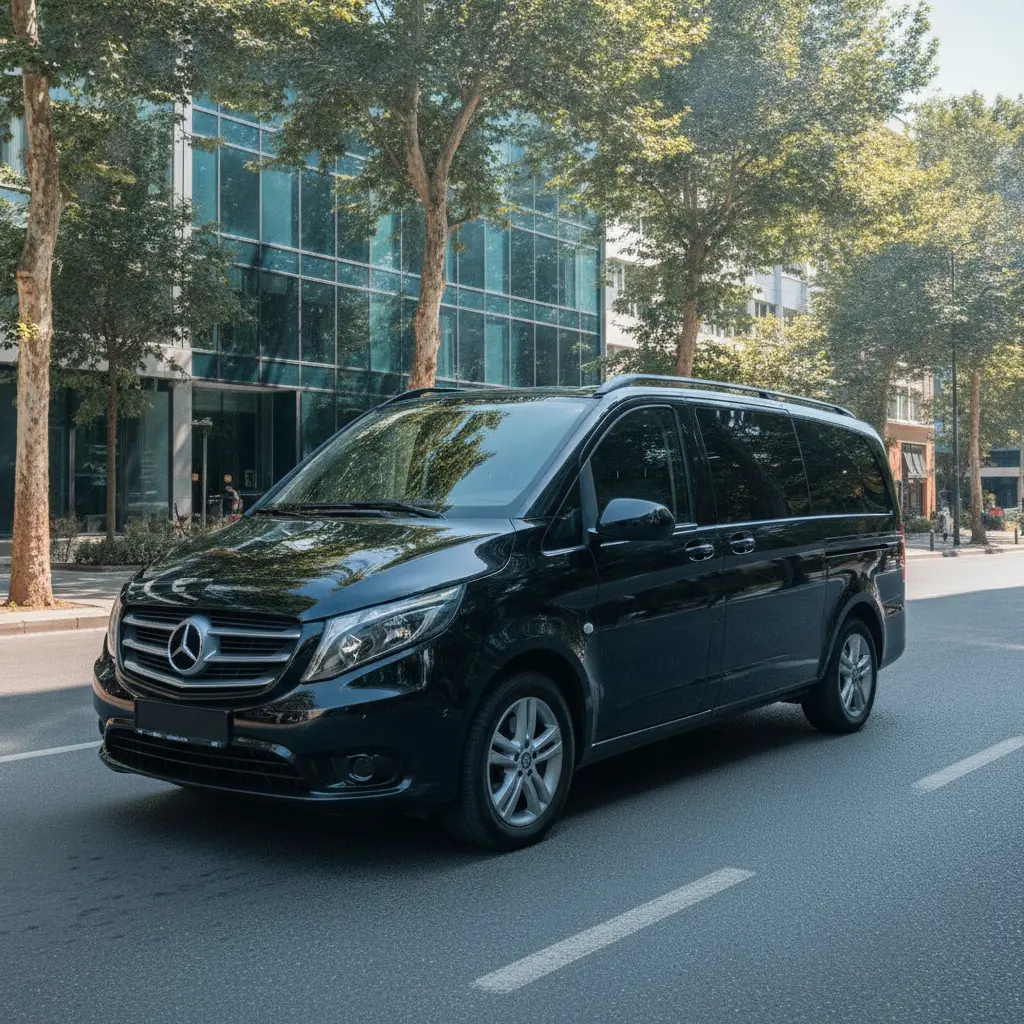
- Two VIP vans: excellent flexibility for twelve to fourteen people. For twenty-four it means two vehicles, two drivers, two parking spaces and two coordination problems, and the convoy waits for itself at every stop.
- Minibus plus taxis: looks economical on single-destination runs, but once the group fragments during the day, guiding and timing both suffer.
In short: for twenty-two to twenty-six people, a 27+1 midibus is the most balanced choice on both budget and route flexibility. Cross thirty and the coach becomes unavoidable — along with its route restrictions.
Seven questions to ask before you sign
- When does the driver's shift start and end, and are breaks included in that window?
- Is the vehicle model and age guaranteed, or does the contract contain an equivalent-vehicle clause?
- Are fuel, parking, bridge and tunnel charges included in the quoted price?
- Is there a daily mileage cap, and how is any excess charged?
- What are the cancellation terms, and how many days before departure is cancellation free?
- How is insurance and passenger liability arranged for the vehicle?
- How is the driver briefed on itinerary changes, and are extended routes or extra stops chargeable?
A quote that cannot answer these seven in writing is not comparable, however low the headline number looks. In chauffeured vehicle hire, nearly every hidden cost emerges from one of these headings.
Four use cases, four different calculations
Weddings and ceremony convoys
For a family group of twenty-eight, a 27+1 midibus is straightforwardly practical: one vehicle, one parking spot, one point of coordination. The critical detail is where the convoy stops for photographs. Halting a convoy in a narrow lane locks the street; waterfront lay-bys are the better answer.
Corporate hosting
For a twenty-person delegation arriving from abroad, a midibus handles both the hotel-to-venue shuttle and the evening programme in one vehicle. In this scenario a driver who knows the route landmarks well makes a visible difference to how smoothly the day runs.
Film and production
For crew transport, a midibus separates equipment from talent inside a single vehicle. Because waiting periods are long, daily hire rather than hourly is almost always the better budget decision.
Airport, hotel and venue triangle
With luggage in play, the realistic capacity of a 27+1 drops to eighteen or twenty. You may need a separate baggage vehicle or to split the party. Share the luggage count with the operator at the quoting stage rather than discovering it on the morning of arrival.
How to brief the driver properly
A good midibus day rests on a good brief as much as a good driver. Telling the driver which addresses you are visiting is far less useful than handing over a sequenced stop list with a waiting time attached to each.
- Put times against stops: Balat, 16.00–17.15. The driver plans traffic around that.
- Give a drop-off point and a pick-up point for every stop. They do not have to be the same place.
- State lunch and dinner windows up front so the driver's rest break can be built around them.
- Describe the group's walking tolerance. A party comfortable with 300 metres and one that caps out at 100 metres cannot share an itinerary.
- Nominate a single contact number. Three people calling separately unravels coordination fast.
Putting the brief in writing removes almost every small ambiguity that otherwise surfaces mid-afternoon, especially with larger groups.
Same route, different season
The same Istanbul lane is one thing between April and August and something else entirely in November. In midibus planning, season means not just weather but crowding and the availability of parking.
Spring (April–May) and autumn (September–October) are the most balanced windows: walking weather, attractions that are busy but not overwhelming, and parking that is findable. In summer, an early start pays for itself; after 10.00 both traffic and footfall in the historic peninsula climb sharply. In winter, shortening the programme and keeping the vehicle at a smaller number of fixed points makes sense on both comfort and cost.
Religious holidays and the New Year week are peak demand periods for midibus hire. Vehicles are available, but early booking is not optional.
Five planning mistakes that cost real money
- Ignoring luggage. Planning by seat count and then stalling on the airport run is the single most common error.
- Listing stops in sequence rather than with times. A driver gets no speed information from an ordered list; they get it from a timed one.
- Trying to take the vehicle into the square. Confusing drop-off with arrival point costs time at every single stop.
- Squeezing both sides into one day and picking the bridge at random. The right bridge in the morning is often not the right bridge in the evening.
- Leaving the driver's rest break out of the plan. Programmes built without a break usually finish late and pick up an extra charge on the way.
The bottom line: when 27+1 is the right call
For a party of twenty to twenty-six travelling through Istanbul's historic fabric, a 27+1 chauffeured midibus is almost always the right answer. One vehicle, one driver, one parking space and a body that fits the lanes — those four together make an itinerary both smoother and more predictable. Where it becomes the wrong answer is the moment luggage dominates: airport transfers and longer out-of-town programmes should be planned around a realistic capacity of eighteen to twenty.
On the budget side there is a single rule. Do not compare quotes on the headline number alone. If driver hours, mileage caps, parking and crossing charges are not itemised in writing, the two offers are not describing the same service. View the Isuzu Novo Lux 27+1 chauffeured midibus rental listing on Turlago and take the date and route details through directly.
If you want to finish the day on the water rather than in traffic, anchoring the evening around a fixed venue makes the vehicle's job simple. On the Bosphorus that can be arranged through a private-table Bosphorus dinner and Turkish night, with the midibus dropping the group nearby and collecting them once. For a larger party that wants the water built into the programme, there are also Istanbul yacht charter arrangements to consider — the midibus drops you at the pier and picks you up when you are done.