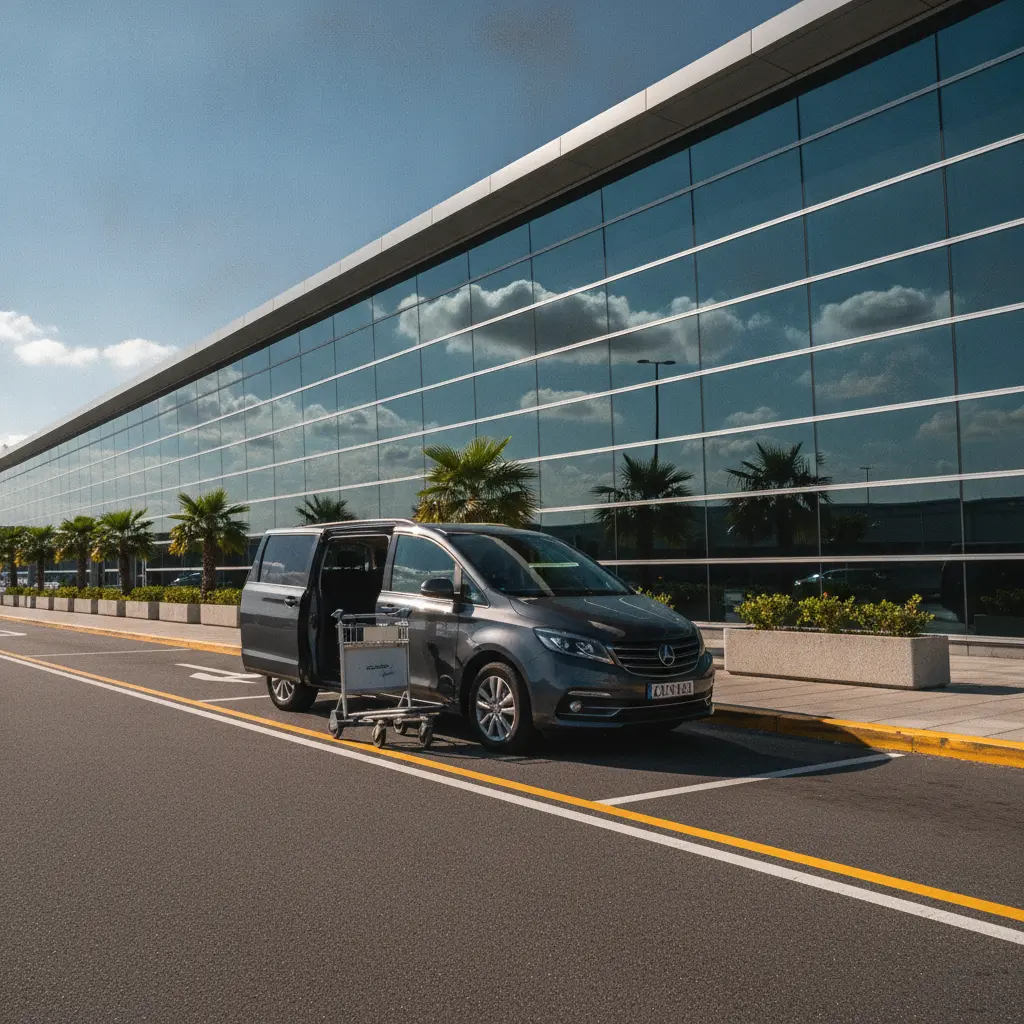
Airport Hotel Transfer: Seasonal & Hourly Timing Analysis

Most travellers plan a transfer around a single question: what time should the car arrive? The honest answer is that there is no fixed number. The same route can take forty minutes on a July morning at 05:30 and eighty minutes on a February morning at 08:00. Distance rarely changes; what changes is season, hour of day, day of week, school holidays and how busy the terminal happens to be. This guide treats airport-to-hotel transfer timing as a planning exercise rather than a guessing game. Work through the seasons, the hourly bands and the eight-step method below, and you will end up with a departure time you can actually defend. If you already know your flight number and hotel address, you can pair this method with the vehicle options listed on Turlago’s VIP car rental page and build a complete plan in one sitting.
The six inputs that decide your transfer time
Think of timing as a formula. Change the inputs and the output changes with them. Leaving without pinning down the following six variables is like driving without a map: possible, but unnecessarily risky.
- Departure time and terminal: The terminal matters as much as the clock. At large airports, moving between terminals adds real minutes, and check-in closing times vary by airline.
- Domestic versus international: International departures need more room for passport control and security queues. Travelling with family widens that gap further.
- Season: Winter brings visibility and road condition issues; summer brings peak-season volume. Late spring and mid-autumn are usually the most predictable windows.
- Hour of day: The 07:00–10:00 and 17:00–20:00 bands carry the heaviest urban traffic. Late night roads empty out, but service availability narrows.
- Day of week and calendar: Friday evenings, Sunday returns, public holiday eves and end-of-holiday surges are congestion events in their own right.
- Traveller profile and luggage: Small children, child seats, ski gear, oversized suitcases or a large group all add loading and walking time.
If you can summarise all six in one sentence — for example, two adults, two large suitcases, a Saturday in August, a 09:40 international departure from the city centre — you have already done most of the work.
Season-by-season timing analysis
Season affects a transfer through two separate channels: the physical condition of the road and the volume of people using it. The four periods below behave quite differently even on identical routes.
Winter (December–February): the widest buffer of the year
Winter risk is rarely a single factor. Morning fog or ice, afternoon rain and an early sunset can all land on the same day. When planning, do not just add normal traffic time; add a probability allowance for slow-downs. On routes that cross higher ground or mountain passes, winter tyre and chain regulations can extend journey times considerably.
There is a smaller winter detail that catches people out: loading the vehicle. In wet weather, protecting suitcases takes longer. The driver opens the luggage compartment, arranges the bags and covers them, and that is a few extra minutes at the door. If you are leaving before dawn, build that into the pickup time.
Who is winter good for? Business travellers and anyone chasing low-season prices. It is also the least forgiving period for tight connections and same-day returns, so plan accordingly.
Spring (March–May): calendar risk outweighs weather risk
Spring weather usually cooperates; the calendar often does not. School breaks, public holidays, long weekends and city events can all fall in the same week and fill the roads unexpectedly. The gap between an early departure and a mid-morning departure widens noticeably in this period.
Spring has one clear advantage: daylight arrives earlier. For early flights, both the walk to the terminal and the hotel exit feel easier. The sensible approach is to trim the winter buffer slightly, but always check the holiday calendar before you do.
Summer (June–August): peak volume and the early-start strategy
Summer demands the most planning. Three things happen at once: terminal volumes rise, intercity and coastal traffic increases, and hotel check-out times cluster together. Between 08:00 and 11:00, both city roads and airport approach routes are at their busiest.
The best summer strategy is simply to start earlier. A transfer leaving between 05:00 and 06:30 is far more predictable than one leaving an hour later. For afternoon flights, the 12:00–15:00 window offers relative calm once the lunchtime peak has dispersed.
Who is summer good for? Families, larger groups and holiday-focused trips. It is also the least tolerant period for last-minute planning, so book vehicle capacity early.
Autumn (September–November): the most predictable stretch
From mid-September to early November, timing is at its most balanced. Holiday traffic has thinned and the weather is still mild. From November onward, morning fog and rain return, so it helps to split the season in two: September and October are relaxed, November requires care.
Autumn rewards flexible travellers with both price and timing advantages. Even so, a November morning flight deserves a buffer close to winter rules.
Hourly bands compared
Regardless of season, the day has a rhythm. These bands are practical categories you can use when setting a pickup time.
04:00–07:00: empty roads, fewer options
Traffic is close to zero, so this band buys you time. The catch is on the supply side: shared transfer vehicles run less frequently at these hours, and route consolidation increases waiting risk. For very early flights, a private transfer is the safer choice if schedule certainty matters. Also confirm that your hotel reception is staffed at that hour, or arrange an express check-out the night before.
07:00–10:00: the busiest and least forgiving band
School runs, commuter traffic and airport-bound travellers all converge. If your transfer falls in this window, add a meaningful allowance to your normal journey time. Avoid the band if you can; if you cannot, move the hotel departure one step earlier than feels comfortable.
10:00–16:00: balanced, with blind spots
Broadly comfortable. Two blind spots remain: midday delivery and loading activity in city centres, and the late-afternoon school pickup. Flexibility is high in this band, which makes it the most efficient window for afternoon flights.
16:00–20:00: the evening surge
Return traffic and the commute begin together. Predictions are difficult here; the same route can take thirty-five minutes or seventy-five. If your flight is in the evening, leaving in the early afternoon lets you skip this band entirely.
20:00–00:00 and after midnight: quiet but careful
Roads clear and journey times shorten. Three things still deserve attention on a night transfer: confirming the vehicle in advance, receiving the driver’s details, and checking that the hotel entrance is open. For late arrivals, verifying 24-hour reception before you fly saves you a problem that is hard to solve at the airport.
Day of week: the quiet factor that decides outcomes
Weekday early mornings are usually the most predictable. Friday evenings are risky at any time of year for both city traffic and airport volume. Saturday mornings are busy because departing and returning travellers move at the same time, especially in summer. Sunday evenings create a second peak as weekend travellers head home.
A simple rule: for weekend flights, leave one step earlier than you would for the same departure time on a weekday. That single adjustment removes a surprising amount of risk.
An eight-step planning method
Work through these in order and the question of when to leave stops being a guess.
- Pin down the flight details. Departure time, terminal, airline and whether the flight is domestic or international. No calculation is reliable without these four.
- Set your required arrival time at the terminal. Allow more room for international departures, less for domestic. If you are checking bags, include the counter queue.
- Add in-terminal time. The walk from the entrance to check-in, then security, then the gate is a substantial item at large airports.
- Adjust journey time by season. Write two figures: one for winter, one for summer. Seeing the gap makes the case for a buffer concrete.
- Mark the hour and the day. Are you in a peak band? Is it Friday or Sunday? If yes, add an allowance.
- Record your traveller and luggage profile. Child seats, ski or golf equipment, and multiple suitcases all extend loading time.
- Work backwards. Subtract journey time and loading time from your terminal arrival time. What remains is when the vehicle should be at your door.
- Add a genuine safety margin. A small but real allowance covers road incidents, roadworks and slow hotel check-outs.
Once you have written this down, the next similar trip takes minutes. Over time you build personal multipliers: my winter-morning allowance from the city to the airport, my summer-Saturday allowance, and so on.
How to calculate the buffer
Build the buffer item by item rather than by feel. Start with the base journey time, then layer on season, hour, traveller and terminal allowances. Treat the multipliers as calibratable rather than fixed; your own history is the best source.
- Base time: the journey in free-flowing conditions.
- Season allowance: highest in winter and peak summer, lowest in mid-spring and mid-autumn.
- Hour allowance: highest in the 07:00–10:00 and 16:00–20:00 bands.
- Day allowance: add for Fridays, Saturdays, Sundays and holiday eves.
- Traveller allowance: add for child seat installation, excess luggage or large groups.
- Terminal allowance: add for the walk to the gate at large terminals.
The total is almost always longer than the optimistic instinct suggests. That is the point: optimism is the expensive option in transfer planning.
Airport-specific planning notes
Airports behave differently even within the same country. These notes highlight what to watch depending on distance and route type.
Istanbul Airport (IST)
Distance to the city centre and route choice drive the timing. The terminal is large, so the walk to the gate deserves a generous allowance. Early-morning departures from the city tend to flow better, while the evening behaves the opposite way.
Sabiha Gökçen (SAW)
Access from the Anatolian side is shorter; from the European side, the bridge crossing makes journey times far more variable. Treat bridge traffic as its own buffer line. In peak hours, discussing an alternative route with the driver in advance is worthwhile.
Antalya (AYT)
Distances to coastal hotels vary enormously depending on location. Central hotels and northern bay areas are very different propositions, and the gap widens in high summer. Giving the exact hotel address and district when booking sharpens the estimate considerably.
Dalaman (DLM)
The hub for long coastal transfers. Here, a single wrong assumption can shift the entire plan. Mountainous sections and winding roads reduce average speed, and night journeys make this more pronounced.
Bodrum-Milas (BJV)
Peninsula traffic changes markedly with the season. In summer, the coastal road and the town centre can both slow down. For early flights, remember that the exit from the peninsula funnels through a limited route.
Izmir Adnan Menderes (ADB)
The city centre is relatively close, but longer transfers to the south and west depend on motorway access. Early-morning city exits are usually smoother than afternoon ones.
Ankara Esenboğa (ESB)
The route to the city centre is generally predictable; in winter, snow and ice become the main variable, so widen the buffer for winter departures.
Return transfers: planning in reverse
The hotel-to-airport leg matters more than the outbound journey, because there is no recovery time if you are late. Work backwards and add three extra items.
- Check-out time: Busy hotels, especially on summer mornings, can produce a queue at reception. Either allow for it or settle the bill the night before.
- Baggage collection: With families, gathering suitcases, waiting for the lift and moving everything to the lobby takes longer than expected.
- In-terminal processing: Bag drop, security and passport control. For international departures this item grows considerably.
Add the traffic allowance on top of these three, and you have your hotel departure time. Note that the vehicle’s arrival time is not the same as your departure time; the car should be waiting before you are ready to leave.
Large groups, children and special equipment
Timing changes when the traveller profile changes. Installing a child seat takes a few minutes; with two small children it doubles. If you are carrying ski, cycling or diving equipment, loading takes longer and you may need a larger vehicle. If a group of six is split across two cars, both must be ready at the same time — confirm this at the booking stage rather than at the door.
In these situations, vehicle choice and timing should be decided together. VIP car rental options make it easier to match luggage capacity and seating layout to your group before you fix the schedule.
Seven common timing mistakes
- Planning with the free-flow time: treating the route as if no one else is on it.
- Forgetting in-terminal time: you do not step off the vehicle and onto the aircraft.
- Ignoring the season: using the same plan in January and July.
- Missing the weekend effect: calculating Fridays and Sundays as if they were Tuesdays.
- Treating check-out as instant: in busy hotels on summer mornings, it is not.
- Overlooking route consolidation on shared transfers: other passengers mean extra stops and waiting.
- Not reconfirming: booking and then never checking again is the riskiest scenario at night and before dawn.
Which season and hour fits which traveller?
Timing advice depends on who is travelling. This short comparison helps you find your own case.
- Families with children: early-morning summer slots are calmer than afternoons, and quieter terminal periods reduce stress.
- Business travellers: mid-spring and mid-autumn are the most predictable; the 10:00–16:00 weekday window is the most efficient.
- Long coastal transfers: daytime journeys are more comfortable for both scenery and safety; night journeys take longer.
- Late-night arrivals: service options narrow, so a private transfer is usually the better fit. Confirm the hotel’s night entry procedure in advance.
- Large groups: plan vehicle capacity and luggage volume early; availability tightens in summer.
Frequently asked questions
How many hours before my flight should I leave the hotel?
A single number would be misleading. What matters is the time you need to be at the terminal. Allow a shorter terminal buffer for domestic flights and a longer one for international, then add season, hour and day allowances. The method is more reliable than memorising a number.
Shared or private transfer?
Shared transfers make sense when budget is the priority. For pre-dawn flights, large families and tight itineraries, private transfers offer greater schedule certainty. Look at waiting risk, not only price.
Why does night require different planning?
Roads are empty so journeys shorten, but service and confirmation processes become more critical. Sharing driver details in advance, knowing the vehicle plate and confirming the hotel entrance are the three essentials.
How can I predict congestion in advance?
Read hour, weekday and season together. If all three point the same way — summer, Friday, 18:00 — expect congestion. Conversely, a Tuesday at 05:30 in midwinter is usually quiet.
What happens if my flight is delayed?
Providing your flight number at booking helps with tracking. In every case, keep a direct channel to the driver open. For arrivals, flight tracking determines how waiting time is handled.
Does luggage really affect timing?
Yes, especially with larger groups and big suitcases. Plan vehicle capacity alongside luggage, or you will lose time at loading or need an additional vehicle.
Build your own timing formula in three steps
The whole analysis comes down to one habit: thinking in variables instead of fixed clock times. Three steps make it permanent. First, keep season, day and hour as separate lines in your pre-flight checklist. Second, take notes when you use the same route in different periods and build your own multipliers. Third, turn working backwards from your terminal arrival time into a routine.
Do this and the question of when to leave stops being a source of stress and becomes a two-minute calculation. Whatever transfer type you choose — shared, private or group — correct timing removes the most tense part of the journey. To compare vehicles by luggage, group size and preferred time slot, browse the VIP car rental options on Turlago. The right hour, the right vehicle and the right buffer: those three together make up the first forty-five minutes of a good trip.