Choosing a Hotel Transfer with a Baby: What Really Matters

The first sixty minutes decide how the whole trip feels
Stepping off a plane with a baby changes the arithmetic of travel. You are no longer one person with a suitcase; you are a small logistics operation carrying a tired child, a folded stroller, a nappy bag and two suitcases. For an adult alone, twenty-five minutes in a taxi queue is an inconvenience. For a family with a baby, it is a slow-motion crisis involving tears, sweat and a nappy change on a terminal floor.
That is why booking a hotel transfer is not really about hiring a car. You are buying the first sixty minutes between the aircraft door and the hotel reception desk. Price is only one part of that decision, and often the least predictive of how the journey will actually go. Seat compatibility, waiting policy, luggage volume and the driver's experience with small children matter just as much.
Treat the criteria below as a decision tree rather than a checklist. A few of them are non-negotiable and are reason enough to cancel a booking on their own. Others can flex with your budget. To get a sense of vehicle classes and equipment levels before you start, it helps to browse the VIP car rental options on Turlago and see how the categories are laid out.
Child seats: available is not the same as suitable
The phrase you will see most often on booking forms is that a baby seat is available. That sentence tells you almost nothing. The question that matters is which age and weight group the seat is designed for, to what standard it is built, and where in the vehicle it will be installed.
Matching the seat to the child
Child seats are classified by weight and height, not by age alone. Children under roughly 13 kilograms need a rear-facing seat. Between 9 and 18 kilograms, a forward-facing seat becomes appropriate, and from about 15 to 36 kilograms a booster seat takes over. Telling the operator your child's exact age, weight and height at the time of booking is what prevents a generic baby seat from arriving when you needed something quite specific. Round numbers are your enemy here; give the latest measurement, especially if your child sits close to a category boundary.
Why this item is not negotiable
A wrongly installed seat can be more dangerous than no seat at all. A rear-facing seat fitted forward-facing, a belt routed the wrong way, or an ISOFIX-compatible seat loosely secured with a lap belt will not reduce the force of an impact the way it is supposed to. Ask for three details in writing after booking: the seat type, the mounting position, and the standard it complies with. A verbal assurance that a baby seat exists is not enough, and written confirmation also prevents an argument at the airport curb.
How many adults actually fit?
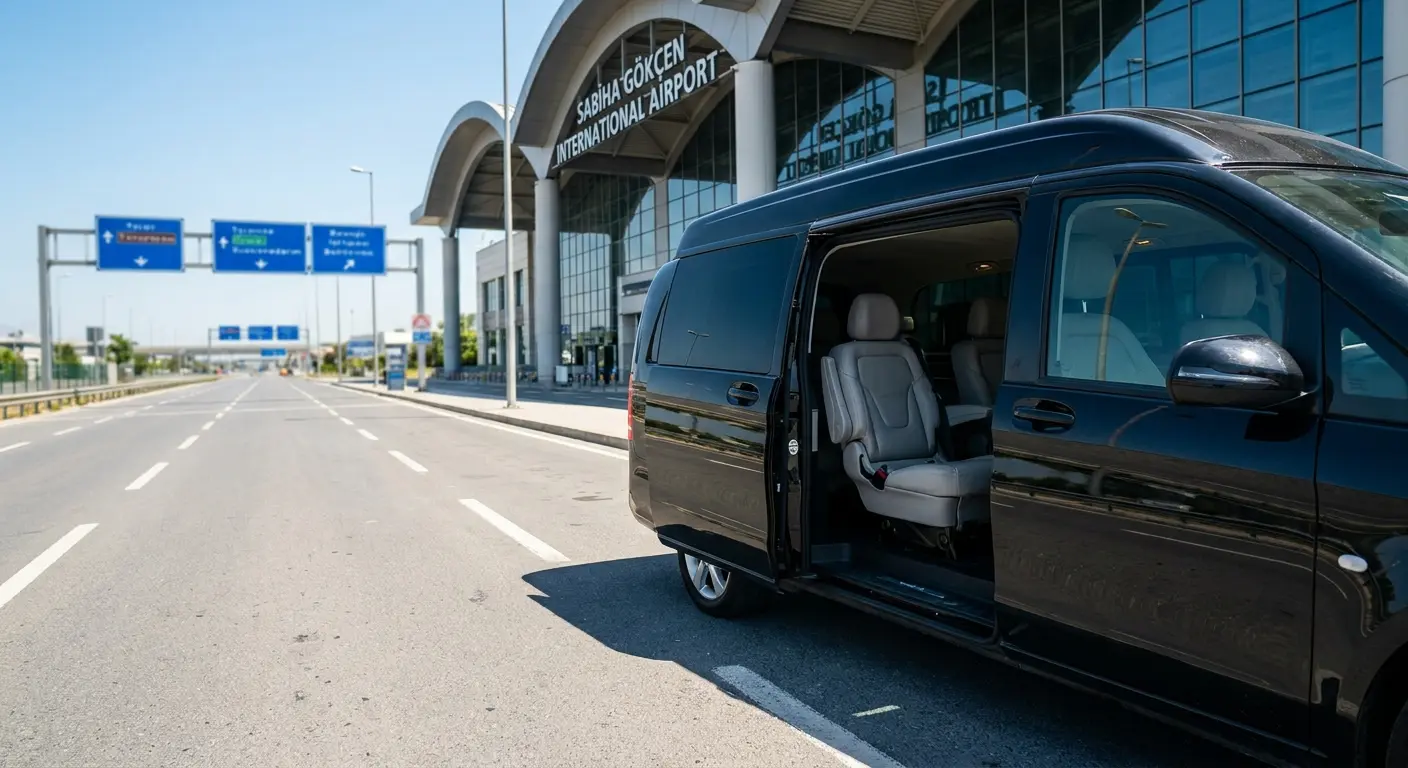
This is the detail most families miss. Once a child seat is installed in the back, the remaining seating space shrinks. In a standard sedan, a child seat, two adults and a stroller rarely fit together comfortably. For families with babies, a minivan with a large boot and sliding doors is usually the most practical answer. Sliding doors matter more than they sound: they let you lift a baby out of the vehicle in a narrow hotel forecourt without swinging a door into traffic.
The luggage equation nobody budgets for
A family with a baby does not travel with the luggage of two adults. A folded stroller, a travel cot, a changing bag, a feeding bag, spare clothes and a portable high chair can double the volume in an instant. Instead of typing two suitcases into the booking form, list the items one by one. That is what allows the operator to recommend the right vehicle class rather than a hopeful guess.
The stroller question
Whether a folded stroller fits in the boot is the most concrete test of vehicle class. Double strollers and large travel-system models can defeat a sedan boot entirely. Sharing the folded dimensions, particularly length and width, makes the recommendation reliable. If measuring feels fussy, send a photo of the stroller folded; it takes ten seconds and removes all ambiguity.
A rough starting point
- 1 baby, 2 adults, 2 large suitcases and a stroller: a large-boot SUV or a compact minivan
- 1 baby, 3 adults, 3 suitcases, a stroller and a travel cot: a minivan
- Twins and 2 adults: a minivan that can take two child seats, or two separate vehicles
- A large family with five or more adults and two babies: two coordinated vehicles rather than one
Use this as a starting point, not a guarantee. The reliable answer comes from asking the operator for boot capacity in litres in writing. An operator who cannot answer that question is unlikely to give you a precise answer about child seat standards either.
Meet and greet: why the last two hundred metres matter most
Airport pickups come in two models. Either the driver meets you at the terminal exit with a name board, or the car waits in a car park and you walk to it. For a family with a baby, the gap between those two options is far wider than it looks on paper.
Why in-terminal meeting is worth paying for
Because the real effort is not the drive, it is the distance between the terminal and the car. Pushing a stroller, carrying a cabin bag and holding a child through car park levels can be the most exhausting part of the entire transfer. With a proper meet and greet, the driver takes the luggage off your hands and walks you to the vehicle. For a parent travelling alone with a baby, that is a decisive difference in comfort, not a luxury. Lifts and travelators also stretch the distance when you are pushing a stroller, and a meeting service shortens all of it.
Free waiting time: how many minutes do you actually get?
The free waiting window that starts when your flight lands is the most disputed clause in any transfer contract. The standard allowance is usually 45 to 60 minutes, which is frequently not enough for baggage reclaim, a nappy change and a feed. For families with babies, anything under 60 minutes carries real risk. Ask what the charge is per additional 15 minutes before you book, not after.
Is the flight tracked?
Professional operators enter your flight number into their system and monitor delays automatically. This is what stops a driver from standing around unpaid and stops you from being billed for a delay you did not cause. If an operator says they do not track flights, giving them your flight number will change very little.
Delays and late-night arrivals: is there a plan B?
Delays are more likely than not when travelling with a baby, regardless of departure time. Landing at two in the morning with a transfer already waiting is a completely different experience from landing at two in the morning and hunting for a taxi with a crying child.
Night rates and surcharges
Many transfer services apply a night rate between 22:00 and 06:00. That surcharge should be visible at the time of booking, not added at the end of the ride. Ask for the total in writing so the number you agreed to is the number you pay.
The cancelled flight scenario
Ask what happens to the transfer if your flight is cancelled. A good operator will see the cancellation through the flight number and either move the booking free of charge or refund it. Look for that in the written policy rather than accepting a verbal promise. Cancellation and delay rates rise sharply in winter, so the value of this clause goes up accordingly.
Route choice: fewest interruptions beats shortest distance
With a baby on board, 45 minutes is not automatically worse than 30. What matters is how many times you have to stop. The shortest route into a city centre may be full of traffic lights and lane changes, while a longer orbital road can be the smoother option that lets your child fall asleep.
Say this to the driver
State your route preference at the time of booking: you are travelling with a baby and would prefer a route with fewer stops and starts. That single sentence changes how the driver plans the journey. Discuss breaks as well. On transfers longer than an hour, one stop should be treated as standard, and you should know in advance whether it costs extra.
Price transparency: what is actually included?
When comparing transfer quotes, look at the total cost rather than the headline number. Hidden line items for families with babies usually appear in a handful of predictable places:
- Child seat fee: some operators charge per seat, others include it
- Infant passenger fee: yes, some operators charge for a baby travelling on a lap
- Extra luggage or stroller fee: added after the fact when volume exceeds the declared allowance
- Waiting overage: charged per minute beyond the free window
- Night surcharge: a multiplier that depends on the hour of travel
- Airport parking or entry fee: sometimes included, sometimes not
A transfer with a fixed price guarantee will not call you to charge for an extra twenty minutes stuck in traffic. Look for the words fixed price and treat metered or distance-based pricing as unpredictable cost when a baby is involved. It is also worth asking why a quote is unusually low; the answer is usually that one of the seat, waiting or luggage items has quietly been left out.
Vehicle age, cleanliness and scent sensitivity
A baby's immune system and airways are more sensitive than an adult's. Cabin cleanliness, air conditioning filters and scent are genuine selection criteria for a family with an infant, not fussy details.
Three questions worth asking
- Has anyone smoked in the vehicle? Smoke absorbed into upholstery will bother a baby for the entire journey.
- When was the air conditioning filter last changed? A clogged filter degrades air quality for the whole ride.
- Is an air freshener used? Strong fragrance can cause headaches and nausea in babies and sensitive adults. Put a fragrance-free request in the booking notes.
Vehicle age is an indirect indicator too. ISOFIX anchor points became standard in newer models, and rear-seat ergonomics are generally better. On vehicles older than about five years, confirm the condition of the seat anchor points separately. In summer, air conditioning performance directly affects comfort; a poorly maintained system will leave a baby overheated within twenty minutes.
The driver factor
A good transfer driver is more than a driver when there is a baby in the car. They carry the bags, fold the stroller, wait a couple of extra minutes without sighing, and do not fill the silence with conversation that raises the temperature of the journey. This is the factor that never shows up on a booking form but decides how the transfer actually feels.
Language and responsiveness
In an unfamiliar city, and especially with a baby, it helps if the driver can communicate in a language you understand. At minimum, test response times before booking by sending a WhatsApp message or an email. How fast you get a reply is the best available indicator of whether anyone will answer when something goes wrong at eleven at night.
Briefing the driver
Use the booking notes to state the child's age, the preferred seat orientation, the folded stroller dimensions, the fact that you will be moving slowly through the hotel entrance with a stroller, and any extra stop. Most cases of a driver being unprepared come from notes that were never written. Short bullet points work far better than a long paragraph.
Cancellation, changes and payment terms
Plans change when a baby is involved. A flight time shifts, a child gets ill, a hotel check-in moves a day earlier. The cancellation and amendment policy is therefore the second thing to read after the price.
Three clauses to check
- Free cancellation window: how many hours before departure can you cancel without penalty?
- Amendment rights: if the flight time changes, is the booking updated free of charge?
- Payment timing: prepayment or pay in the vehicle? Before sharing card details, check that the operator sends written confirmation.
With operators who require prepayment, clarify the refund conditions and how long a refund takes. Written confirmation by email is always safer than a verbal agreement, and that confirmation should list the vehicle class, the number of child seats and the waiting allowance item by item. Anything not written down is the part most likely to be disputed later.
Travelling with two children or a large family
With twins or three children, a single vehicle often stops being enough. The question then is whether both vehicles will actually be at the airport at the same time. If you are booking two cars, settle these points first:
- Are both vehicles tracking the same flight?
- Has luggage been split in advance, and which car carries the stroller?
- Are both drivers going to the same hotel address, or could one get lost?
- Has the combined cost of two cars been compared with a single minivan?
In most cases one minivan is cheaper and better coordinated than two cars. But with two child seats and five adults, two vehicles become unavoidable. The riskiest moment for a family with babies is transferring between vehicles, because the whole loading process restarts once a child wakes up. If two cars are used, ask the drivers to coordinate so they arrive at the hotel at the same time.
Prepare the hotel side as well
The transfer does not end at the hotel door; the first five minutes at reception are part of the same equation. Telling the hotel your expected arrival time means an early check-in request or a cot is more likely to be ready when you walk in. It is also worth asking in advance whether the hotel accepts transfer vehicles at its entrance. Some boutique properties sit on pedestrian-only lanes where the last stretch is covered on foot.
The final hundred metres
Find out where the entrance actually is and how many steps or how many metres you will cover after leaving the car. With a baby, that distance affects the overall comfort of the transfer more than you would expect. Where possible, ask whether the hotel has a step-free entrance suitable for a stroller.
Step by step: how to book a transfer with a baby
- Confirm the flight and the hotel details. Flight number, landing time, hotel address and check-in time.
- Build a passenger and luggage inventory. Adults, babies, ages and weights, folded stroller size, suitcase count.
- Choose the vehicle class. Account for the seating space left after the child seats are installed.
- Request the seat standard in writing. Type, mounting direction and compliance information.
- Learn the waiting policy. Free window, overage charge, flight tracking.
- Get the total price itemised. Including child seats, infant fee, luggage and night rate.
- Read the cancellation and amendment terms. Ask for written confirmation.
- Fill in the booking notes. Child's age, stroller, language preference, extra stop.
- Confirm 24 hours before arrival. Driver details and plate number in advance.
- Keep a contact channel open on arrival day. The driver's number in your hand, not in an email.
All ten steps take about half an hour in total. Every step skipped, however, tends to cost minutes or hours at the airport while you are juggling a baby. The step most often dropped is the ninth: a confirmation 24 hours ahead guarantees that a driver has actually been assigned and that your stroller and child seat notes have been read.
Twelve questions to ask before you book
- Which age and weight group does the child seat cover?
- Can the seat be installed rear-facing?
- How many ISOFIX anchor points does the vehicle have?
- Is there an extra charge for the child seat?
- Is there an infant passenger fee?
- How many minutes of free waiting time are included?
- Do you track flight delays automatically?
- Which hours does the night rate apply to?
- Does the stroller fit in the boot, and is there a size limit?
- Is the price fixed, or does it change in traffic?
- What are the cancellation and amendment conditions?
- Has the vehicle been smoked in, and is an air freshener used?
If you cannot get written answers to these twelve questions, it is too early to take that operator on a journey with a baby. Clarity of answers is the best available predictor of service quality.
Season and timing: planning for peak periods
In July and August, airport exits, terminal congestion and hotel check-in times all converge. The most common planning error families make is to treat the landing time and the hotel arrival time as the same thing. Between baggage reclaim, passport control and getting a baby ready, leaving the terminal usually takes 45 to 60 minutes. Plan your transfer around that and choose a package that includes a meeting service. In winter, delay probabilities rise, and the value of a flight-tracked operator rises with them.
Longer journeys: transfers over two hours with a baby
An airport-to-hotel run is short. Some families, however, go straight from the airport to another city or a coastal town. On a transfer longer than two hours the criteria shift: number of breaks, cabin temperature control, the fit between the seat belt and the child seat, and access to spare clothes become the priorities. On longer journeys, planning for an adult to sit next to the child seat directly affects the baby's comfort. Agree a fixed price and a written route for these trips as well, so motorway tolls and rest stops do not become a source of ambiguity halfway through.
Airport transfer or a daily chauffeur?
Some families choose a car with a driver for the whole day instead of a one-way transfer. With a baby, that can be appealing because it lets you return to the vehicle when your child falls asleep. The detail to watch is the child seat: it should stay installed in the car all day rather than being removed at every stop. Confirm that before booking. If you want to balance comfort against budget, separating the airport transfer from local transport usually works out cheaper.
Budget: how much extra is worth paying?
The sensible budgeting rule for families with babies is simple: do not economise on the seat or the waiting time. Both are directly tied to safety and stress. Be flexible instead on vehicle brand, extras and the colour of the name board. A useful guideline is to allocate a meaningful share of the transfer budget to seat compatibility and waiting allowance, and let the rest go to comfort. The most expensive transfer, in the end, is the one that has to be fixed at the airport because the seat was wrong or the free waiting window was too short.
Conclusion: the right transfer protects the first hours of the holiday
Choosing a hotel transfer with a baby is really a decision about how the first hours of your holiday will feel. A cheap-looking option can begin with an hour of stress at the airport over a wrong seat or a short waiting allowance. A slightly higher-priced option with a written seat standard, flight tracking and a fixed price gives you the calmest possible start.
Set your priorities in this order: seat compatibility, luggage capacity, waiting policy, price transparency and cancellation terms. Once those five are settled, everything else is secondary. You can compare vehicles with the right seat and boot capacity by browsing the VIP car rental options and transfer services on Turlago, then put every requirement into the booking notes in one go. Half an hour of preparation now saves the part of the trip you cannot get back.