Sabiha Gökçen Night Hotel Transfer: Guide by Time Slot
A plane touches down at Sabiha Gökçen at 23:40 and the same question lands with it: is the metro still running, or do I go straight to the taxi rank? The honest answer depends less on the airport than on the clock. The slot you exit the terminal in decides how much you pay, how long you wait, whether your hotel reception is still staffed, and how the following morning actually feels. This guide splits the night into four working windows — 21:30–23:30, 23:30–01:30, 01:30–04:00 and 04:00–06:30 — and tells you what is genuinely available in each, what is a false economy, and how to build a plan that survives a delay. If you would rather have the vehicle sorted before you fly, Turlago's premium VIP car rental page is a sensible place to start.
Why the clock matters more than the distance at Sabiha Gökçen
Sabiha Gökçen sits on Istanbul's Asian side, in the Pendik–Kurtköy corridor. From the terminal, the rough distances are these: Kadıköy around 35 km, Ataşehir and Maltepe in the 30–40 km band, Taksim and Beşiktaş roughly 50 km, and Sultanahmet or Fatih pushing 55 km. But kilometres are the least interesting number here. What actually changes your night is the hour at which you cover them.
The same 40 km stretch can take 45–55 minutes at 22:00 on a busy evening, drop to 30–35 minutes at 03:00 on an empty motorway, then stretch again between 05:00 and 06:30 when the outbound departure wave and the first commuter traffic overlap. So the useful question is never how far is my hotel. It is which part of Istanbul is moving when I am moving through it.
That is the lens this guide uses throughout. No single price, no single journey time — a decision map that shifts with the hands on the clock.
21:30–23:30 — the last public transport window
This is the luckiest slot of the night for arrivals. Public transport is still genuinely on the table, and it is the last window where you can reach the city without a private vehicle.
- Metro (M4 line): Connects the airport towards Kadıköy and the wider network. Services thin out towards midnight, and the moment you miss the last train your fallback becomes a taxi. Confirm the exact last departure on your travel date via official operator sources or the terminal information screens — schedules are not something to assume.
- Airport shuttle services: Typically run towards Taksim and Kadıköy, timed around flight arrivals. Late at night the intervals widen. Allow 15–20 minutes to walk to the stop and wait after collecting your bags.
- City bus routes: Frequency drops sharply after dark, and a journey with a transfer can easily exceed two hours. Not realistic if you want to be in your hotel before 23:30.
The classic mistake in this slot is confusing landing time with exit time. Between touchdown and stepping out of arrivals, 30–60 minutes can disappear into immigration and baggage reclaim depending on how many flights arrived together. A plane that lands at 23:00 usually produces a passenger on the kerb at 23:45 — which means you are already in the next slot. The rule: plan from your terminal exit time, never from the landing time.
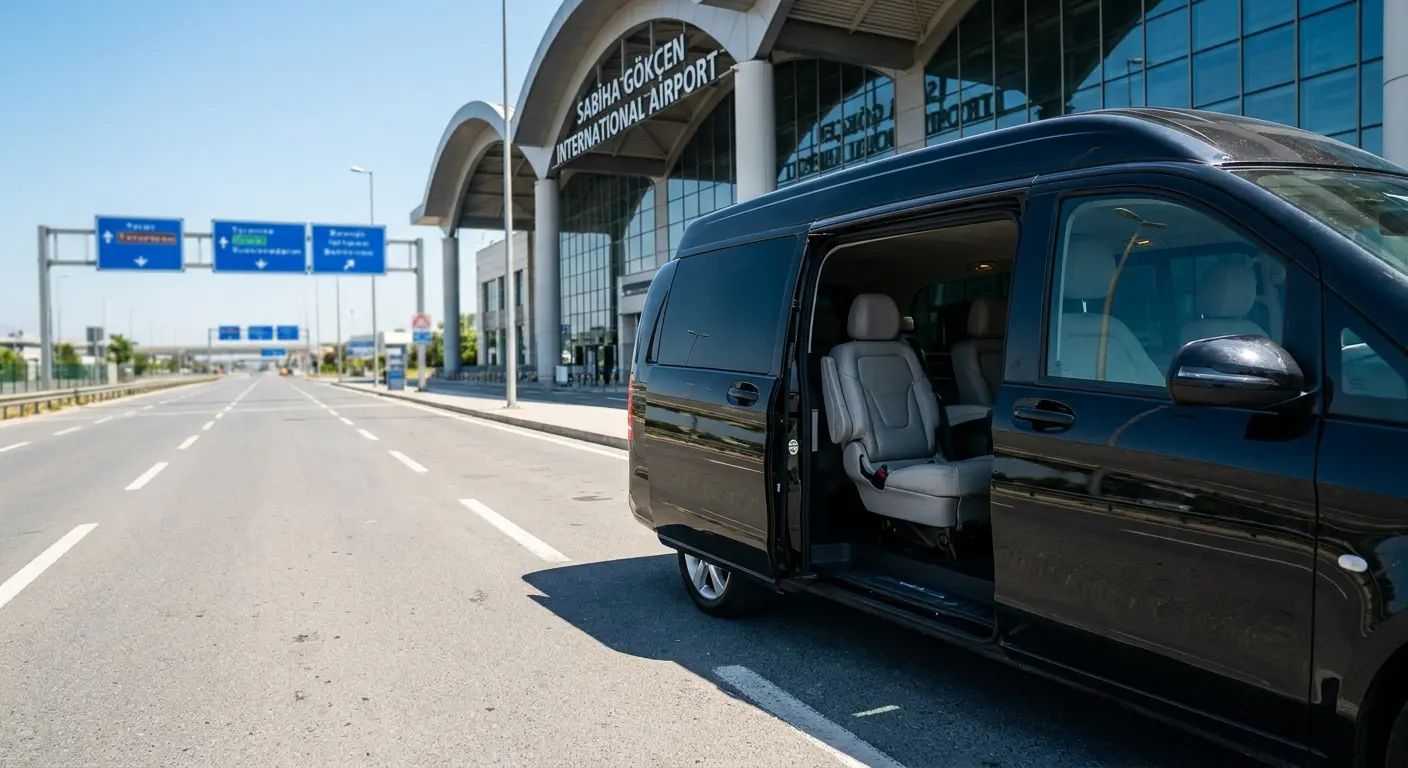
Suggested image alt text: black VIP transfer van waiting outside the Sabiha Gökçen terminal exit — night airport transfer Istanbul.
23:30–01:30 — the midnight gap
Public transport has largely stopped, but the airport is still very much awake. This is the slot where the trade-offs become sharp. There is usually a taxi rank operating outside arrivals, yet two variables work against you: demand spikes and vehicle availability.
When three or four flights land within twenty minutes of each other, the taxi queue can reach 20–30 minutes. Ride-hailing apps are an option, but with fewer drivers available at this hour, pickup times stretch and pricing can become dynamic. This is precisely where a pre-booked, fixed-price transfer with a meet-and-greet earns its keep: it removes both the queue and the price uncertainty in one move.
Practical decisions for this slot
- Luggage is the real constraint: Two large suitcases plus a cabin bag will strain a standard sedan. Families or anyone travelling with three or more cases should look at a large-boot vehicle or a minivan class from the start.
- Pin down the meeting point: Drivers at Istanbul airports typically wait with a name board. Confirm exactly how your name will be displayed and which number the driver will contact.
- Flight tracking: A serious provider takes your flight number and monitors delays themselves. At half past midnight, that is the difference between walking out to a waiting car and standing in arrivals phoning around.
- Cash and cards: Card acceptance varies between taxis and shuttle services. Carrying a small amount of local cash makes a late-night transaction much smoother.
The most common failure in this window is deciding at the airport. At 00:30, tired and loaded with bags, evaluating options is the last thing you want to be doing. A plan settled before departure is the single biggest quality factor in a night transfer.
01:30–04:00 — the quiet corridor
This is the fastest and least prepared-for window of the night. Roads are empty, the terminal is calm, and the run into the city is at its shortest. Two real risks sit underneath that calm.
The first is vehicle availability. The number of taxis waiting at the kerb drops noticeably in these hours. App-based pickups can mean long waits or cancellations. A pre-booked transfer removes the risk almost entirely, because the driver is waiting for you rather than the other way round.
The second is the hotel side of the equation. Arriving at 03:00 does not guarantee a staffed reception. Small boutique properties, serviced apartments and seasonal hotels may close their desks overnight or switch to self check-in. In that case you need the lockbox code, the door code and an emergency contact before you board your flight — not after you land.
Who this slot suits
- Travellers with an early meeting the next day who want to go straight to bed.
- Anyone coming off a long, multi-leg journey — 30 minutes on an empty road is a real comfort.
- Heavy packers: empty terminals make baggage trolleys easy to find, crowded ones do not.
- Anyone who wants the cost settled in advance rather than discovered at the kerb.
One caution: some hotels apply a surcharge for late-night check-in, or accept it only if notified in advance. Add your estimated arrival time to the booking notes as a matter of habit.
04:00–06:30 — the early-wave overlap
This is the most deceptive window of the night, because the night and the morning collide. You are planning a quiet ride to your hotel while the airport simultaneously begins welcoming the outbound departure wave.
From around 04:30 the terminal forecourt fills with drop-offs and pickups. That slows your transfer vehicle's approach and makes it harder to spot you. If your flight lands near 05:00, adding 10–15 minutes to the vehicle wait is a realistic expectation rather than pessimism.
Inside the city the picture inverts: roads are still quiet, but from roughly 06:00 the metro and airport shuttles come back online, which makes public transport a genuine option again.
The hotel trap in this slot
Reaching a hotel at 05:00 is the hardest scenario in standard hospitality logic. Unless you booked the previous night, your room is generally not ready until 14:00–15:00. There are three workable answers:
- Book the previous night as well: It looks wasteful on paper, but for night arrivals it is the most reliable option — the room is yours the moment you walk in.
- Request early check-in: Ask in writing before you travel. It is subject to availability and cannot be guaranteed, but most properties will do what they can.
- Drop the bags and go out: Leave luggage at reception and head into the city. Walking until breakfast also happens to be one of the better ways to handle jet lag.
Which side of the city are you sleeping on?
Time slot matters, but so does the shore. Landing at Sabiha Gökçen presents two very different city scenarios:
- Asian side (Kadıköy, Ataşehir, Maltepe, Pendik, Ümraniye): No bridge crossing, shorter distance. A night drive usually falls in the 25–40 minute band. This is the most comfortable option for a late arrival.
- European side (Taksim, Beşiktaş, Şişli, Sultanahmet, Bakırköy): A bridge crossing enters the picture, and both the toll and the route choice can be reflected in the transfer quote. Roughly 45–60 minutes in empty traffic, longer closer to morning.
A practical suggestion: for travellers arriving late with no fixed morning commitment in the historic centre, spending the first night on the Asian side and crossing the next morning is often the less tiring option. If you only have two days in Istanbul and the old city is your priority, staying in Sultanahmet or Fatih is worth the extra 20 minutes at night — an extra 20 minutes then beats two hours of backtracking later.
What actually drives the price at night
The difference between quotes rarely comes down to one line item. It is usually a combination of these:
- Vehicle class: Sedan, SUV, VIP minivan and minibus sit in clearly different brackets. Pricing is usually per vehicle rather than per person, so the per-head cost falls sharply for groups.
- Distance and route: Bridge and motorway crossings can be added to the total.
- Night tariff: Taxis and some services apply a higher rate during certain late-night hours. Confirming the tariff before you get in is the simplest way to avoid a surprise at the other end.
- Waiting time: Meet-and-greet services usually include a set free waiting period. If a flight delay pushes past it, an extra charge can apply — ask about this at the booking stage.
- Pre-booking: A fixed price removes the uncertainty of hailing a car at 02:00. That is less about saving money and more about predictability.
Because rates shift with season, fuel costs and local regulation, treat any specific figure you read online as indicative rather than fixed. The safer approach is to collect more than one quote and ask directly whether it is all-inclusive — bridge tolls, parking and waiting time included.
Booking a night transfer, step by step
- Write down your landing time, not your target time. Then add 45 minutes as a realistic average for immigration and baggage. In high season, make it 60.
- Fix your terminal exit time. That is the time to give the transfer provider, along with your flight number.
- Check your hotel's night policy. 24-hour reception, self check-in, or a late-arrival surcharge — know which one applies to you.
- Choose the vehicle class by luggage, not headcount. Baggage volume is the binding constraint far more often than the number of passengers.
- Confirm the meeting point and contact method. Name board, driver phone number, or in-app message — pick whichever is fastest at that hour.
- Tell the hotel your arrival time. A short message before you fly is the cheapest insurance against a locked door.
- Build a backup. Two contact channels, not one, plus a fallback idea such as the terminal taxi rank.
- Verify the payment method. Cash, card, or prepaid. Sort this before departure rather than discovering a card limit problem at 03:00.
Completing these eight steps 48 hours before departure removes almost all of the uncertainty a night arrival creates. That is the real value of a planned transfer: it takes the decision-making out of the airport.
Seasonal and weekly variation: the same hour, a different night
Timing a night transfer also means reading the calendar. The same 23:30 arrival feels very different depending on when in the year it happens:
- Summer and weekends: Terminal and taxi queues at their heaviest. Friday and Sunday nights are where inbound and outbound waves collide. Pre-booking is close to essential.
- Winter: More vehicles available, but weather can extend journey times. On wet nights city traffic moves slower than expected; add 15–20 minutes and you will usually be right.
- Public holidays and long festive breaks: Both the airport and the city get busier. Moving your transfer one slot earlier than you think you need is a sensible hedge.
- Midweek night arrivals: Generally the calmest, most predictable scenario. Empty roads, short queues, quick hotel arrival.
There is also the flight side of the equation. A 03:00 arrival lands in the airport's quietest hour, which speeds up baggage and immigration. A 05:30 arrival runs into the departure wave and can cost you an extra 15–20 minutes inside the terminal before you even reach the kerb.
Common mistakes worth avoiding
- Treating landing time as exit time. The single most common error, and the one that most often results in a missed meet-and-greet.
- Not checking reception hours. A closed desk at 02:00 can derail the entire plan.
- Underestimating luggage. Booking a sedan for a family with three large cases leads to an on-the-spot vehicle upgrade and extra cost.
- Not asking what the price includes. Bridge tolls, parking and waiting time should be settled before you travel, not at 01:00.
- Relying on a single contact channel. One phone number that goes unanswered at 03:00 leaves you with no plan B.
- Assuming public transport schedules. Timetables shift seasonally; verification beats assumption every time.
Frequently asked questions
Can I find a taxi at Sabiha Gökçen at 03:00?
There is normally a taxi point operating outside arrivals, but the number of waiting vehicles drops in these hours and queues can form when several flights land together. No honest source can guarantee availability; a fixed-price pre-booked transfer removes the question entirely.
Does the metro run overnight?
The M4 line does not operate through the night; services end towards midnight. Confirm the exact last departure on your travel date through official operator channels. For flights landing after midnight, treat the metro as unavailable.
What happens to my transfer if the flight is delayed?
If you supplied your flight number, a good provider tracks the delay and adjusts the pickup themselves. That is why sharing the flight number matters, and why you should ask how many minutes of free waiting are included.
What should I ask my hotel before a night arrival?
Three things: whether reception is staffed 24 hours, whether there is a surcharge for late check-in, and — if it is a self check-in property — how and when you will receive the access code. Get the code before you fly.
How far in advance should I book?
For summer, weekends and public holidays, 48–72 hours is a safe window. Last-minute bookings tend to narrow your choice of vehicle class rather than your choice of provider.
Will a night transfer affect the next day?
It can. Checking in at 03:00 makes a 09:00 tour genuinely tough. Consider moving the first activity to the afternoon, or starting with a light walking route rather than a full-day programme.
The takeaway: knowing the slot is half the work
Landing at Sabiha Gökçen at night is not a problem in itself. The problem is deciding without knowing which options genuinely exist at which hour. Between 21:30 and 23:30 public transport is still a real choice; between 23:30 and 01:30 a pre-arranged, fixed-price transfer is the sensible default; between 01:30 and 04:00 speed and comfort lead but the hotel reception question must be answered first; and between 04:00 and 06:30 you need to account for the departure wave.
Match those four windows to your own flight and only one task remains: settling the plan before you fly. Once the vehicle, the meeting point and your hotel arrival time are confirmed, a night landing turns into a short, quiet drive instead of a test of endurance. To compare vehicle classes and what each service includes, take a look at Turlago's premium VIP car rental page and build the option that fits your slot.