First-Time Private Yacht Charter: Who It Suits, Who It Doesn't
Most people who hesitate before their first private yacht charter are not worried about the sea. They are worried about looking foolish. They do not know whether they are renting a boat, buying a guided excursion, or signing up for something that will turn out to be far more work than a hotel. This guide answers the question they actually have: is this a good idea for me and my group?
Here is the short version. A private yacht charter is not a luxury version of a tour. It is a time-and-space rental with rules attached. For a defined window, a boat belongs only to your group. You influence the pace, the mood and, within legal and safety limits, the route. What you do not control is the weather, the current, the traffic in a busy waterway, or the captain's final call on safety. Groups who accept that balance usually have a calmer, more personal day than any hotel could offer. Groups who fight it spend the afternoon arguing with reality.
By the end of this article you should be able to answer one question honestly: does private charter fit us, or would a shared boat tour be the smarter buy?
First, separate two products that share a name
In Turkey, as in most coastal markets, “yacht trip” covers two very different things. Confusing them is the most common reason first-timers end up disappointed.
A scheduled boat tour: you buy a ticket, board at a set time, follow a fixed route, and share the vessel with strangers. The advantages are real: zero planning, low per-person cost, and a quick way to see a city or coastline from the water. The disadvantages are equally real: crowds, a route you cannot change, and a day governed by someone else's clock.
A private charter: the boat is reserved for your group only. You decide who comes, when you leave, where you swim, and how long you linger over lunch, subject to the captain's judgement and local rules. You gain privacy, flexibility and control. You take on the total cost, the coordination, and the responsibility of a group.
A simple test: if the idea of sharing a deck with forty strangers irritates you, and your group is already stable and reasonably sized, private charter is the better fit. If you simply want to see the skyline from the water for two hours, a scheduled tour will cost less and deliver more per lira.
The vocabulary you will meet in every quote
Negotiating a charter without knowing the terms is how people end up paying for things they did not want. These eight concepts do most of the work in any offer.
Crewed versus bareboat
Crewed means the boat arrives with a captain and usually at least one deckhand or steward. You are a guest, not an operator. Bareboat means you skipper the vessel yourself. In Turkey, bareboat is heavily conditioned: commercially licensed passenger vessels must carry a captain, and skippering your own charter generally depends on the boat's flag, its registration and documented experience. For a first charter, crewed is almost always the right answer. You are buying a day, not a qualification.
Gulet, motor yacht, catamaran
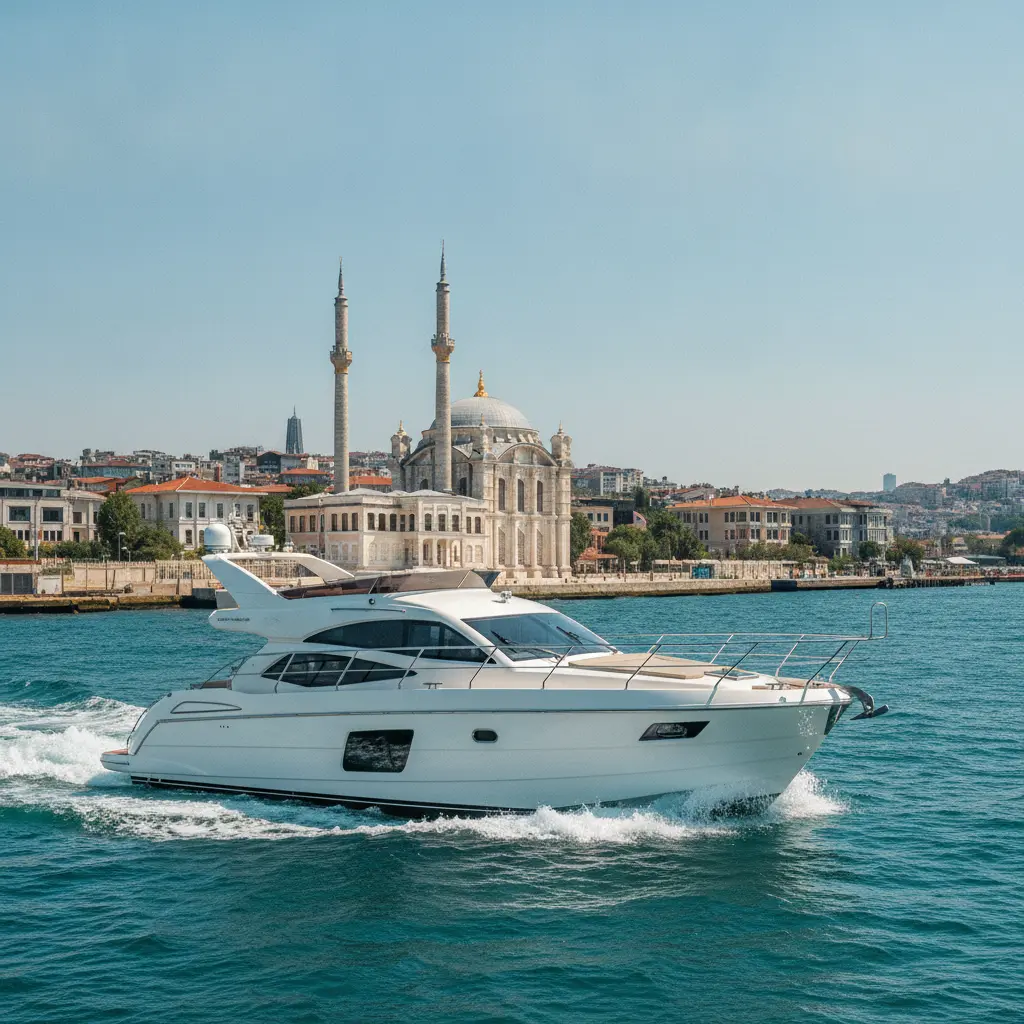
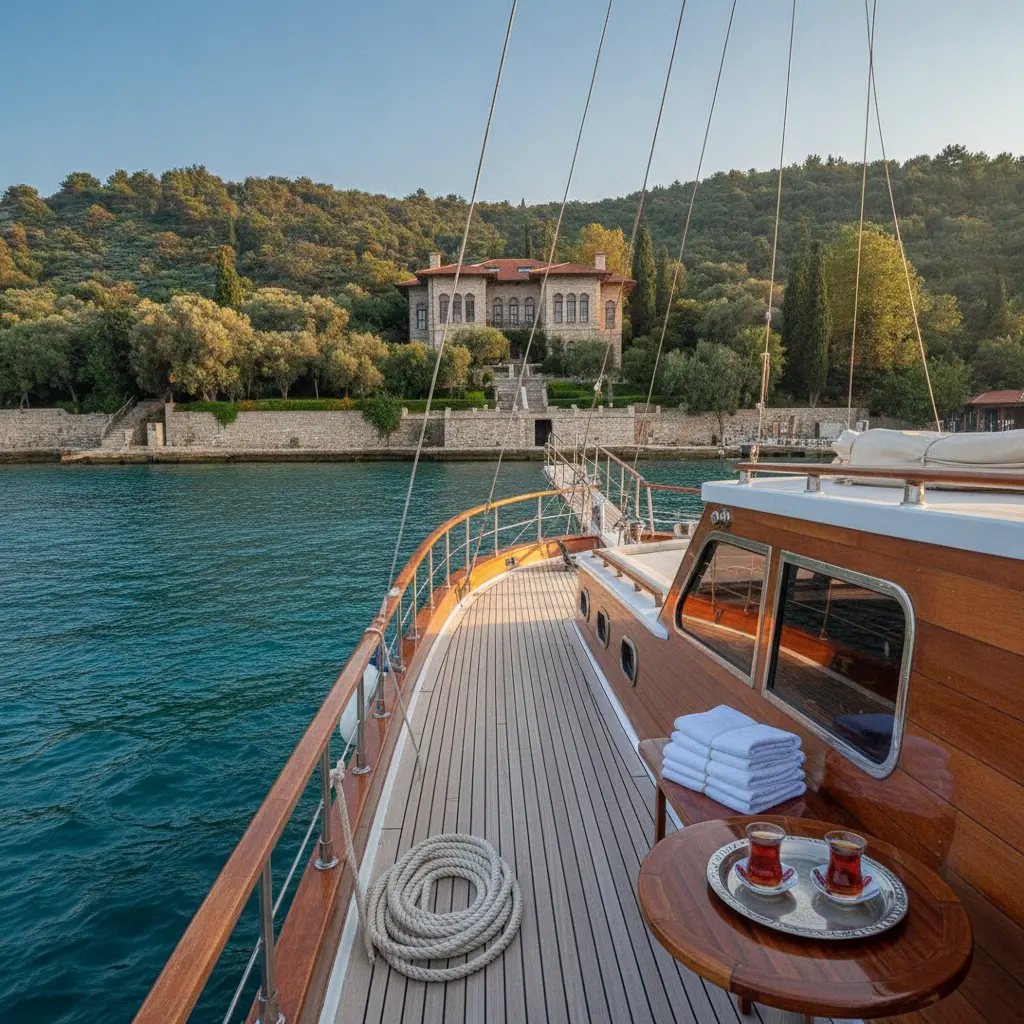
A gulet is a wooden, traditionally styled vessel with a wide deck and auxiliary sails: slow, spacious, and excellent for families and long, lazy afternoons. A motor yacht trades some of that romance for speed and range, which matters if you want to cover ground in a short day. A catamaran is the most stable of the three and is the usual recommendation when someone in the group is prone to seasickness.
Cabin charter
You book one cabin rather than the whole boat and share the common areas with other guests. It is a budget-friendly option for solo travellers and couples, but it is not a private charter. Know which one you are buying.
Half day, full day, evening
These are the standard duration packages. For a first experience, four to six hours is the sweet spot: long enough to swim and eat properly, short enough that nobody is trapped if the motion disagrees with them. Multi-day blue voyages are a second purchase, made after you know you like being on the water.
The included / excluded column
What the price covers varies by boat: fuel, marina fees, crew, cleaning, water toys, food and drink. When comparing quotes, the headline number tells you very little. The included/excluded list tells you everything.
Crew gratuity
On many crewed charters a tip is customary and sometimes stated in the contract. Budget for it from the beginning rather than discovering it at the dock.
Marina and harbour handling
Where you board, where you moor and which permits apply are operational details that shape the day. In a dense city such as Istanbul, the marina you choose directly determines what time you can realistically start.
Captain's authority
Contracts usually state it plainly: the captain may change the route for weather, current, traffic or safety. This is not fine print designed to annoy you. It is how a boat stays safe.
Group by group: where private charter makes sense
There is no universal answer. The same boat that is perfect for one group is a waste of money for another. Four profiles cover most first-time bookings.
Families, including multi-generational groups
Why it works: Flexibility is the whole product. A toddler naps when the boat is still, a hungry child eats before the restaurant opens, and nobody negotiates a buffet queue. A gulet with a shaded aft deck and easy water access can be genuinely less tiring than a resort with small children.
What to check: railing height, non-slip decking, correctly sized life jackets confirmed in advance, and a hard-top or awning that actually casts shade. With young children, favour a short cruise with long swim stops over an ambitious route. The best boat for a family is rarely the most impressive one in the listing.
Couples and honeymooners
Why it works: Privacy. Booking an entire vessel for two looks extravagant until you realise you are not buying square metres, you are buying hours on a deck with nobody else on it. A short city-side escape is one of the highest-value uses of a charter.
What to check: a very large boat for two people means unnecessary cost and a slightly empty feeling; a well-finished mid-sized motor yacht or a classic wooden boat is the better match. Also keep romance realistic: flowers, live music and a special dinner are usually add-ons requested in advance, not spontaneous gifts.
Groups of friends, six to twelve people
Why it works: Split across a group, the per-person cost is often far more reasonable than expected, and the day runs at your own rhythm. Birthdays, anniversaries and reunions are the most common reason people book their first charter.
What to check: coordination, not comfort, is the risk. One person must sign, collect the money and be the single point of contact with the crew; agree on that before you book, not on the morning of. The second issue is the party expectation. Music levels, cut-off times and marina noise rules are real, and so are crew working hours. Discussing them in advance prevents an awkward conversation at four in the afternoon.
Corporate groups and client hosting
Why it works: undivided attention. No restaurant noise, no shared conference room, no other guests. A small team or an important client gets a setting that almost nothing else can replicate.
What to check: invoicing and contracting are more formal than private bookings, so request company invoicing, cancellation terms and liability insurance details up front. Technical needs are the second trap: internet at sea is shared and variable, and mobile coverage has gaps. If the day includes a critical call, get the connectivity situation in writing. Punctuality matters too, because corporate guests expect departure and return times to be exact.
The honest section: who should not book a private yacht
A good guide is willing to say no. If you recognise yourself below, a private charter will probably cost you money and leave you mildly annoyed.
- People who need a minute-by-minute itinerary. At sea, a plan is a proposal. Wind, current and traffic rewrite it. High need for certainty is a bad match.
- People expecting a genuinely all-inclusive price. Fuel, marina fees, extra equipment and gratuity can sit outside the headline figure. Read the inclusions before you commit.
- People chasing nightlife. A charter day starts early and usually ends at the dock in the evening. It is not a floating club.
- Solo travellers who want to meet people. Private charter does the opposite: it removes the crowd. Cabin charter or a scheduled group tour is the right product if company is the point.
- Anyone prone to seasickness who has made no plan. Motion affects a share of first-timers. Tablets, bands and a sensible breakfast are preparation, not weakness.
- People who need total control. The captain's safety authority is not negotiable. If shared decision-making irritates you, a boat is a stressful choice.
- Short-stay visitors who mainly want to see the city. If your one free day must cover both the old town and the water, a two-hour scheduled cruise is simply more efficient.
Eight expectations that trip up first-timers
- “The route is entirely mine.” Largely, yes; entirely, no. The captain can reroute for weather, current or traffic. Calling that flexibility rather than failure is the difference between a good day and a tense one.
- “We can stop and swim anywhere.” The Bosphorus is a working shipping lane with strong currents and anchoring restrictions. Swim stops happen in designated bays and where the captain judges it safe.
- “The Wi-Fi will be fine.” Offshore coverage weakens and boat internet is shared. Handle anything important on land.
- “The air conditioning runs all night.” Power on board comes from a generator, and generators are often switched off overnight. Set comfort expectations according to the specific boat.
- “Bigger is always better.” For a group of ten, an oversized vessel means higher cost and a colder atmosphere. What matters is deck space per person and shade.
- “The crew does everything.” Crew handle service, safety and navigation, within working hours and defined roles. Courtesy gets you better service than instructions.
- “A yacht is a hotel.” Water, power and waste capacity are finite, the floor moves, and sound travels differently. These are properties of boats, not defects.
- “I booked it, so I'm done.” The real work starts after booking: arrival time, dietary needs, allergies, life jacket sizes, special requests. Groups who confirm all of this a week ahead have noticeably better days.
Ten questions to answer before you request a quote
- How many of us are there, and how many are children?
- How many hours do we actually want to spend on the water?
- Is the main goal swimming, seeing the city from the sea, or simply being together?
- Is shade non-negotiable for anyone in the group?
- Do we want food served on board, or will we arrange our own?
- Is anyone prone to seasickness?
- Is our budget a hard ceiling or a flexible range?
- What are the cancellation and bad-weather terms?
- How will we get to the departure point?
- If we are celebrating something, how far in advance must we request it?
Building the real budget, including the invisible lines
The classic first-timer mistake is treating the charter fee as the total cost. The total is a stack of items, and listing them early is what keeps the last hour of the day relaxed.
- Charter fee: driven by duration, boat type and season.
- Fuel: included in some quotes, metered in others. If you plan a long route, ask directly.
- Marina and harbour fees: depend on where you board and whether you moor overnight.
- Food and drink: on-board catering, restaurant delivery or your own shopping. The three options differ enormously in cost.
- Crew gratuity: read the stated expectation in the contract.
- Extra equipment and water toys: usually outside the package and priced on request.
- Transfers: getting a large group and its luggage to the marina is the most overlooked line of all. For a fixed-price, comfortable solution, VIP car rental options are a practical way to remove that stress.
- Deposit and cancellation terms: especially what happens if the weather turns.
Practical rule: compare quotes on what is included, not on the number at the bottom. The same figure can describe two very different days.
Timing: which season and which hour suit a first charter
For a first experience, the date matters as much as the boat.
May, June and September are the most forgiving months: mild air, thinner crowds, more predictable wind. Ideal for families and for anyone who dislikes jostling for a mooring.
July and August deliver the best swimming but the busiest marinas and the highest rates. Afternoon breezes can roughen the water, so morning departures are both calmer and cooler.
Time of day: early departure means flat water and empty bays. Late afternoon means warmer sea and a livelier mood. If the goal is only to see the skyline, a shorter evening departure works; if you want a full day, start early.
Weekday or weekend: Friday evening and Saturday are when marinas and popular bays fill up. Choosing a weekday can measurably improve a first charter.
The booking process in seven steps
- Define the group and the purpose. Headcount, age range and the one thing the day must deliver.
- Choose a realistic duration. Four to six hours for a first booking.
- Get two or three quotes and put them in one table. Boat type, capacity, hours, inclusions, departure point.
- Ask about licensing and safety documentation. Commercially operated passenger vessels carry specific certificates; confirm them politely.
- Clarify crew and service scope. How many people on board, and what exactly is covered.
- Put special requests in writing. Dietary needs, allergies, celebration setup, children's life jackets, shade requirements.
- Plan the arrival. Aim to be at the marina 30 to 45 minutes early and factor in city traffic.
What a first charter day actually looks like
Before departure: marina meet-up, a short safety briefing, life jackets distributed, shoes off, deck rules explained. Those fifteen minutes matter more than any other part of the day.
Morning: cruising on calm water, skyline and shoreline, the best light for photographs.
Midday: a swim stop in a sheltered bay, lunch on deck, shade and rest. This is the longest block of the day, and it should not be rushed.
Afternoon: a second swim or the return leg. If the group is tired, heading back early is a perfectly good decision.
Return: docking, goodbyes, gratuity if deserved, photos shared in the group chat.
The most important line in that schedule: you do not have to see everything. First-timers routinely try to turn a boat day into a checklist. Less, slower, is almost always the better memory.
Seven common mistakes and their easy fixes
- Confirming the headcount late. It affects capacity, catering and life jackets. Give a firm number a week ahead.
- Ignoring shade. Six hours of direct summer sun is not a holiday. Confirm an awning or hard top.
- Skipping the shoe conversation. Barefoot or non-marking soles are standard. Tell your guests in advance.
- Leaving food to the last day. Catering, provisioning or restaurant delivery needs lead time.
- Not reading the weather clause. Look for rescheduling and refund terms in the contract.
- Waiting for one perfect photo moment. Light changes constantly at sea. Bring a power bank.
- Leaving crew communication to the morning. A short message the day before confirming arrival time and requests improves everything.
Frequently asked questions
How many people should we be for a first charter?
Six to ten is the most comfortable range: costs split sensibly and the deck still feels spacious. Two people are better off on a smaller, well-finished boat; fifteen need a wide-decked gulet.
How long should we book?
Half a day or a full day. Multi-day voyages make more sense once you know you enjoy being on the water for its own sake.
Can I charter without a captain?
In Turkey, commercially operated passenger vessels must carry a captain. Bareboat arrangements depend on the vessel's flag, registration and your documented experience. For a first charter, crewed is simpler and safer.
What if someone gets seasick?
It is manageable: a light breakfast, medication or wristbands taken before departure, and sitting outside in fresh air. Captains often adjust to a calmer route. If someone is highly sensitive, choose a short, coastal itinerary.
Is it safe with children?
With the right boat, yes. Wide decks, high railings, shade and correctly sized life jackets are the essentials. Prioritise deck safety over speed or style.
Do we get a refund if the weather turns?
Entirely contract-dependent. Read the cancellation, rescheduling and bad-weather clauses before paying, and insist on written terms rather than verbal reassurance.
Conclusion: decide with three questions
Private yacht charter is not the right holiday for everyone. With the right group and honest expectations, though, it offers something a hotel cannot: uninterrupted time. Before you book, ask yourself three things. Does my group's natural pace match the pace of a boat? Have I budgeted the full cost, including the lines nobody mentions? And do I see a change of plan as part of the experience, or as a problem?
If those answers feel comfortable, keep the first booking modest: half or full day, crewed, with reliable shade. One day on the water will tell you more than any amount of research. Sort the logistics in advance with VIP car rental options for a calm arrival at the marina, and plan the day itself through Turlago's yacht and boat charter listings.