Istanbul Airport to Hotel Transfer with Kids: Full Plan
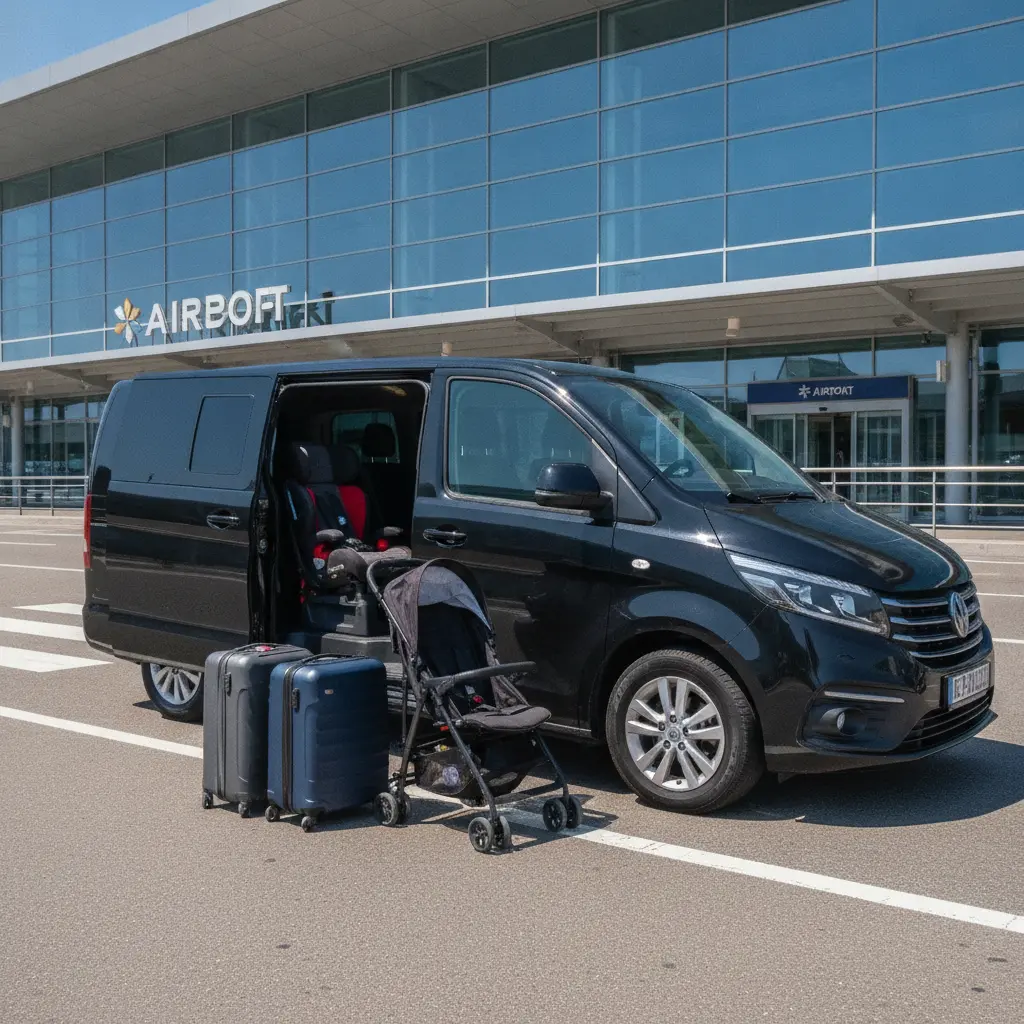
The plane doors open and suddenly you are managing two children, two large suitcases, a folded stroller and one free adult hand. That moment is not the time to make decisions about transport. An Istanbul airport to hotel transfer with children is a small logistics project, not a taxi ride: it involves nap schedules, toilet timing, cabin bags and waiting limits that all overlap. This guide answers the questions parents actually ask, one by one: which vehicle, how far in advance, who fits the child seat, where exactly do we meet the driver, and what happens if the flight lands late?
Why does a family transfer need a different plan?
Short answer: Because you are moving more than people. You are moving a child seat, a stroller, a diaper bag and a sleep routine, and none of those resolve themselves in the trunk of a random taxi.
For two adults, the airport-to-hotel leg is simple arithmetic: exit door, taxi queue, twenty minutes, done. Add a three-year-old and the number of variables multiplies. A child seat is almost never available in a standard taxi, and when it is, you still want to check that it has been fitted correctly. A folded stroller eats a significant share of the boot even when packed flat. On a late arrival, a young child's tolerance for being awake is roughly thirty to forty minutes, and a taxi queue can consume all of it before you have left the terminal.
So the planning starts with three questions rather than a price comparison. How many passengers and how many large bags? What are the children's ages and what seat do they need? Does the landing time collide with bedtime? Once you answer those honestly, the vehicle class, the meeting type and the booking window all follow naturally.
Which transfer type actually suits a family with children?
Short answer: A pre-booked private transfer with a confirmed child seat. Public transport and shared airport shuttles are cheaper, but the combination of luggage, stops and walking distances wears small children down.
Private (VIP) transfer
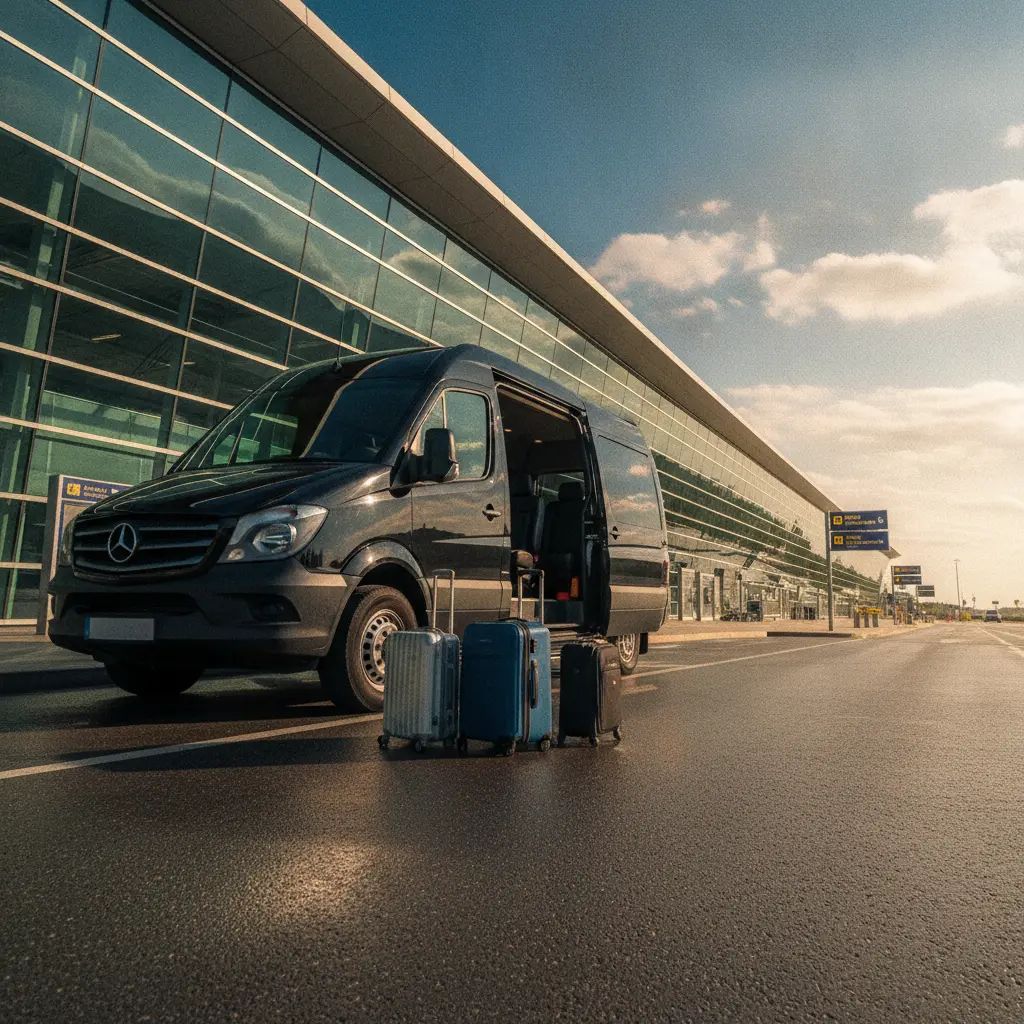
Name-board greeting, fixed price, a child seat requested in advance and a direct drop at the hotel entrance. The real advantage is predictability: the price does not change in traffic, the driver is tracking your flight, and the luggage layout is decided before you get in. Larger vehicles and minivans sit in this category, which matters when you are travelling with a stroller. You can compare vehicle classes and add a child-seat request in the booking notes through private vehicle rental options on Turlago.
Taxi
Taxis look like the fastest fix but carry two uncertainties for families: boot space and seats. The airport queue does not guarantee a large vehicle; if a sedan pulls up, fitting a stroller plus three suitcases becomes the driver's judgment call. Route and waiting charges are also open to interpretation when they have not been agreed in advance.
Airport shuttle and public transport
The cheapest route, with three drawbacks for families: fixed departure points, transfers, and walking distances with luggage. If your flight is delayed, the shuttle will not wait. Metro and rail combinations can turn into an elevator hunt with a stroller and suitcases. They work well for short daytime hops, but they are not a good idea for a late-night arrival with tired children.
How do you guarantee the child seat?
Short answer: Requesting it is not enough. Put the child's age, weight and seat type in writing, then get a confirmation back.
Most transfer operators offer child seats free or for a small supplement, but seat stock is limited, so last-minute requests often go unmet. When you book, include:
- Age and weight: for example, 2 years and 12 kg, or 5 years and 19 kg. The seat type follows from this.
- Number of seats: two children means two seats. A seat never holds two children.
- Direction: rear-facing for infants and toddlers, a booster for older children.
- Alternatives: if you plan to bring your own travel seat, ask whether the driver can install it in the vehicle.
When you get in, do a ten-second check: is the belt routed correctly, does the seat wobble, is the chest clip at chest height? Asking the driver to double-check is not rude; fitting habits vary between companies. For children using a booster, make sure the seat belt crosses the shoulder rather than the neck.
Which vehicle class do you need for a stroller and luggage?
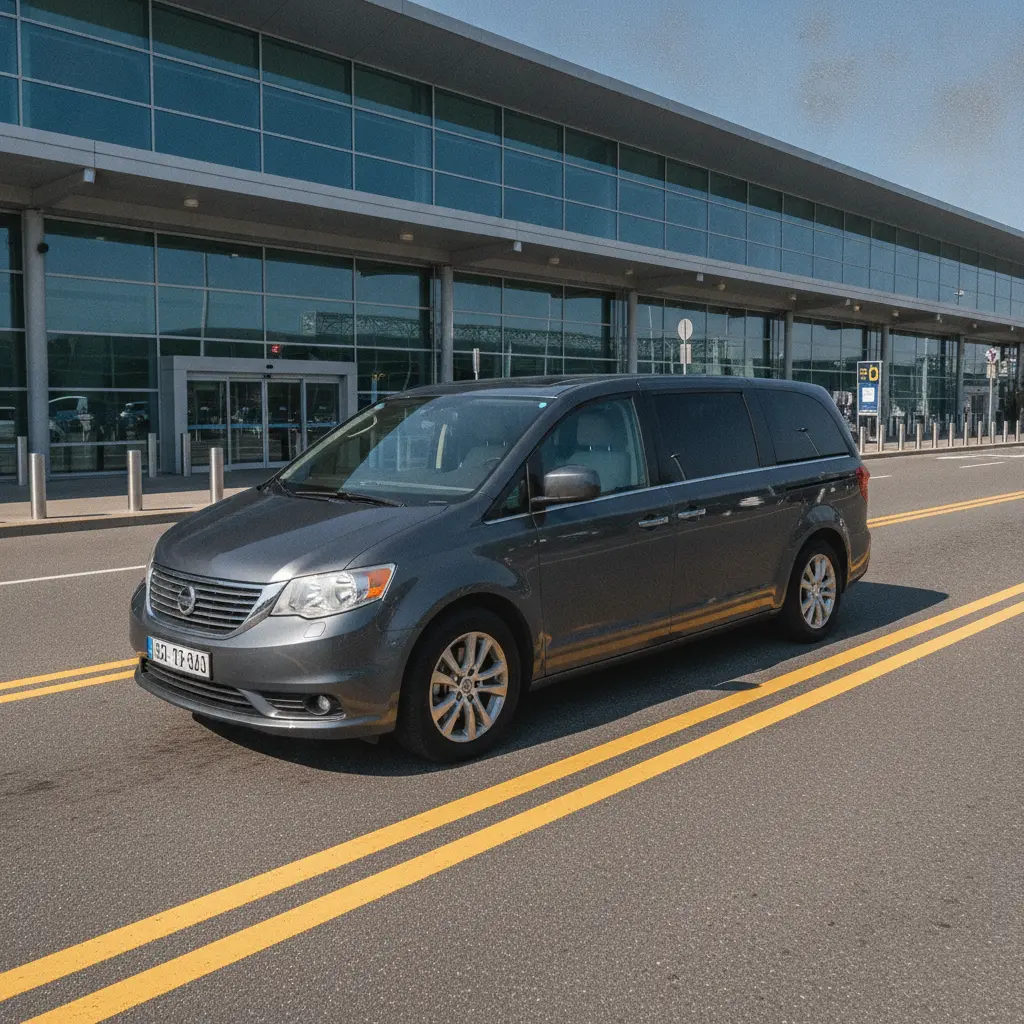
Short answer: Two adults, two children and a stroller make a sedan borderline. A minivan or a large SUV is the safer choice.
A rough luggage calculation: one cabin bag per person, one bag per child, plus a stroller and possibly a folded buggy. A sedan boot usually takes two large cases and a cabin bag; the stroller only fits if it rides on the back seat, which is impractical with two children. Minivans add both seat count and boot depth, so a folded stroller can stand upright behind the rear seats.
Use this rule of thumb: choose the vehicle class based on people plus one large item, not on people alone. A six-seat vehicle for a family of four is not luxury, it is the space your stroller and cases actually require. Remember that winter coats and boots take up room too, so the same family may need a larger class in January than in April.
What happens if the flight is delayed or arrives early?
Short answer: If your flight number is in the booking, the driver monitors the landing time and the delay stops being your problem. Confirm this before you pay.
The most exhausting scenario with children is a three-hour delay and no idea whether someone is waiting for you. Ask three specific questions at booking:
- Is the flight number tracked, and does the driver extend the waiting time if the flight is late?
- How many minutes of free waiting are included? Passport control and baggage reclaim stretch out when you are travelling with children.
- If the delay exceeds that window, what is the hourly charge and how is it collected?
Early arrivals are a separate issue: some flights land thirty to forty minutes ahead of schedule, and the driver may not be at the terminal yet. With children, that wait means standing beside the luggage for half an hour. Note the possibility of an early landing in your booking comments and keep your phone reachable at the arrivals door.
What changes for a late-night arrival?
Short answer: Everything. At night a private transfer stops being a preference and becomes the sensible option, because public transport largely drops away and a quiet arrival protects the children's sleep.
On late flights, most children are already halfway to sleep when they land. Your only goal should be reaching the hotel with minimum stimulation. Queueing for a taxi, walking through the terminal and completing paperwork in a lobby are three steps that fully wake a child. With a pre-booked transfer, two of those disappear and you can go straight to the room.
Three extra preparations help. Put pyjamas in the cabin bag, confirm that the hotel reception is staffed overnight, and consider leaving the stroller at the aircraft door rather than checking it into the hold. Also note that some hotels have a different night entrance or reception floor, so give the driver the entrance description rather than just the street number.
How far in advance should you book?
Short answer: Twenty-four to forty-eight hours normally. Five to seven days during summer, public holidays and major event weeks.
Bookings that include a child seat need a longer runway. Seat stock is limited, so requests made in the final twenty-four hours may not get the seat type you want. In Istanbul, be especially early during the July and August peak, the New Year week, long public holidays, and any week when the city hosts a major sports or cultural event. Availability tightens and road times stretch during those periods.
If you are booking at the last minute, check vehicle availability by phone or messaging first, then complete the online confirmation. A verbal agreement without a confirmation risks arriving to find no vehicle. Save the confirmation as an offline screenshot so it opens even with data roaming switched off.
Where exactly do you meet the driver at the airport?
Short answer: At the arrivals exit after baggage reclaim, with a name board. Ask for the exact meeting instructions before you book.
Istanbul Airport is a large terminal with several exit doors and levels. Not knowing which door your driver is standing at means walking between floors with suitcases and children. Clarify these points at booking:
- Is the greeting a name board, or a phone call from the driver?
- Which exit door is the meeting point, and what name appears on the board?
- Is the car in the car park or at the kerb, and how far is the walk?
- Is the driver's phone number shared before the trip?
A practical habit: send one short message when you land, saying you have arrived and are waiting for bags. The driver can then adjust the timing and you avoid conducting a phone call while wrestling with luggage. One more detail for families: strollers sometimes come out of the hold late, so plan on thirty to forty minutes rather than fifteen.
Istanbul Airport or Sabiha Gökçen: which one fits your hotel?
Short answer: European-side hotels are better served by Istanbul Airport; Asian-side hotels by Sabiha Gökçen. Ticket price and flight time can still override that logic.
Istanbul Airport sits in the north-west of the city, Sabiha Gökçen in the east. For hotels in Sultanahmet, Taksim, Beşiktaş or Şişli, the road journey from Istanbul Airport usually runs fifty to eighty minutes. For Kadıköy, Üsküdar, Ataşehir or Maltepe, Sabiha Gökçen can be twenty-five to forty-five minutes. Mismatched pairings, such as landing at Istanbul Airport for an Asian-side hotel, need bridge traffic factored in.
With children, that calculation has a hidden cost: a longer drive means a bored child and a possible stop. Ninety minutes on the road with a five-year-old is a very different experience from forty. Weigh the airport choice together with the hotel location, because within the same city the two airports directly affect both your transfer budget and your family's comfort. If the arrival is at night, the distance gap matters even more.
What drives the price, and what should you ask before booking?
Short answer: Distance, vehicle class, waiting time, season and extras such as child seats or a name board. Get a fixed-price confirmation.
The most common surprise in transfer pricing is waiting time billed on top. Since waiting is unavoidable with children, a fixed price with a defined free waiting window is essential. Note these questions:
- Is the price fixed, or does it change in traffic?
- How many minutes of free waiting are included, and what is the hourly rate after that?
- Is the child seat an extra charge?
- Is there a night surcharge?
- When and in which currency do you pay?
- What are the cancellation terms, and what happens if the flight is cancelled?
Getting those answers in writing removes any argument at the kerb. The same applies to the return leg: for the trip from hotel to airport, requesting the car three hours before departure is a reasonable buffer in Istanbul traffic. With children, stretching that to three and a half hours makes check-in noticeably calmer.
Timing the journey around your child's day
Short answer: Build the transfer around the flight time, not the nap, but prepare so the two line up as much as possible.
A 07:00 flight means being at the airport by 04:30, which means strapping a child into a car at 03:30. In that scenario a private transfer is the only reasonable option: the car is at the door, a sleepy child is moved directly into a seat, and a short walk takes you to the check-in desk. Afternoon flights allow more flexibility; finishing the midday nap before the transfer means you are not waking a sleeping child at the terminal.
The arrival side has a similar logic. On a flight landing at 21:00, children are usually tired and the hotel may not be reached until 22:30. Telling reception in advance that you are arriving late, and asking for the extra bed to be ready, cuts lobby waiting time. After long flights, carsickness becomes more likely too, so a small bottle of water and plain crackers in the hand luggage are simple but useful precautions.
Step-by-step booking checklist
Working through this list in order prevents most family transfer problems before they happen.
- Count people and bags. List adults, children, stroller, large cases and cabin bags separately.
- Define the seat requirement. Note each child's age and weight plus the seat type needed.
- Choose the vehicle class. Apply the people-plus-one-large-item rule. The private vehicle rental options on Turlago page makes that comparison straightforward.
- Enter the flight number. Delay tracking runs on that number.
- Select the greeting type. Name board, or meeting by phone?
- Confirm the waiting window. Free minutes and the rate afterwards, in writing.
- Plan the return leg too. Booking both directions with the same operator usually produces more consistent service.
- Save the confirmation. Keep it accessible offline on your phone.
- Store the driver's contact. Save the number for a short message before landing.
- Give the hotel address with directions. In the historic peninsula, vehicle access is often via one-way streets.
Six mistakes families make most often
1. Requesting the child seat at the last minute
Seat inventory is finite. Families who do not ask at the moment of booking sometimes learn at the kerb that no seat is available.
2. Trying to make a sedan work
Even folded, a stroller wedges into a sedan boot. One class up saves the first half hour of your holiday.
3. Not asking about the waiting window
Passport control and baggage reclaim take longer with children. Fifteen free minutes rarely covers a busy arrival.
4. Leaving out the flight number
Without it, the driver is not alerted to a delay, and the car may not be there when you land.
5. Not pinning down the meeting point
Waiting at the wrong door in a large terminal means walking between floors with luggage. Get the door number in writing.
6. Forgetting the return transfer
Even a smooth arrival needs the same planning on the way back, and early-morning departures make finding a taxi harder.
Quick questions, quick answers
Is the child seat an extra cost?
It varies by operator. Some include it, others charge a small supplement. Confirm at booking.
How many child seats can I request?
It depends on the vehicle's seat count. Minivans usually allow two, sedans typically one.
How long does airport waiting take?
With children, baggage and passport control can take forty to sixty minutes, so offers that include forty-five minutes or more of free waiting are safer.
What about an unaccompanied child?
Escorted child transfers are a separate service with different procedures and paperwork. Ask the operator well in advance.
Does the driver wait at the hotel?
On round-trip packages the driver is ready at the hotel at a set time. Waiting time and any charge should be in writing.
Is there bottle warming or water on board?
Not as standard. Carrying a thermos and prepared formula water is the most reliable solution.
Final thought: plan the transfer a week out, not a day out
For a family with children, a good transfer is one where you make no decisions at the airport exit. If the vehicle class is settled, the seat is fitted, the driver is at the door with a name board and the price is fixed, the rest of the day belongs to the children. Moving the planning to a week before departure is the single step that creates that difference.
In a city where traffic shifts hour by hour, covering the distance between Istanbul Airport and your hotel in the right vehicle with the right waiting allowance sets the tone for the whole trip. To compare vehicle classes, child seat requests and fixed-price options, take a look at private vehicle rental options on Turlago, and remember to note your children's ages and your luggage situation in the booking comments.