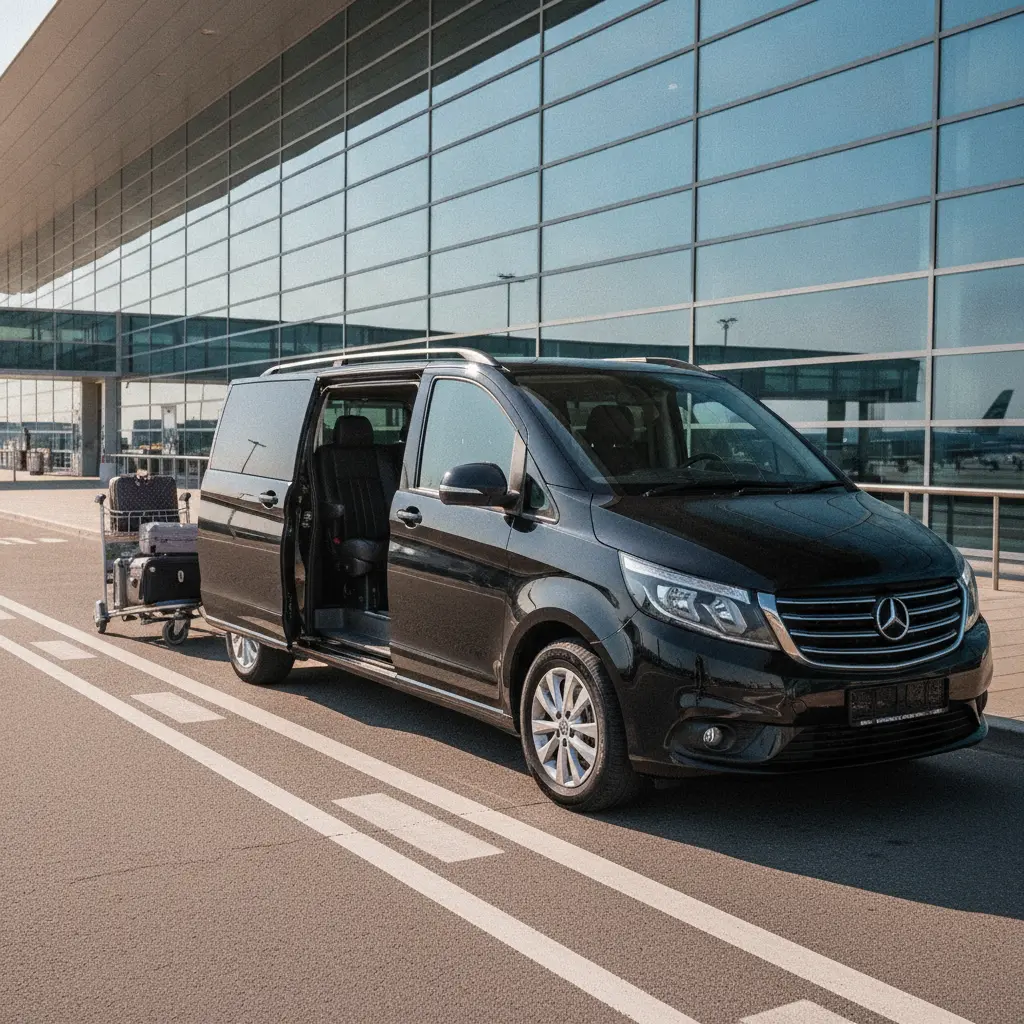
Istanbul Airport Transfer: A First-Timer's Step-by-Step Guide

Your plane has landed at Istanbul Airport. You have cleared passport control, collected your suitcase, and now you are standing in the arrivals hall with two bags and a booking confirmation for something you have never done before: an airport transfer. Five questions are running through your head at once. Who is meeting me? Where exactly will they be? What happens if my flight is delayed? Do I pay now or in the car? And what about traffic?
This guide is written for exactly that moment. It walks through the process in order, tells you what to check and when, and covers the points where first-timers most often get stuck. If you are booking through Turlago, you can compare vehicle classes and conditions in advance on the chauffeur-driven private car hire page, so you are not making decisions while standing in a terminal with luggage at your feet.
What a transfer actually does — and what it does not
A transfer is a pre-booked vehicle taking you from point A to point B at a pre-agreed price. The key word is pre-booked. You do not hunt for a car on arrival, you do not negotiate, and you do not try to work out whether the meter is behaving. You enter your hotel address and your flight number when you book, and the driver is waiting.
What it does not do: it is not a guided tour, it does not stop for photos along the way, and it does not turn into a city sightseeing trip. It is a comfortable, predictable, fixed-price bridge between two places. The value is in everything you do not have to handle — connections, luggage, parking, and the low-level stress of not knowing what a ride should cost.
The four arrival options, side by side
- Private transfer: The car is reserved for you alone, door to door, with the price locked at booking. Highest comfort and predictability; the cost per person drops as your group grows.
- Taxi: Immediate, but the fare depends on traffic and route, vehicle size and condition are not guaranteed, and peak hours mean queueing.
- Airport shuttle or coach: The most economical option, but it runs to fixed stops. From the last stop you may still need a taxi or a walk with your bags.
- Metro and rail: Unaffected by traffic and cheap, but awkward with heavy luggage, with children, or late at night.
If you are unsure, ask yourself one question: where do I want to spend my energy at the end of this journey? On your first arrival in an unfamiliar city, tired and in a language you may not speak, the honest answer is usually not on your suitcases.
Ten minutes of preparation before you book
Most first-timers fill in the booking form correctly but leave one detail out, and that detail is what causes trouble at the airport. Note these down before you start:
- Your flight number. Not "I'm flying with Turkish Airlines" but the full code, such as TK1. This single field drives everything else.
- The right airport. Istanbul has two international airports and they are far apart. Confusing Istanbul Airport with Sabiha Gökçen is the single most common first-timer error.
- Full accommodation address. Not just the hotel name. If the hotel sits in a side street, the street number and door number save the driver a search.
- Passenger count and ages. If you need an infant seat or a child booster, request it at booking; adding it later is not always possible.
- Luggage count and type. Two cabin bags and two large suitcases are not the same vehicle class.
- Oversized equipment. Skis, golf bags, strollers, wheelchairs — state them explicitly.
- Arrival time. Some operators apply a night supplement for arrivals after midnight. Better to see it now than to discover it at the kerb.
- Your contact channel. Say whether you use WhatsApp. Most driver communication happens there.
Booking, step by step
If you can picture the sequence, the form goes much faster. A typical flow looks like this:
- Choose the route. Airport to hotel, hotel to airport, or airport to airport. Booking the return leg at the same time prevents a last-day scramble.
- Choose the vehicle class. Economy, comfort, or VIP, based on passengers and bags. Larger groups can usually pick a minivan.
- Enter date and time. For arrivals you enter the landing time, not the departure time from your origin. For the return leg, the pick-up time is calculated backwards from your flight's departure.
- Add the flight number. The most important field on the page.
- Passenger details. Names matching the passport make life easier, particularly on international bookings.
- Extra requests. Child seat, name board, an additional stop.
- Confirm and keep the message. The confirmation contains the emergency number and the meeting instructions. Do not delete it.
- Final check. Airport, date, time, hotel address. Read those four fields one more time.
Why the flight number changes everything
The discovery most first-timers make is flight tracking. Once your flight number is on the booking, the operator sees your actual landing time. Land forty minutes early and the driver adjusts. Delay by an hour and the driver is not standing around pointlessly — but has not left either.
Without a flight number, most providers fall back to a fixed pick-up time, and the risk of a delay sits with you. A missed connection, a rebooking by the airline, a diversion — none of that is visible to the operator. Entering the flight number works like an insurance policy on the booking itself.
What happens if the flight is delayed
The standard practice: the driver positions based on the tracked landing time, and a free waiting allowance after landing covers baggage and passport queues. That allowance varies by operator and is written on your confirmation. Before it runs out, a short message to the driver is all that is needed. For genuinely large disruptions — a flight pushed to the next day, for example — you must contact the operator to amend the booking. Do not assume it will sort itself out.
After landing: from the aircraft door to the meeting point
This part is shorter than most people expect. Three things decide how long it takes: passport control, the baggage belt, and the walking distance inside the terminal.
1. Passport and visa control
Arriving from abroad, queues at peak times can run from twenty minutes to an hour. Early morning and late afternoon are when long-haul arrivals stack up. If you land in those windows, build the buffer in from the start rather than hoping.
2. The baggage belt
Allow fifteen to forty minutes. Use the time to switch your phone on and read the driver's messages. Good operators send a note at landing: I am here, I am at this point.
3. Local SIM and connectivity
Airport Wi-Fi usually requires some form of verification, so connecting before passport control saves time. If you plan to buy a local SIM, the operator counters are in the arrivals hall and there can be a queue. Since the transfer meeting usually runs over WhatsApp, sorting the SIM immediately after landing is a smart move.
4. The five-minute pause
A small but real tip: take five minutes for the toilet and a bottle of water before you go to the meeting point. Once you meet the driver and get into the car, you will not want to get out again.
5. The exit door
Stepping out of the arrivals hall, you enter the zone where every greeting service operates: drivers holding name boards, car rental desks, taxi directions. The crowd can look chaotic, but the meeting instructions on your confirmation take you straight to the right spot.
Meeting point: name board or WhatsApp pin?
Two practices dominate. In the first, the driver stands at the arrivals exit holding a board with your name. In the second, you are given a specific meeting point in advance — a particular door number, a café, a car park level — and you meet there. The second is increasingly common at large airports, simply because a name board is hard to spot in a dense crowd.
Whichever applies, your job is identical: send one short message after landing. My plane has landed, I am waiting for baggage, I expect to be out in about twenty minutes. That message prevents both sides from waiting on the other.
What is said at the handover
The driver usually confirms your name, takes the bags, and walks you to the car. You only need to give your name or booking reference. There is no reason to discuss price or negotiate at this point, because the fare was fixed at booking. If you want an extra stop, say so before the car moves rather than halfway through the journey — that is how avoidable arguments about supplements start.
Waiting time: the free minutes and the fine print
Most transfer services include a free waiting allowance after landing, sized to cover passport control and baggage. It is not the same everywhere, so read the number on your confirmation.
- Once the free allowance expires, an additional waiting charge usually applies, calculated per minute or per hour.
- If the driver waits in an airport car park, check whether the parking fee is included in your price.
- On the return leg the free waiting window at your hotel is typically shorter, so be in the lobby on time.
- At cruise ports and bus stations, ship or coach delays usually cannot be tracked, so leave a generous buffer.
The practical takeaway: the moment you land, take the phone off flight mode and send one line to the driver. That single action removes most of the problems first-timers run into.
Vehicle classes: people and suitcases are two different counts
The classic mistake is choosing a car by passenger count and forgetting the luggage. Four adults with four large suitcases and two cabin bags will not fit comfortably in a standard sedan. The logic below keeps you out of trouble:
- Economy: one to three passengers, two to three bags. Ideal for solo business trips and short city runs.
- Comfort: three to four passengers, three to four bags. More boot space, more legroom.
- VIP: premium vehicles, generous interiors, often water on board and a higher service standard. Chosen by travellers hosting business guests and for special occasions.
- Minivan: five to six passengers, five to six bags. The most efficient option for families and groups, and the cost per person falls sharply.
- Minibus: eight passengers and above. Used for group travel, weddings and corporate transfers.
You can compare classes and current capacities on the chauffeur-driven private car hire page. When in doubt, going one class up costs less than wrestling with bags at the kerb.
How the price is built
Airport transfers are usually priced as a fixed, door-to-door rate. Whether the drive takes forty-five minutes or ninety, the amount you pay does not change. For a first-timer this is the biggest single benefit: no meter anxiety.
What goes into the number:
- Distance and route — airport to city centre, airport to airport, intercity.
- Vehicle class and passenger count.
- Night hours and public holiday periods.
- Extras: child seat, name board, additional stop, meet-and-greet service.
- Whether motorway and bridge tolls are included.
The only thing that can genuinely surprise you is a hidden extra. Read the included and not-included lists on the booking page. A well-built booking shows the total clearly before you pay.
Payment and tipping
Payment runs one of two ways: prepaid online, or paid in the vehicle. With prepayment, the card is charged at booking and you do not need to carry cash at the airport. With in-car payment, cash and card acceptance varies by operator; if you are arriving from abroad, having some local currency on you is still sensible.
On tipping, there is no hard rule. Tipping transfer drivers in Turkey is not obligatory, but a small gesture is appreciated if the driver handled heavy bags, went out of their way, or waited longer than expected. Rounding up is enough. If you paid by card, handing a tip in cash is simply easier for the driver.
Journey times and Istanbul traffic, honestly
Istanbul Airport sits well outside the city centre. This is the most misunderstood part of the whole exercise: even a moderate distance can take a very different amount of time depending on the hour.
- Late night and very early morning: Fastest. Roads are open and times are predictable.
- 07.00 to 10.00: Heavy inbound to the city. Easier if you are heading out to the airport, harder if you are heading in.
- 17.00 to 20.00: The worst window of the day. Allow well above your estimate.
- Friday evenings and Sunday returns: Weekend movement adds time; build in extra buffer.
For the return leg, work backwards. If your flight leaves at 21.00, aim to be at the airport two hours before, then add a traffic buffer on top. Airline check-in cut-offs do not bend, and a late pick-up has no remedy. Leaving early on the way to the airport is almost always the right call.
Late-night arrivals: what changes
Flights landing after midnight need a slightly different plan. The terminal is quieter and the roads are clearer, but services around you thin out.
- Some operators apply a night rate. It is visible at booking, so it should never be a surprise.
- Meeting points are easier to find with fewer people around, but some terminal cafés will be closed.
- Check that your hotel reception is open around the clock. Smaller boutique hotels sometimes close the desk late at night.
- Save the driver's number before you fly, and carry a power bank if your phone battery is unreliable.
- Taxis may look plentiful at night, but a car already arranged for you is what actually removes the stress.
The ten mistakes first-timers make
- Booking the wrong Istanbul airport.
- Leaving the flight number blank and losing protection when the flight is delayed.
- Not stating luggage count, then fitting bags around passengers.
- Entering the departure time instead of the landing time.
- Skipping the meeting point instructions and wandering the terminal.
- Not messaging the driver after landing.
- Giving the hotel name but not the address.
- Requesting a child seat after the booking is confirmed.
- Leaving the return transfer until the final day.
- Not saving the emergency contact number from the confirmation.
Travelling with children and oversized gear
With children, the real benefit of a transfer is that you are not managing a child and several suitcases simultaneously in a crowded hall. A few details still need arranging in advance.
- Infant seats and boosters must be requested at booking; they are not standard in every vehicle.
- A stroller takes separate boot space, so count it as an extra item when choosing a class.
- Skis, snowboards, golf bags and dive equipment need to be declared.
- If a wheelchair is involved, discuss the vehicle's boot layout and whether a ramp is needed.
Airport-to-airport and intercity transfers
If you are connecting between Istanbul's two airports, plan this differently from a normal city transfer. The distance and the traffic mean the connection time must be realistic. With less than three hours between flights, it may be safer to book a single through-ticket rather than rely on a road transfer.
Intercity transfers are a separate category: Bursa, Sapanca, Abant, Izmit and beyond. On longer runs, comfort and luggage space matter more, and it is worth asking whether the itinerary includes a rest stop or a driver change.
Hotel transfers: three things to verify
It looks simple — the car pulls up at the hotel — but not every hotel allows vehicles to the door. Many small hotels in the historic peninsula sit in narrow streets with restricted access. In that case the driver drops you at the nearest reachable point, and carrying bags to the entrance is not always part of the service.
- Check whether your hotel has vehicle access when you book.
- Note the hotel's phone number alongside the address.
- If you arrive late at night, tell reception in advance.
Transfer or public transport? A decision guide
Not everyone needs a transfer. It clearly makes sense when:
- It is your first visit and you do not know the city.
- You are travelling with several pieces of luggage.
- You are with children or an older traveller.
- You land after midnight.
- Time is critical, as on a business trip.
- Your hotel is far from public transport stops.
Public transport can be the smarter choice when you are travelling solo with cabin baggage, landing in daylight, and watching the budget. Weigh comfort against cost according to how you actually travel, not how you think you should.
When things go wrong: a short crisis checklist
Your flight is two hours late. Your bag has not appeared. The passport queue is not moving. For a first-timer these feel like emergencies; all of them have answers.
- Message the driver or the operator. One line is enough: what the delay is and your realistic exit time.
- For a missing bag, file a report at the airport baggage services desk and get a reference number. Tell the driver rather than letting them wait in the dark.
- Call the emergency number on your confirmation. If WhatsApp replies are slow, ringing is faster.
- On long delays a supplement may apply. Ask before it becomes a dispute, and get the answer in writing.
- If nothing works, use the official taxi rank outside, but tell the operator you are cancelling.
A realistic ninety-minute timeline from landing to hotel
- Minutes 0-10: Aircraft on stand, phone on, message sent to the driver.
- 10-40: Passport control — highly variable on international arrivals.
- 40-60: Baggage collection.
- 60-70: Arrivals exit, meeting point, name confirmed.
- 70-75: Bags loaded, passengers seated.
- 75-80: Leaving the airport.
- 80-150: Drive into the city, depending on traffic.
So for a first-timer, ninety minutes to two and a half hours between landing and the hotel door is normal. Knowing that in advance removes the why-are-we-still-driving anxiety entirely.
Useful phrases for the handover
You do not need Turkish to use a transfer, but a few words smooth the first two minutes:
- Merhaba — hello.
- Rezervasyonum var — I have a reservation.
- Bagajlar burada — the luggage is here.
- Otelim bu adreste — my hotel is at this address, while showing the address on your phone.
- Teşekkürler — thank you.
Frequently asked questions
Is traffic included in the price?
On most airport transfers the price is fixed, so a slower journey does not change the total. Still read the conditions on your confirmation to see whether tolls and bridge crossings are included.
Will I pay extra if my flight is delayed?
With a flight number on the booking, the driver tracks the flight and there is usually no extra charge. Problems arise with major changes, such as a flight moved to the next day, which require an amendment.
Where will the driver be waiting?
Your confirmation states it: usually at the arrivals exit with a name board, or at an agreed meeting point communicated in advance. Sending a message after landing makes this step much easier.
When do I pay?
Whichever the booking page states — prepaid online or paid in the vehicle. If you would rather not carry cash at the airport, choose prepayment.
I entered the wrong passenger count. What now?
If the vehicle is too small there may be a problem. Contact the operator as soon as you notice; an upgrade to a larger vehicle is usually possible.
My bag is missing. Will the driver wait?
Waiting allowances are limited. Tell the driver if the baggage process will take a while, and ask whether the bag can be forwarded to your hotel later. This is the scenario first-timers are least prepared for.
Conclusion: get one thing right on your first transfer
Using an Istanbul airport transfer for the first time is far less complicated than it looks. Give the right airport, the right date, the right flight number and an honest luggage count, and the only remaining variable is traffic — which you solve with a buffer. Everything else is a sequence of small, predictable steps.
Three rules cover most of it: message the driver right after landing, read the meeting point before you fly, and never leave the return transfer until the last day. Do those and the first-time nerves disappear.
To compare vehicle classes, capacities and current conditions, take a look at chauffeur-driven private car hire on Turlago, and book the return leg at the same time so the last day of your trip stays calm.