Istanbul Airport Transfer: Meet & Greet and Luggage Checklist
Your flight lands at Istanbul Airport. Passport control is behind you, the belt has delivered your bags, and you are standing in arrivals with two suitcases and a carry-on. Everything that goes right or wrong in the next forty-five minutes comes down to two questions: who is meeting you at the door, and will those bags actually fit in the vehicle? Most transfer complaints are not about price. They are about these two things being left to chance. The checklist below walks you through the whole process in order, from the booking screen to the hotel reception desk.
It is organised into three blocks: before you book, at the airport, and after arrival. Each block lists what to do and flags the items travellers most often skip. If you are arranging your ride through Turlago, these points map directly onto the booking form, so keep the premium VIP car rental page open while you read.
Who this checklist is for, and when to use it
Different travellers worry about different things. Someone arriving in Istanbul for the first time with three children has completely different priorities from a weekly business traveller who knows the terminal layout by heart. Read the list through the lens of your own trip:
- First-time visitors and larger families: Focus on meet-and-greet type, luggage volume and child seats. Finding your driver in a crowded arrivals hall is the hardest part of the whole journey.
- Late-night or very early arrivals: Focus on waiting time, night tariffs and how you will contact the driver. Arriving alone at 2 a.m. is not the moment to start negotiating with an unlicensed cab.
- Travelling back to the airport: Jump to the return section. The countdown from flight time, plus an update on how many bags you now have, is where most missed flights begin.
Reading it once is not enough. Revisit the first block before booking, the second block before you land, and the return block on the morning you check out.
1. Before you book: eight decisions to make
A smooth transfer is mostly the result of accurate information given at the booking stage. Missing details mean your driver calls you from the terminal while you are still at the baggage belt, and both sides lose time.
Flight number and actual arrival time
Give the flight number rather than a clock time. Operators that track flights will see delays automatically and adjust the pickup. Time-zone confusion is common on international arrivals, and a flight number removes it entirely. Also be clear that you are giving the landing time, not the departure time from your origin city.
Meet-and-greet: sign, phone call, or car park?
This is where most of the price difference comes from. There are three standard options:
- Name sign at the exit: The driver waits in arrivals with your name on a board, helps with the luggage and walks you to the vehicle. Best for families, first-time visitors, elderly travellers and anyone with a lot of baggage.
- Phone meeting: The driver calls you and explains where to meet. Cheaper, but it depends on your phone working, which is not guaranteed if you have not sorted roaming or an eSIM.
- Car park meeting: You walk to the vehicle yourself. Fine for light packers who know the terminal; a poor choice with heavy bags.
Confirm in writing which of the three is included in your quote. The question “is the sign included?” prevents almost every arrivals-hall surprise.
Declare your luggage honestly
Vehicle class is usually assigned on a passengers plus bags basis, not passenger count alone. Saying “there are three of us” tells the operator almost nothing. Provide:
- How many large checked suitcases you have.
- How many carry-ons, backpacks or handbags.
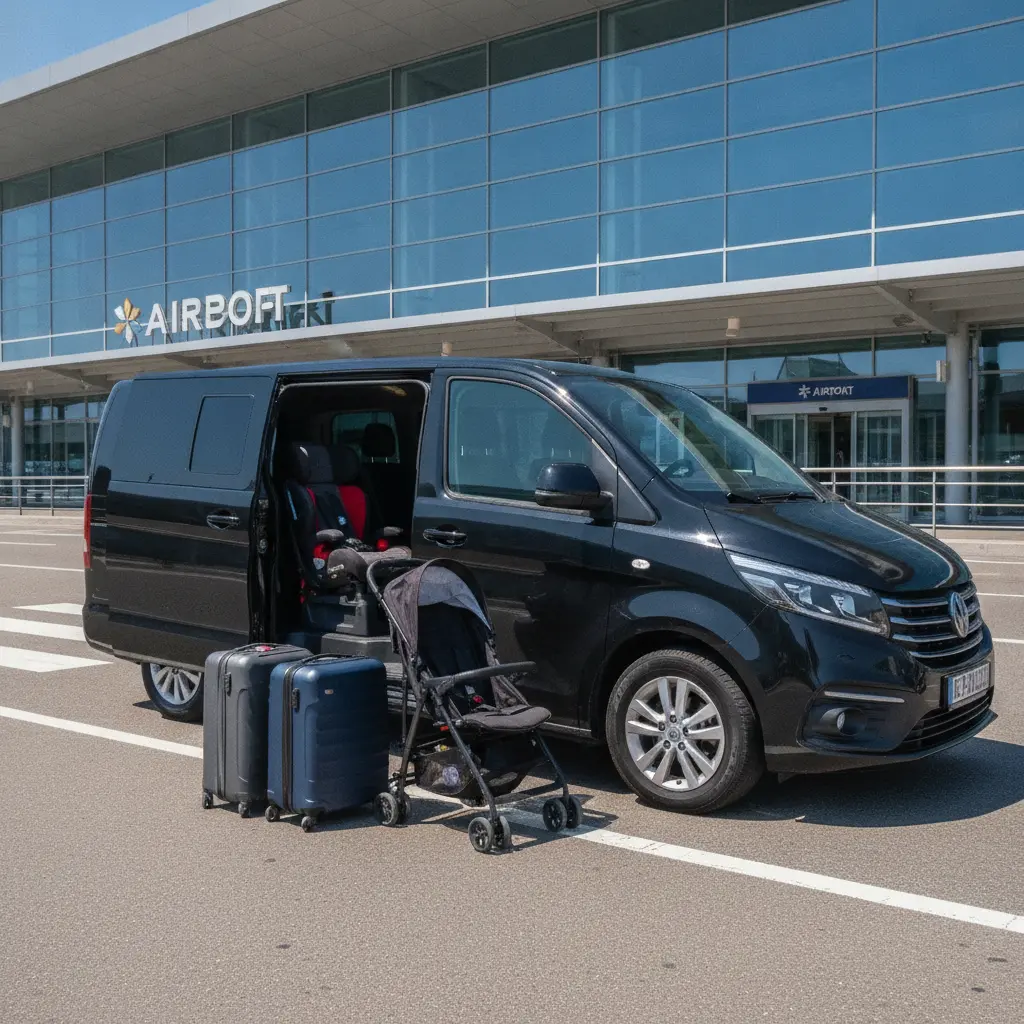
- Whether a stroller folds flat and whether it has a travel bag.
- Any long or awkward equipment: skis, snowboard, surfboard, bicycle, golf bag.
- Any wheelchair or medical device.
- Any pet carrier.
Answer these six questions before you pay. A single “yes” may push you from a sedan into a larger class. Upgrading at the kerb is not always possible, especially on busy days when the fleet is already out.
Vehicle class and passenger count
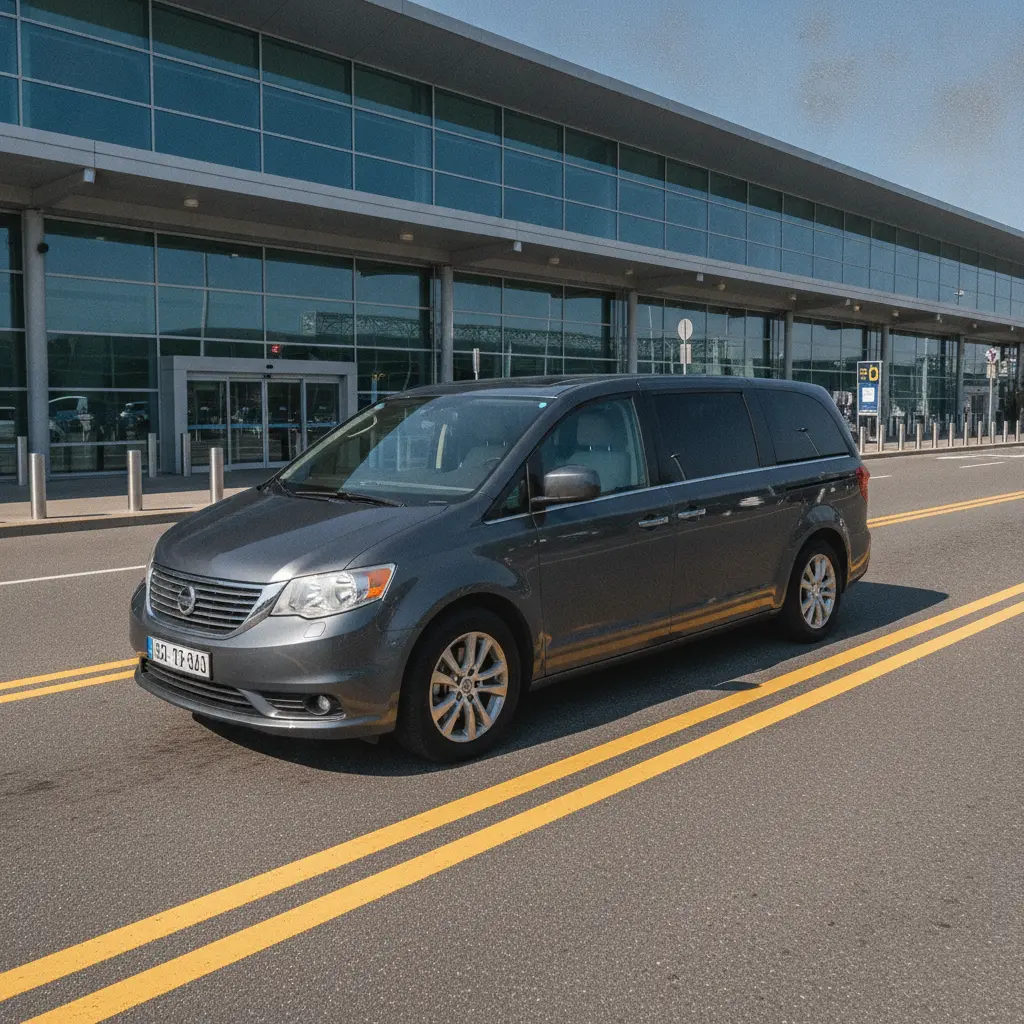
As a rough guide: two to three passengers with two suitcases usually fit a sedan. Four passengers and four suitcases need an SUV or an estate with a generous boot. Five to seven passengers are best served by a VIP minivan, which balances seating and luggage space. Eight or more moves you into minibus territory. These thresholds vary by operator and model, so put your luggage count in writing rather than relying on a rule of thumb.
What the price includes, and what it does not
Ask about each of these individually so the total is not a surprise:
- Are motorway and bridge tolls included?
- Who pays the airport car park or entry fee?
- How long is the free waiting period, and what is charged after it?
- Which hours count as the night tariff?
- Is an extra stop (a second hotel, a different address) chargeable?
- Is a child seat or booster an extra cost?
- Do you pay in advance or in the car, and are cards accepted?
Seven answers, one written confirmation. A WhatsApp message or email thread is your reference if anyone at the airport tries to add an undisclosed charge.
Cancellation, changes and delay policy
What happens if your flight is cancelled? How many hours before pickup can you cancel free of charge? Is there a charge for waiting out a delay? How long before the pickup are you considered a no-show? All four answers should be in writing. On connecting itineraries, ask specifically whether the transfer can be moved if the first leg is missed.
A contact channel that actually works
You need a number you can reach the moment you land; email alone is not enough. Check whether the number on your confirmation supports WhatsApp. Non-Turkish speakers should look for operators with English-speaking support. Test it a day before departure: send a short message and see how quickly it is answered.
2. At the airport: where and how to meet your driver
Istanbul Airport is a large terminal, and the walk from the arrivals hall to the exit plus the crowd can make meeting up harder than expected. Plan the meeting physically, not just in theory.
Arrivals exit and meeting area
The meeting point is normally the area immediately outside the arrivals hall, where drivers hold up name signs. Exit door numbers change with periodic terminal adjustments, so do not memorise a number. Instead, read the instructions your driver sends and share your location as you approach the exit. Telling the driver which exit you are heading to after collecting your bags noticeably shortens the search.
What should be on the name sign
The name on the sign should match your passport spelling. Turkish characters are often rendered differently in booking systems abroad, so spell your name out during booking and check the confirmation. For groups, ask for the surname on the sign; it is easier to spot than a first name.
Passport control, baggage and timing
On international arrivals, the gap between landing and emerging into the hall depends on immigration queues and the baggage belt. The time you give your driver should be the expected exit time, not the landing time. If your bags are slow, message the driver immediately. Most operators track the flight and already know about a delay, but they cannot see that your suitcase is still missing.
Connectivity before you land
If you are arriving from abroad, sort out an eSIM or roaming before departure. Free airport Wi-Fi exists, but connecting during peak hours can take longer than you would like. Save the driver’s number as a screenshot as well as a contact; it still works when your battery is low or the app will not load.
3. Delays and waiting time: how to manage the clock
Flight delays are the most unpredictable part of any transfer. Most operators track flights and adjust automatically, but you should still have your own plan.
- Report the delay yourself: If the operator does not track flights, a message after thirty minutes of delay prevents a wasted dispatch and an extra charge.
- Know your free waiting window: Meet-and-greet services usually include a set number of minutes, after which an hourly rate applies. Learn this at booking, not at the kerb.
- Reschedule long delays: If the flight moves by several hours, ask for a new pickup time rather than paying for hours of waiting.
- Add baggage time separately: Even an on-time landing can mean twenty to forty minutes at the belt. Build that into the pickup time.
A practical rule: add 60 to 75 minutes to the landing time for international arrivals and 30 to 40 minutes for domestic. That buffer covers most immigration and baggage scenarios without making the driver wait unnecessarily.
4. Luggage checklist: before you reach the airport
Lost or damaged baggage is the worst-case scenario in any transfer. Tick these items at home or in your hotel room, before you close the suitcases.
- Write down your bag count: How many large cases, how many carry-ons, how many shopping bags. Note it on your phone.
- Photograph each suitcase: Closed, with the tag visible. It serves as evidence if something goes missing or gets damaged.
- Put a name and country-coded phone number on the outside tag: A name alone is not enough. Add the country code and an email address.
- Put a second ID note inside: It saves the day if the outer tag tears off.
- Check the weight: Tell the driver in advance about any case over 23 kg so lifting and loading can be planned.
- Pack fragile items separately: Duty-free bottles, glassware and gifts belong in one bag or box, and the driver should know which one it is.
- Keep the carry-on out of the boot: Passports, medication, chargers, laptops, valuables and one change of clothes stay with you in the cabin.
- Check the stroller: Does it fold? Is there a travel bag? If it does not fold, choose a larger vehicle class.
- State the size of special equipment: Skis, snowboards, surfboards, bicycles and golf bags need length and cover details up front.
- Confirm the pet carrier: Size, ventilation and where it will travel inside the vehicle should be agreed beforehand.
- Allow for duty-free shopping: If you plan to buy at the airport, your bag count will grow. Tell the operator in advance.
- Check zips, locks and wheels: Make sure the wheels are intact and the handle is not cracked. Keep keys for locked cases with you.
5. Five-minute loading check at the kerb
Five minutes of checking while the bags go in prevents almost every later dispute.
- Count out loud together: “Four large cases, two carry-ons, one stroller.” Do it in front of the driver.
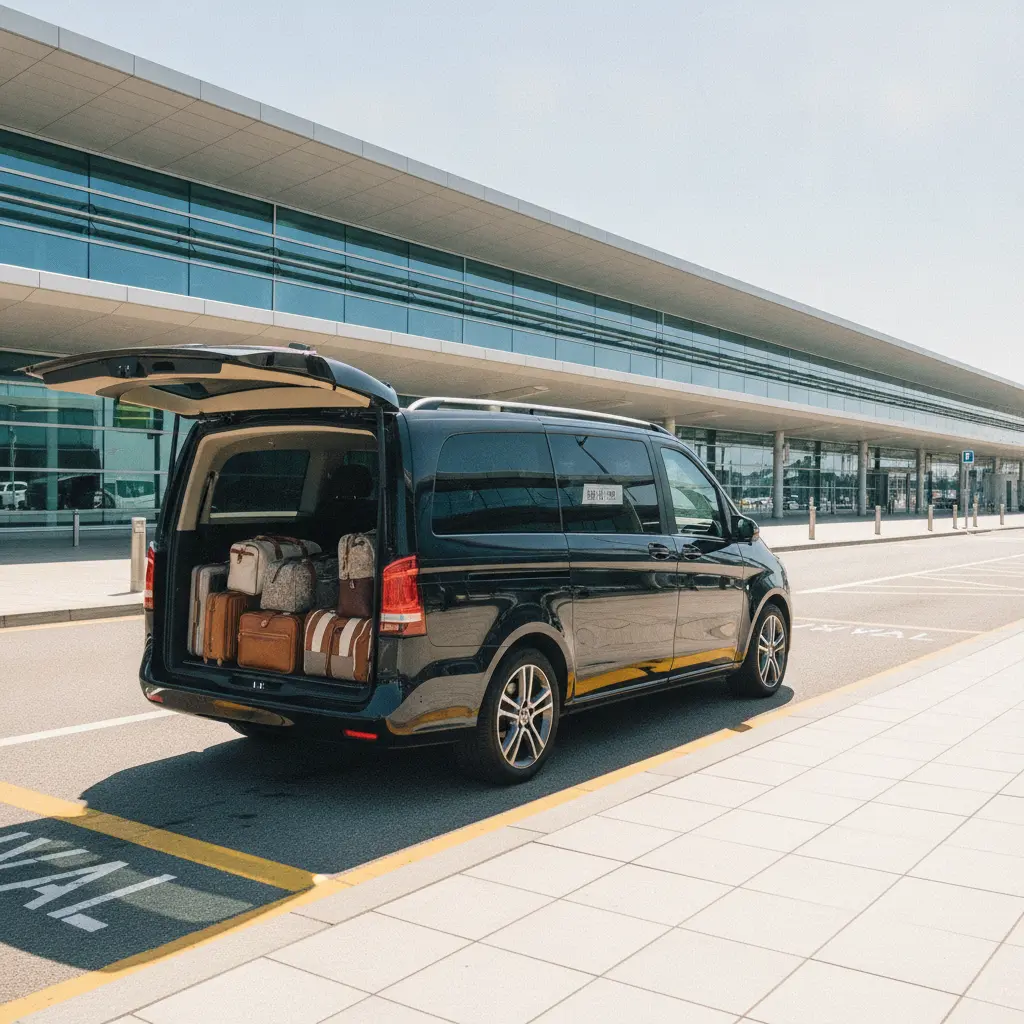
- Photograph the open boot: One frame once everything is loaded covers both count and condition.
- Heavy on the bottom: Never stack heavy cases on top of fragile items.
- Keep tags visible: Check that tags are not crushed when bags are stacked.
- Check the child seat: Is the belt tension correct and the fixing secure? Confirm booster placement with the driver.
- Repeat the address and route: Hotel name, district and any extra stop. Navigation does not always find the right entrance, especially in the old city.
- Payment and receipt: Show your prepayment confirmation, or ask whether the card machine works if you are paying in the vehicle.
6. On the road: comfort and safety items
Travel time between the airport and the city varies enormously with traffic. A few practical points make the ride easier:
- The first fifteen minutes around the airport can be the slowest part; plan your departure from the hotel with that in mind.
- Mention air conditioning and charging needs before you set off.
- On long intercity transfers, plan a rest stop; it is safer for both driver and passengers.
- Do not leave valuables in view. Keep the laptop with you rather than in the boot.
- Call the hotel reception with your estimated arrival time; it speeds up a late check-in.
7. On arrival: the final check before you step out
The last check is the most commonly skipped step. Do it twice: once before unloading and once after.
- When the boot opens, confirm the number of bags matches what you loaded.
- Check the seats and door pockets: phone, glasses, charging cable, book, a child’s toy.
- Look in the glovebox and door bins with the driver rather than after he has driven off.
- Take your receipt; you will need it for expenses if you are travelling for work.
- If you spot damage, photograph it immediately and show the driver. Evidence weakens once you are inside the lobby.
8. The return leg: a reverse checklist for hotel to airport
The return is usually more stressful than the arrival because a missed flight is expensive. Work backwards in this order:
- Count back from the flight time: Being at the airport about three hours before an international departure is a safe buffer; domestic flights can be tighter.
- Add a traffic allowance: The road into the airport stretches noticeably during morning and evening peaks. Skipping this allowance is the single most common mistake.
- Include checkout and bag collection: With a group, gathering suitcases and waiting for the lift can take twenty to thirty minutes.
- Update your bag count: You arrived with three cases; you may leave with five. Add new purchases to the booking details.
- Confirm with the driver 24 hours ahead: Essential for very early departures, when a no-show at 4 a.m. is hard to fix.
- Ask about the night tariff: Pickups between midnight and early morning are priced differently by many operators.
- Settle the hotel bill early: Ask whether checkout can be completed the night before so you are not queueing at reception at dawn.
9. Eight mistakes that show up again and again
- Giving an approximate luggage count, then discovering the vehicle is too small.
- Providing only a pickup time instead of a flight number, so a delay goes unnoticed.
- Not confirming the meet-and-greet type, then searching the hall for a sign that is not there.
- Never asking how long the free waiting period lasts.
- Loading the boot without photographing it first.
- Requesting a child seat at the last minute.
- Leaving no traffic buffer on the return leg.
- Keeping the driver’s number in an email instead of saving it to the phone.
10. What changes with the season
Summer months and public holidays make both the terminal and the roads busier. Waiting times stretch and vehicle availability tightens, so booking early is the most effective precaution. In winter, allow a wider buffer for weather-related disruption; it is the cheapest insurance against a missed flight. Around Ramadan and New Year, demand for late-night transfers rises, so confirming a few days in advance is worthwhile.
Frequently asked questions
Is the meet-and-greet service included in the price?
It depends on the operator and package. A name sign at the exit is often a separate service added to the total. Ask in writing during booking whether meet-and-greet is included or an add-on.
Do I pay extra if my flight is delayed?
Operators that track flights do not charge for a delay itself, but an hourly rate can apply once the free waiting window is exceeded. Find out where that limit sits before you travel.
What happens if my luggage does not fit?
Upgrading at the kerb is not always possible. Declaring the correct bag count at booking is the only reliable protection. If bags genuinely do not fit, a second vehicle may be needed, at additional cost.
How does a late-night arrival work?
The arrivals hall is quieter at night, but public transport options thin out. A pre-confirmed transfer with a meet-and-greet is the safest choice, and you should have the driver’s number saved before you fly.
Should I request a child seat?
Yes, and at the time of booking. Child seats and boosters are limited in number and last-minute requests may not be met. Give the child’s age and weight so the right seat is provided.
Can one vehicle serve several addresses?
Usually yes, but an extra stop may carry a charge. Set out the route in writing when booking so the driver can plan the order of drop-offs.
The bottom line: a short list, a big difference
A good Istanbul airport transfer starts with accurate information rather than a fancier car. Giving the flight number, declaring the bag count, confirming the meet-and-greet type in writing and knowing the waiting rules removes most of the friction on their own. On the luggage side, the trio of photographs, a count out loud and clear tags sharply reduces both loss and damage risk.
When you plan your ride, compare the premium VIP car rental options on Turlago and match the vehicle class to your passenger and luggage numbers. Whether you are going airport to hotel, hotel to airport or on an intercity route, the same three habits apply: accurate information, written confirmation, and a five-minute check while the boot is open. Those habits turn the most tiring part of a long journey into the calmest.