Istanbul Cruise Port Transfer: What to Check Before Booking
Why a Cruise Port Transfer Needs a Different Kind of Planning
An airport transfer feels controllable. You know your flight time, you calculate when to leave, and you decide when the car shows up. A cruise port transfer works the other way around. Disembarkation times are staggered and announced by the ship, customs adds another layer, and terminal security has its own rhythm. You are not setting the schedule; you are fitting into it.
Then there is luggage. Cruise passengers rarely travel light. Two large suitcases per person is normal, and add-ons like a stroller, a mobility aid or a golf bag are common. A standard sedan that comfortably handles an airport run may not physically fit the trunk load of a single cruise guest — let alone two.
Finally, there is the surge effect. A cruise ship may disembark hundreds of passengers and board hundreds more on the same morning. For a few hours, the area around the terminal experiences concentrated demand. Cars become scarce, prices climb, and pickup spots get crowded. Planning for that window is the whole game.
This guide walks through the criteria that actually matter when selecting an Istanbul cruise port transfer, explains why each one matters, and ends with a step-by-step selection process and the mistakes that cost travellers the most time. If you also need vehicles for airport legs, hotel hops or intercity travel, Turlago's private car rental options let you arrange all of it through one provider.
1. Identify the Right Terminal, Not Just the Right City
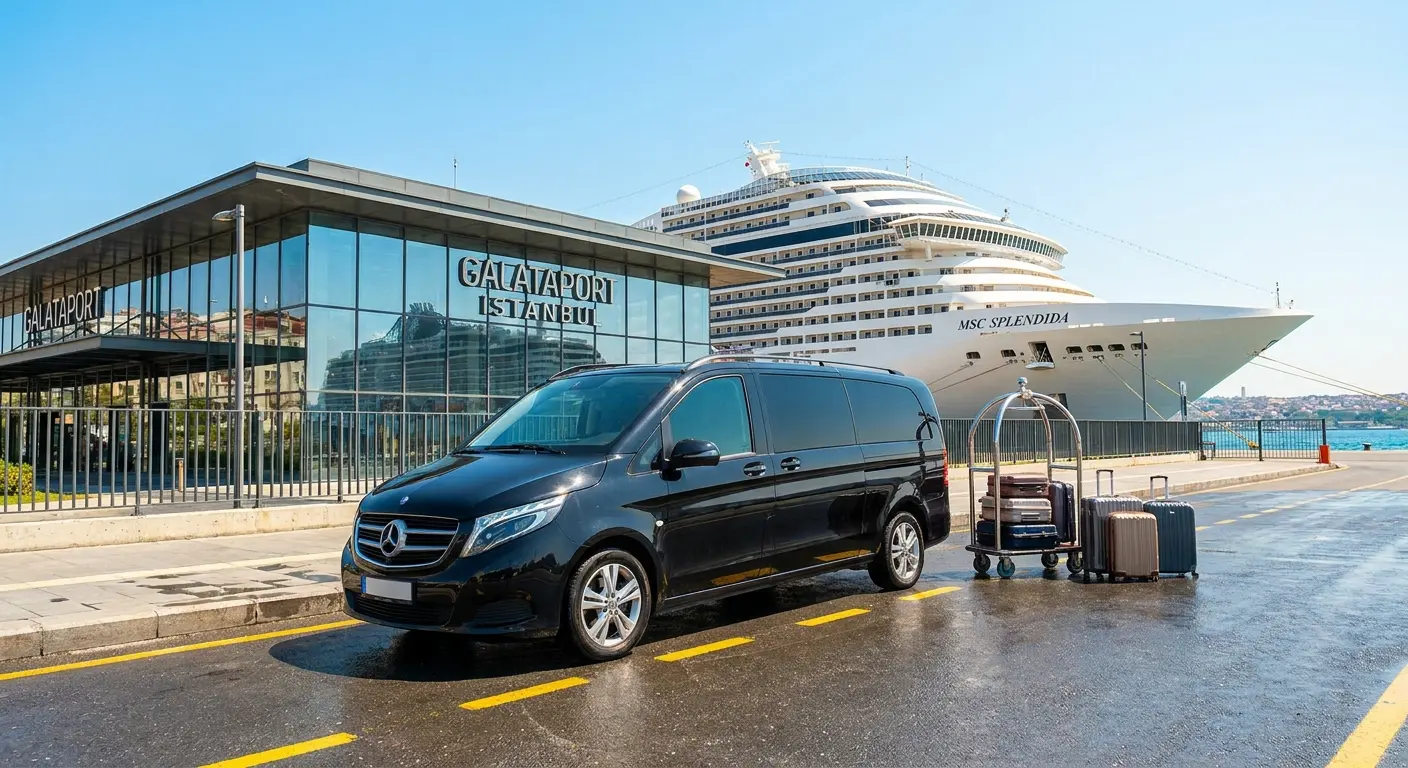
Istanbul's main cruise terminal is Galataport in Karaköy, on the European side. But "the cruise port" is not a single doorway. The terminal complex includes multiple berths, different passenger exit points and separate vehicle access routes. Which one applies to you depends on where your ship is moored that day.
This matters more than it sounds. A driver waiting at the wrong exit is 200 metres and 20 minutes away, and in a busy terminal, directing someone by phone is genuinely difficult. When you book, provide:
- Ship name and voyage number: this lets the driver verify the berth against the port's schedule.
- Terminal and exit details: "Galataport" alone is not enough; add the passenger hall or gate if you have it.
- Arrival or departure: are you being dropped at the port or collected from it? The meeting protocol differs.
If you are unsure, ask the company how they handle terminal positioning. A strong answer describes a specific meeting point and a fallback. A weak answer is "we know the port."
2. The Meeting Protocol Decides the Whole Experience
Most transfer complaints are not about car quality. They are about the first ten minutes: the passenger standing with three bags, scanning for a vehicle that is not where they expected. A clear meeting protocol eliminates that entirely.
A well-run cruise transfer follows a predictable sequence:
- The driver confirms via message shortly before disembarkation.
- The driver waits at a designated point, with a name sign or a precise description.
- The meeting point is as close as terminal security permits, and the walking distance is communicated in advance.
- Luggage assistance is provided — cruise bags are heavy and awkward.
- Waiting time and any delay charges are defined in writing before you travel.
The more of these points a company volunteers without being asked, the more operationally mature it is. Providers that quote a price and leave the rest to you will also leave problem-solving to you.
One extra note for cruise guests: the distance between the ship's gangway and the vehicle area can be substantial. If you are travelling with a wheelchair, a stroller or limited mobility, say so at booking. It changes both the vehicle type and the meeting point.
3. Timing: Build Around the Ship, Not Around Your Guess
Timing is the single most consequential variable. Miss a flight and there is another one. Miss a ship and you are chasing it to the next port, which is expensive and exhausting. That asymmetry is why you plan in both directions.
When leaving the port after disembarkation
Disembarkation is usually staggered. Early groups leave first; independent travellers often go later. If you have arranged your own transfer, do not book against the start of the window. Book against your realistic exit time and give the driver 30-45 minutes of tolerance.
When returning to the port for departure
The riskiest moment of any cruise transfer is the return leg. A sensible rule is to be at the terminal at least two hours before the ship sails. If you want a safety margin against Istanbul traffic, plan to leave the city centre three hours ahead.
The most common error here is assuming short distance equals short travel time. In Istanbul, an eight-kilometre trip can easily take fifty minutes in peak conditions. Bridge congestion and special events can make it worse.
4. Luggage Volume Determines the Vehicle, Not the Headcount
Cruise luggage is the primary driver of vehicle choice. Reporting the right number of people and the right number of bags is essential. Under-report and you may need a second car on the spot — a waste of both time and money.
A practical mapping looks like this:
- 1-2 passengers, 2 large cases: a sedan is usually sufficient.
- 3-4 passengers, 4 cases plus carry-ons: an SUV or a large-trunk vehicle is needed.
- 5-7 passengers, heavy luggage: a VIP minivan is the correct choice.
- 8+ passengers or a large family group: a Sprinter-class van or a coordinated two-vehicle convoy.
Declare odd-shaped items separately. Golf bags, strollers, mobility aids and musical instruments do not behave like suitcases and cannot be counted as equivalent volume. Mention each one.
There is a reverse trap as well. If you spend a few days in the city before boarding, your luggage will be heavier on the way to the port than it was on arrival. If you book your hotel transfer and your port transfer with the same provider, update the luggage details in one go so the vehicle assignment stays accurate.
5. Pricing: Fixed Rate or Meter? Ask What Is Included
The wrong question is "how much?" The right question is "is this fixed, and what does it cover?"
There are three common pricing models:
- Fixed, pre-confirmed rate: the most predictable option. Traffic, waiting and route adjustments do not change the fare, provided the terms are written down.
- Metered fare: looks attractive for short hops and rises fast in congestion. For cruise passengers it is usually the wrong model.
- Hourly or half-day hire: sensible when you want to be collected from the port, tour the city, and be returned to the ship.
Even with a fixed rate, confirm these items: meet-and-greet fee, port or parking access charges, night tariff, extra waiting time, bridge and motorway tolls, and excess luggage. Good operators bundle these into one figure and do not surprise you later.
When comparing quotes, compare coverage rather than numbers. The same figure can mean sixty minutes of free waiting and luggage handling at one company, and per-minute waiting charges at another. Waiting is almost guaranteed on a cruise transfer, so the waiting policy matters as much as the fare.
6. Licensing, Insurance and Driver Familiarity with the Port
The legal side of a transfer is not paperwork for its own sake. It determines who carries the risk if something goes wrong. Operators with passenger transport authorisation, proper vehicle registration and passenger insurance protect you in the event of an accident or a lost bag. Informal "private car" arrangements do not.
Clarify before booking:
- Does the vehicle hold a commercial passenger transport licence?
- Is there per-passenger insurance cover?
- Is the driver experienced in both city and long-distance driving, and familiar with the terminal area?
- What is the age and maintenance status of the vehicle?
Port familiarity is more important than it appears. Parking restrictions, one-way systems and temporary traffic arrangements around the terminal change frequently. A driver who knows the area will not leave you walking 200 metres with your luggage, and will know where the car can legally wait.
Also ask whether the driver monitors the ship's schedule. If the itinerary shifts or the berthing order changes, that monitoring is what determines whether someone is still there waiting for you.
7. Language and Communication Access
Most cruise passengers arriving in Istanbul are international visitors. A driver who can handle basic English dramatically shortens problem-solving time. Without it, even simple matters — a meeting point, an address, a payment question — turn into long exchanges.
The practical side matters too. Know which channel your communication will run on. WhatsApp, SMS or an in-app thread all work; what matters is that you hold a direct number and a name, not only a call-centre line. Companies that give you a central number only tend to move slowly when you are standing in a terminal with a delay.
For Turkish-speaking travellers there is a different advantage: local operators have faster access to same-day conditions — roadworks, events, closures — because the drivers live with that information daily.
8. Groups, Families and Travelling with Children
Cruises are popular with families, friend groups and multi-generational trips, and that changes the transfer brief.
What to verify for group transfers:
- Child seats: legally required but often only provided on request. State ages and numbers at booking.
- Older passengers: high-step vehicles can be difficult. Ask for a low-floor or step-assisted option.
- Luggage coordination: eight passengers usually means eight large cases. One minivan may not cover it; a two-vehicle convoy is more comfortable.
- Group timing: if members leave the ship at different times, waiting time grows. Price that scenario in advance.
If multiple vehicles are needed, they must arrive at the same time. Companies that guarantee this usually coordinate through an operations desk rather than leaving it to a single driver.
9. Traffic and Buffer Time Management
Istanbul traffic is not one variable. It shifts with time of day, weather, school calendars and city events. The only way to manage it on a cruise transfer is to build in buffer time.
A rough framework:
- Port to the Historic Peninsula: short distance, but meaningful peak-hour risk.
- Port to Taksim, Beşiktaş or Nişantaşı: medium distance, defined by tunnel and coastal traffic.
- Port to Istanbul Airport: long distance, generally more predictable because of motorway use, but a high total time.
- Port to Sabiha Gökçen and the Asian side: the most variable route, because it requires a bridge or motorway crossing.
Buffer time costs you a waiting fee. A missed ship costs you far more. Put the two figures side by side and the decision makes itself.
10. Cancellation, Delay and Change Policy
Itinerary changes on cruises are not rare. Weather can alter a route, berthing order can shift, and a ship can arrive late. The flexibility policy of your transfer provider therefore matters as much as the service itself.
Ask about three scenarios before you sign:
- The ship does not call at the port: full refund, partial refund, or none?
- The ship is delayed: how long will the driver wait, and does that cost extra?
- You cancel late: what is the cancellation window and the deduction?
Providers without a written policy can improvise against you when it counts. Having these terms in your confirmation email protects you and signals that the operator is serious.
11. Payment Methods and Documentation
For international passengers, payment is a practical concern. Cash-only requests, foreign-currency conversion markups and missing receipts are recurring complaints. A transparent operator offers:
- Card payment in the vehicle or a secure prepayment option,
- a price locked at the time of booking,
- an invoice or receipt on request,
- advance written notice of any additional charges.
In periods of currency volatility, ask which exchange rate a foreign-currency quote is pegged to. That single question prevents most payment disputes at the end of the ride.
Step-by-Step: How to Choose the Right Cruise Port Transfer
- Lock down your ship schedule. Note arrival and departure times, and the disembarkation window.
- Build a passenger and luggage inventory. Count cases, flag special items and list children's ages.
- Define the route precisely. Port to hotel, port to airport, or port to a city tour with a return.
- Collect three quotes. Compare scope, not price: waiting time, luggage handling, meeting protocol, cancellation terms.
- Request the meeting point in writing. This is critical in a busy terminal.
- Add buffer time. Plan to be at the port at least two hours before departure.
- Save your contact details. Keep the driver's name and a direct number on your phone.
Complete these seven steps and you are holding a plan, not just the cheapest quote. That is what makes the difference on the day.
Eight Mistakes That Cost Cruise Passengers Time
- Booking the driver against a guessed disembarkation time with no tolerance built in.
- Under-reporting luggage and overloading the vehicle.
- Describing the pickup point vaguely as "outside the port."
- Comparing only prices and never asking about waiting or cancellation terms.
- Leaving for the port an hour before the ship sails.
- Ignoring bridge traffic when heading to the Asian side.
- Booking one vehicle for a group and assuming the luggage will fit.
- Leaving the reservation to the last minute and paying peak-season rates.
Frequently Asked Questions
How far in advance should I book an Istanbul cruise port transfer?
During the high cruise season from spring to autumn, booking one to two weeks ahead is advisable. On days when several ships berth at once, demand spikes and vehicle availability tightens considerably.
How long does the transfer from the port to the airport take?
From the European-side terminal to Istanbul Airport, expect roughly 50 to 90 minutes depending on traffic. Crossing to Sabiha Gökçen on the Asian side usually takes longer because of bridge and motorway conditions. Build buffer time in both directions.
Will the price increase if the ship is delayed?
That depends entirely on the provider's policy, and it should be asked before booking. Reliable operators define a free waiting allowance for ship delays and state it in writing.
Can the car wait directly at the terminal exit?
Not always. Port security and traffic regulations often require vehicles to use a designated waiting area, with the driver meeting you on foot. This is exactly why the meeting point should be agreed in advance.
The Bottom Line: Good Transfers Come From Good Questions
There is no single best company for an Istanbul cruise port transfer. There is a best service for a traveller who asks the right questions. Is the meeting point specific? Is the luggage capacity confirmed? Is the price fixed? Is the waiting policy written down? Four satisfactory answers mean you are almost certainly in good hands.
The best moments of a cruise holiday are the ones where nothing goes wrong — and those moments are never noticed. They are not luck. They are the result of planning. If you would like to arrange your port, airport and hotel legs through one provider, you can select the right vehicle and complete your reservation through Turlago's private car rental options.