Istanbul Event Boat Charter: Which Group Type Fits You?
If you are planning an event for 150 people, you have probably spent the last few weeks crossing venues off a list. The one that fits the headcount blows the budget. The one that fits the budget feels cramped. The one with the beautiful outdoor space has nowhere for anyone to park. At some point the question becomes unavoidable: is there a place in this city where 150 people can stand, sit and move around without feeling like they have been packed into a hall?
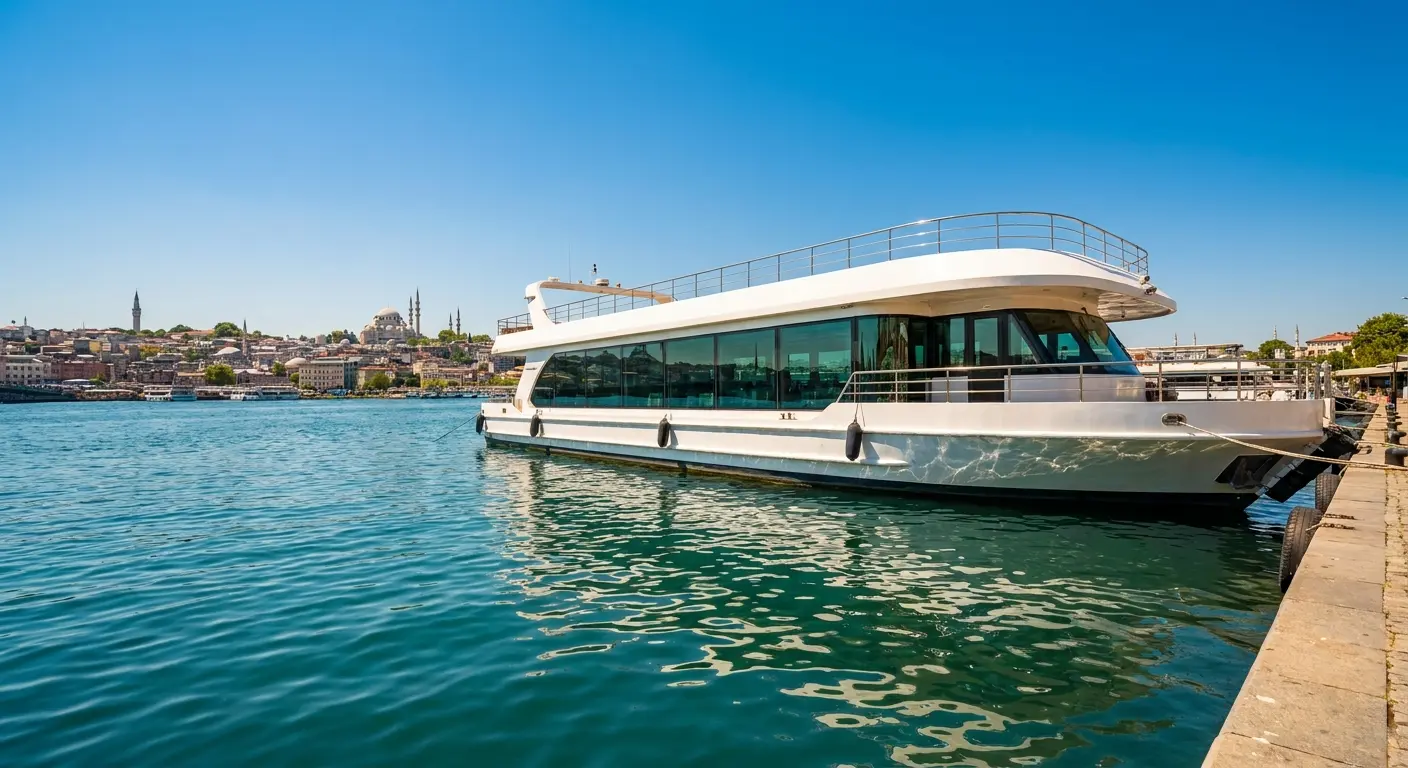
On Istanbul's Golden Horn, one answer comes in the shape of a 31-metre event boat departing from Cibali. See the Özel Gün Davet Teknesi on Turlago and you will find four headline facts: a capacity of 150 guests, a generous indoor salon, panoramic windows and availability in the evening hours. The listing carries a 5-star rating, but let us be straight with you: that score rests on just two reviews. Treat it as an encouraging signal, not as proof.
This article is not a sales pitch. It answers one question: which groups genuinely fit this boat, and which do not? We will also factor in something most charter guides skip, namely what changes in Istanbul as the season turns from summer into autumn and winter. A party in July and a party in November are two different projects, even on the same deck.
What 31 metres and 150 guests mean in practice
Thirty-one metres is a serious length for an event vessel. In real terms it means people can walk past each other on deck, service staff do not get stuck between tables, and a conversation in one corner does not have to compete with the music in another. The 150-guest figure, on the other hand, is a ceiling. Pushing a venue to its ceiling is the fastest way to ruin an evening.
So the first question you should ask is not "can it hold 150?" but "is 150 the standing capacity or the seated capacity?" The gap between those two numbers decides the whole feel of your event. A seated dinner needs a table and a chair for every single guest, which means a genuine floor plan inside the salon. A standing reception needs poseur tables and open service lanes. Ask directly: "For 150 people, are we seated or standing?" If the answer is vague, the number is decorative.
The listing also highlights the indoor salon and the panoramic windows. In Istanbul, evenings are cool for a good part of the year. Windows and salon are not simply a nice view; they act as a buffer zone that keeps a large group spread out and the service flow intact. In summer the party spills onto the open deck. In October it retreats indoors. How well that salon actually works is what you are really buying.
Match the boat to your group
The same vessel does not deliver the same experience to every kind of guest. Below are the four profiles we see most often, and an honest read on where this boat shines and where it struggles.
Family celebrations: moving three generations at once
The hardest part of a big family event is the age range. Keeping grandparents and children in the same place without anyone being bored or exhausted requires a venue that offers everyone their own corner. A 31-metre boat does this structurally: the quiet end of the salon and the busier open deck separate naturally. Older relatives can sit and talk while younger guests stay outside, and neither group disturbs the other.
The real advantage for families is that everything happens under one roof. At a garden venue or a country wedding, half the guests end up in the car park and the other half in a far corner, and the group fragments. On a boat, everyone is in the same place. As the season turns, the enclosed salon also neutralises the "what if it rains" anxiety. Still, ask how the heating works before you sign anything.
Couples: this is not a romantic escape
Let us be clear. A 150-guest event boat is the wrong choice for a dinner for two. If you are looking for a quiet Bosphorus cruise for just the two of you, smaller-capacity listings will serve you better on both experience and budget. Turlago has other boats that fit that brief far more closely.
But if the couple in question is planning an engagement or a wedding, the picture changes completely. Here the boat becomes the venue that carries the guest list. The most common complaint we hear after engagement parties is "it was so crowded we never spoke to anyone." Booking a 150-capacity boat for 90 to 110 guests is a far smarter move than trying to fill every seat. Empty space is what lets a party breathe.
Corporate events: the boat's strongest territory
The listing names corporate dinners and meetings first among suitable events, and we agree. The real challenge in a company event is not content, it is attention. In a hotel ballroom, a speaker addresses a room full of people quietly checking their phones. On a boat the dynamic shifts: guests have nowhere to escape to, but they also have nothing to be bored by. Panoramic windows and an open deck soften the transition between the presentation and the break.
Corporate planning rests on three pillars: presentation layout, service timing and the awards or speech sequence. In a seated set-up for 150, confirm early how the microphone and sound system work, where the speaker will stand, and whether a presentation can be projected. Because evening availability is specifically noted in the listing, an after-work event format slots naturally into this boat's schedule.
Friends and graduations: manage expectations early
Graduation parties and birthdays are also listed as suitable events. The appeal of a boat for a friends' group is obvious, but a word of caution is due. If you are arriving with expectations of loud music, a dance floor and a party that runs late into the night, settle the boat's rules and time limits at the very start. An event boat is not a nightclub. Music levels, DJ permissions and noise rules should all be written into your offer so nobody gets a surprise at midnight.
And if you are collecting money from the group, share the per-head cost at the first meeting. A friend who discovers the real price afterwards will overshadow even a flawless event.
Chartering in Istanbul as the season turns
Chartering in summer is easy. The weather is good, the deck is open, the plan is simple. From late September things start to shift. October and November are actually among the smartest months for a boat event in Istanbul: the city has emptied out, evenings are cool but the deck is still usable. December and January are a different game entirely, where the indoor salon stops being a bonus and becomes a requirement.
During this transition, the questions you need to ask change:
- Is the indoor salon heated? Panoramic windows bring the view and the cold. Get the heating confirmed in writing.
- What is the bad weather policy? If wind or rain shortens the route, does the price change, and does the event continue indoors?
- How do the hours shift? In autumn it gets dark early, so the 18:00 to 23:00 window is the most efficient. Do not let a party that expects a daytime view start in the dark.
- Is the open deck usable? It may be closed in some months; build your seating plan accordingly.
There is also a calendar reality. In the last quarter of the year, corporate events and year-end programmes pile into the same weeks. If you are planning for November or December, acting early is not about price, it is about availability. When a listing says evenings are available, that availability needs to be locked down weeks in advance.
Why departing from Cibali matters for guest logistics
The departure point is the least discussed and most troublesome item in any boat event. Cibali sits on the southern shore of the Golden Horn, within the Fatih district. Being close to the historic centre is a genuine advantage when most of your guests are travelling from inside Istanbul. Proximity to the Eminönü, Unkapanı and Atatürk Boulevard axis means taxis arrive without a detour, while the nearby Haliç metro station offers a practical option for guests who would rather not drive.
The Bosphorus view is clearly stated in the listing, but the route itself is a matter for your offer. On an itinerary that leaves the Golden Horn and enters the Bosphorus, the duration, the stopping points and the return time all shape the flow of the evening. Ask how many hours you are actually on the water and how much of that is stationary. In a 150-guest event, a schedule that slips becomes a service that slips.
Boarding logistics deserve their own line too. Getting 150 people onto a boat one by one is not a five-minute job. Give guests a boarding window on the invitation so the pier does not turn into a queue; it will buy you hours later in the evening.
Fitting 150 people on board: layout, flow and sound
Capacity is a ceiling; comfort is the product of a floor plan. If you are building a seated arrangement on this boat, settle these three things:
- Table layout: How many seats per table, round or long tables, and how much floor is reserved for a dance area? Ask for a drawn sketch.
- Service flow: Is service for 150 handled in one wave or by table groups? The gap between the opening speech and the main course depends on the answer.
- Sound system: Does the microphone coverage reach the whole salon and the open deck? Can you bring your own music?
Add a photo and cake window to that list. The most common mistake on an event boat is squeezing everything into the last half hour. When the cake, the speech, the photographs and the return trip all land in the same 30 minutes, the party dissolves. Build the run of show minute by minute before you board.
How to read the 13,000 TRY hourly rate
The listing shows an hourly rate of 13,000 TRY, with no daily price stated. When you evaluate that number, separate two things: the boat fee and the event fee. The boat fee multiplies by duration; catering, décor, live music and photography are negotiated separately. Ask for those as distinct lines in your offer.
A concrete example helps. At full capacity of 150 guests over a two-hour event, the boat fee works out to roughly 173 TRY per person (2 × 13,000 / 150). That calculation is useful for comparison, because in conventional venue pricing the same per-head figure tends to disappear inside a minimum spend. Run the same maths for four hours and the number doubles, which is exactly why you should define the hours you actually need rather than padding the booking.
Get these five points in writing during the budget conversation: is VAT included, what is the deposit, what are the cancellation terms, are crew and service included, and does fuel consumption change with the route? Those five questions remove most post-event surprises.
Twelve questions to ask before you book
- For 150 guests, is the set-up seated or standing?
- Does the indoor salon have heating, and in which months is it in use?
- Do the panoramic windows open, and how do guests reach the open deck?
- Are departure and return times flexible, and does a delay cost extra?
- What is the route, and how much of the charter is spent on the water?
- Is the bad weather policy documented in writing?
- Are the sound system, microphone and projector included?
- Can we bring our own music, and what is the DJ policy?
- Can we bring outside catering, or is the boat's menu mandatory?
- Can you share a sketch of the table layout?
- Is there parking or a waiting area at the pier?
- What are the deposit, cancellation and date-change terms?
If you get written answers to all twelve, you are talking to the right people. If you only get a verbal "we'll sort it out," you are carrying risk into the most critical week of your event.
Six mistakes people make in the cooler months
- Filling the boat to capacity. Inviting 150 people onto a 150-guest boat removes every bit of comfort. Somewhere between 110 and 130 makes for a far better evening.
- Not asking about heating. In late October the deck is wonderful; in late November the salon is what saves you. Plan around your date.
- Ignoring boarding time. 150 guests queueing on a pier will drain energy before the event starts.
- Overloading the run of show. A speech, a cake, photographs and music will not fit into the same half hour.
- Treating the price as one line. Ask for the boat fee and the event fee as separate items.
- Reading two reviews as a reference. The rating is encouraging but thin; ask the operator for examples of past events during your offer call.
Who will feel at home on this boat?
To summarise: the groups that settle in fastest are those planning a 150-person event, running it in the evening, and worrying about the room falling flat. Corporate dinners and meetings come first; large family engagements and weddings second; graduation and birthday parties third, provided expectations are set clearly from the start. Anyone dreaming of a quiet evening for two should look at a different listing entirely.
Whether an event went well is usually measured the next day, by what guests remember. To avoid the sentence "the venue was a bit dull," the formula is simple: the right capacity, the right hour, the right run of show. Check current availability and full details for the Özel Gün Davet Teknesi on Turlago, then take the twelve questions above into your offer call. The right questions are half of a good event.