Istanbul Yacht Charter for Corporate Teams: One Day, Step by Step
The email landed on a Tuesday: twenty-six people, one day, somewhere that is not a hotel conference room. Deniz, who runs operations for a product team, had three weeks to turn a vague morale budget into something people would actually remember. The options on her desk were a meeting room, a countryside restaurant and a boat on the Bosphorus. The first two were safe and forgettable. The third was risky, and the only one people would still talk about in December.
What follows is not a generic charter guide. It is the account of how one company team booked a yacht in Istanbul, how the day actually unfolded hour by hour, and where the plan nearly fell apart. Because a corporate day on the water needs more coordination than a quarterly review: vessel type, catering, team dynamics, weather and ground transport all have to be managed at once.
Transport was part of the brief from day one. Getting twenty-six people to Kabataş without a scatter of separate taxis meant looking at premium VIP car rental as a single, scheduled solution. Most charter articles skip this detail entirely, which is exactly why it belongs in the first paragraph.
Start with the group, not the boat
Deniz made one mistake early: she began with a list of boats. By the second week she realised the real question was not which yacht, but what the day was supposed to produce. On a corporate outing the vessel is a venue. The value comes from what happens on it.
Six questions had to be answered before a single quote made sense:
- Purpose: a celebration, a quarter kickoff, or an actual working session? Each one implies a different boat, a different length and a different menu.
- Headcount and certainty: twenty-six, or twenty-six plus partners? Until the number is fixed, neither the price nor the vessel is fixed.
- Mobility: anyone with stairs difficulty, seasickness, pregnancy or small children? This decides the hull type more than anything else.
- Alcohol policy: is the company culture an open bar or a controlled one? It shapes the supplier choice as much as the boat choice.
- Duration: four hours or eight? Four hours is a long introduction. Eight hours is a genuine offsite.
- Approvals: who signs the budget, which entity gets the invoice, which card pays the deposit?
Skip these and you are not comparing boats, you are comparing prices. And in corporate yacht charter, the price gap usually comes from what is included, not from how old the vessel is.
Matching the hull to the group
Three candidates made the shortlist. What made the decision easy was knowing which type fits which group.
Gulet: the quiet favourite for larger teams
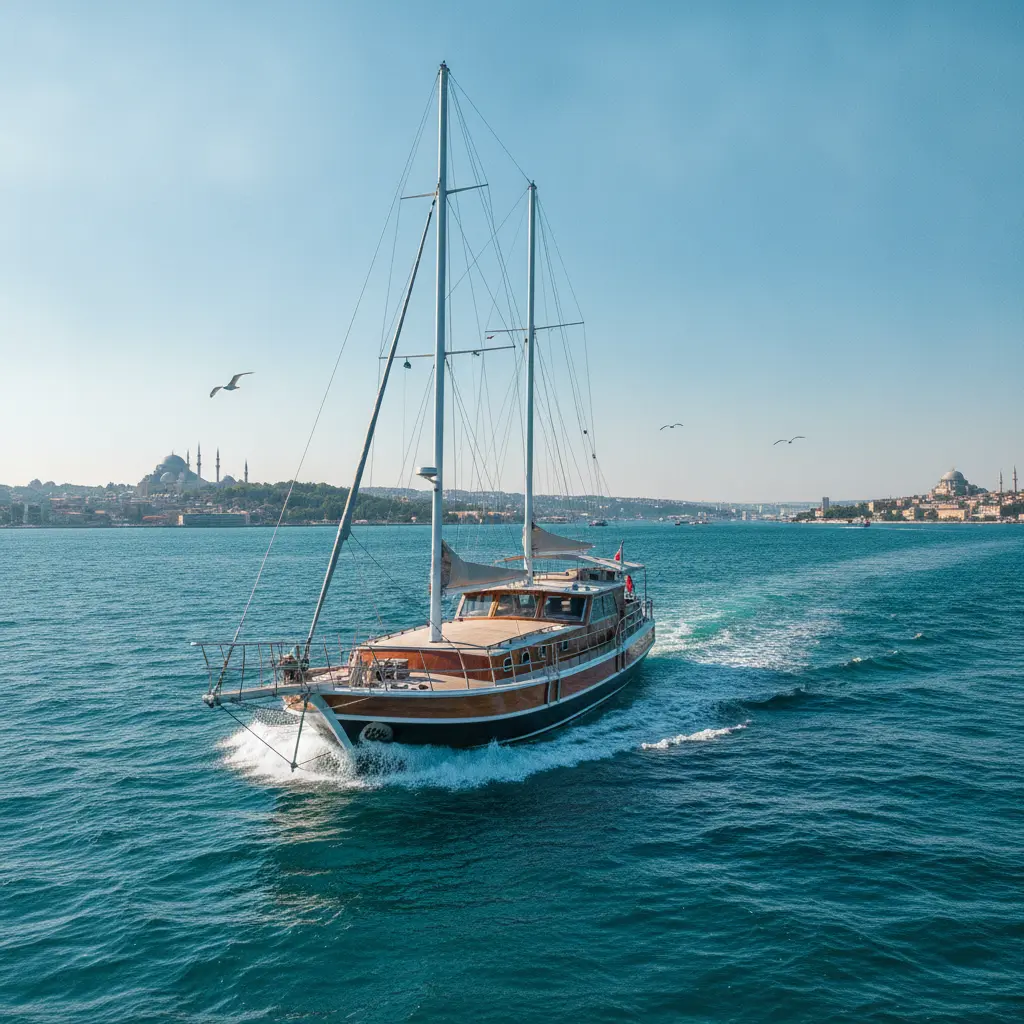
Wide deck, high guardrails, generous seating and a galley with a working crew. For corporate groups of twenty to forty people it is the most balanced option. Speed is low, so the route stays short: out of Kabataş, north along the strait, and back. Because meals can be served on deck, the programme keeps moving and everybody can sit down at the same time.
Motor yacht: smaller, faster, more formal
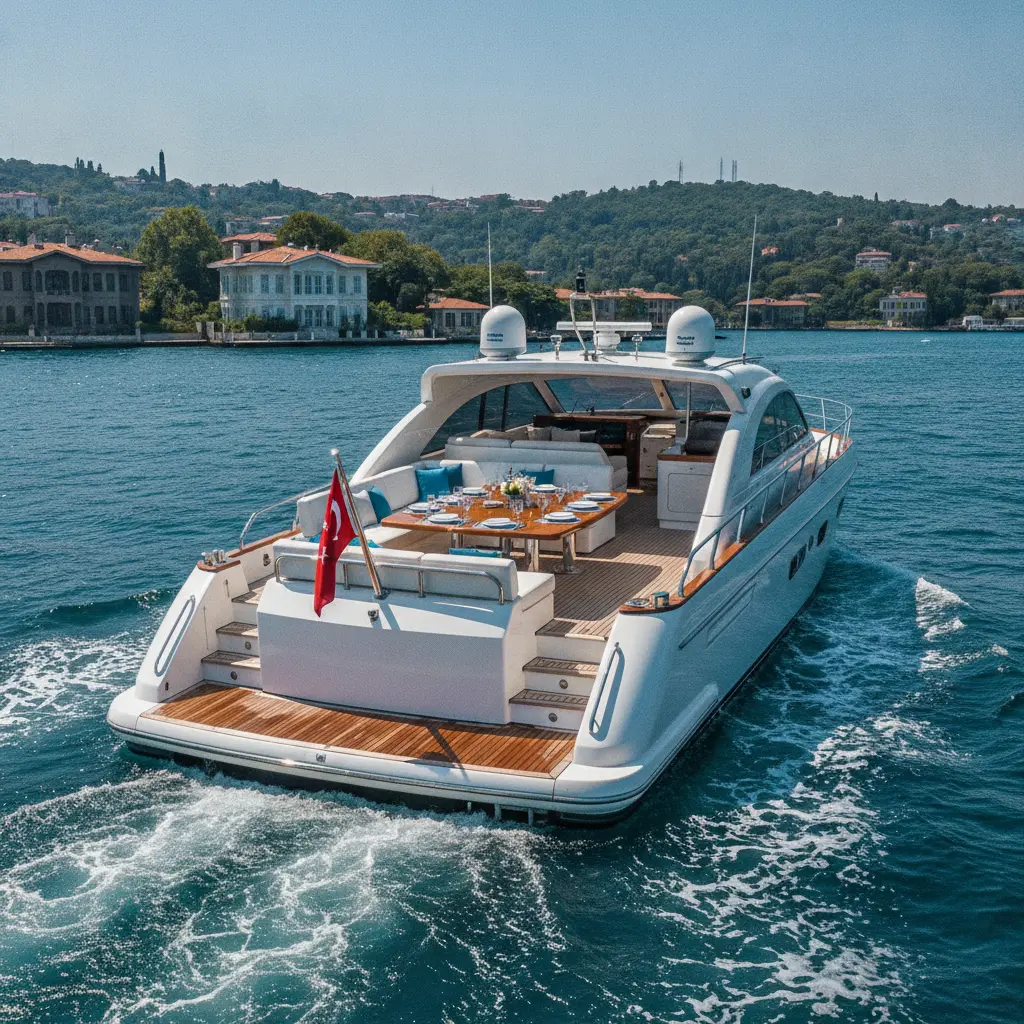
Comfortable for ten to twenty-five guests. Interior quality is high; exterior space is tighter than a gulet. It suits board meetings, senior client hosting and award events. For a team of twenty-six it only works as two vessels, which shifts the budget into a different conversation.
Catamaran: the most stable option
Two hulls mean very little roll, making it the first choice if anyone on the team is prone to seasickness. The flat, wide deck is good for team activities, though capacity is usually limited and motion in stronger wind can still be felt.
Deniz chose a 24-metre gulet. The reasoning was simple: twenty-six people had to be able to eat at the same time. That single criterion took three candidates down to two.
The day, hour by hour
This is the programme that was actually run, not the version that looks perfect on paper and collapses the moment people step aboard. Every block has a buffer.
08:40 — One meeting point, not twenty-six
Asking everyone to find the pier independently exhausts even the quietest participant within the first half hour. The team was collected from a single location in two vehicles, with a twenty-minute arrival buffer built in. Two people were late. The departure time was not affected.
09:15 — Welcome at the pier and boarding
Check-in should belong to one person. List, name badges and welcome drinks on one table. Boarding was done by team rather than alphabetically, so nobody stood alone on deck waiting for someone they knew.
09:40 — Twelve-minute opening
The classic corporate yacht mistake is running a conference on the aft deck. The opening was capped at twelve minutes: quarter summary, two thank-yous, one goal. A microphone and a portable speaker were requested in advance, because a gulet's generator does not carry a voice across an open deck.
10:00 — Morning block: introductions
This block existed to make the three new joiners visible. Two truths and a lie, twenty-five minutes, no pressure, no forced enthusiasm. It worked because it was short and because everyone had to speak once before lunch.
11:00 — Cruising and free time
As the boat headed north, the programme was deliberately left empty. This was the most important part of the plan. People find each other in the gaps. Every filled minute delays the conversations the day is supposed to produce.
12:30 — Lunch
Plated service instead of a buffet. A buffet for twenty-six creates a queue, and a queue breaks conversation. Service finished in thirty-five minutes. The allergy list had gone to the galley forty-eight hours earlier, not handed over on the morning.
14:00 — Working session: forty-five minutes, one question
This is where the business value sits. One question was put on the table: what are we not going to do next quarter? Flip charts on deck, fifteen minutes in small groups, twenty minutes of feedback. Deniz's note afterwards: working on an open deck produces shorter and more honest conversations than a meeting room.
15:15 — Recognition
Quarterly awards were handed out here. Outdoors, brief, no ceremony. It also became the moment the group photo happened.
16:00 — Return and disembarkation
The boat turned back at 16:00 and everyone was ashore by 17:00. Eleven people opted into a separate dinner reservation; it was not made mandatory. Forcing an evening programme onto a corporate day is one of the fastest ways to reduce attendance.
Who this suits, and who it does not
The same vessel does not deliver the same thing to every group. Reading the profile correctly is the whole decision.
Corporate teams (15-40 people)
The strongest fit. A boat loosens hierarchy while keeping the group private. Watch for microphone coverage, seating, the number of heads, wi-fi expectations and a programme that is not speech-heavy. Above forty people, split across vessels or reconsider the format.
Families
Gulets are safe for children: high guardrails, wide deck, shade. But the day should end early, lunch should not slip past 12:30, and the life jackets must include children's sizes. For large family groups, a private boat is genuinely less tiring than a restaurant reservation.
Couples
Here the vessel gets smaller, the duration shorter and privacy matters more. Private charters for two to eight guests with crew are the standard. The critical point is written confirmation that the boat is not shared with another group.
Friend groups
Sound system, music and a flexible schedule. The risks are different: pier rules, swimming safety, alcohol limits and return time. A good operator writes all four into the agreement and repeats them during the day.
Who should not book this? Groups with a strong seasickness profile and no catamaran alternative; two-hour photo-session charters; and any event where the budget is still undefined when the boat is being held.
What you are actually paying for
Corporate charter quotes rarely look alike because their scope differs. The price is built from seven lines:
- Vessel fee: hourly or daily, with a clear difference between high and low season, and between weekdays and weekends.
- Crew: captain, first mate, service team, chef. Sometimes included in the vessel fee, sometimes line-itemed.
- Fuel: rises with route length. A short Bosphorus loop does not burn the same as a run north.
- Food and beverage: the most variable per-head line. Menu scope, service style and drinks package change the number significantly.
- Pier and port services: berthing, waste handling, security, occasionally an environmental fee.
- Taxes and gratuity: is VAT included, and what is the expected crew gratuity? On a corporate invoice this must be explicit.
- Ground transport: the most commonly forgotten line. For twenty-six people, a scheduled premium VIP car rental arrangement is both cheaper and more predictable than a fleet of separate taxis.
Building the budget per head makes comparison honest. Deniz split every quote into three columns: vessel, hospitality, logistics. She never decided without adding all three, and twice discovered that the cheapest-looking quote was the most expensive once logistics were counted.
Food, drink and the alcohol question
On a corporate day, catering sets the pace of the programme. There are three service styles: buffet, plated and cocktail. A buffet looks efficient for a large group but fragments conversation. Plated service takes longer but keeps people at the table and talking. A cocktail format is ideal around a presentation or an award moment.
Alcohol needs a written company policy before the supplier is chosen. Unlimited packages rarely improve a corporate event; a measured package protects both the budget and the end of the day. Dietary requirements and allergy lists should reach the galley forty-eight hours ahead rather than changing hands on the morning of the charter.
Designing the three hours in the middle
Deniz's programme had three activities, each doing a different job:
- Introductions (25 min): makes new joiners visible and brings the quietest person at the table into the conversation.
- One-question working session (45 min): produces an actual decision. This is where the business value of a boat day comes from.
- Recognition and close (20 min): makes effort visible. A short thank-you outdoors lands better than a long presentation indoors.
What to avoid: long deck presentations, slide reading, and anything that depends on a live internet connection. Connectivity on the water is never as reliable as you expect, and the programme needs a backup that does not require wi-fi.
Contract clauses that must be in writing
A verbal agreement is not enough for a corporate booking. These points belong in the contract or in an annex to the quote:
- Departure and return time, pier name, boarding cut-off.
- Maximum guest count and crew count.
- Whether fuel is included and any route limit.
- Menu scope, service style and drinks package.
- Cancellation or route-change rules in bad weather.
- Deposit percentage, payment schedule and refund terms.
- Damage deposit and insurance coverage.
- Whether the invoice includes VAT, plus corporate payment details.
One more clause: the captain's authority to change the route. In Istanbul, weather and traffic can rewrite a plan. A good contract defines that authority and attaches an alternative programme from the start.
No corporate boat day survives without a weather plan
Four days before Deniz's event, a southwesterly warning came in. The day was not cancelled, but two things changed: the route was shortened and the return time moved earlier. That flexibility existed for one reason only, and it was the forty-eight-hour clause written into the agreement.
Practical rules:
- If there is a weather review forty-eight hours out, put it in writing.
- Agree the alternative-date right in advance; in high season that right narrows quickly.
- A vessel with an enclosed saloon is always the safer choice over one without.
- Take simple seasickness precautions: light meals, sitting forward on deck, avoiding long stretches below.
Ground logistics: arrive as a group, not as a crowd
On corporate outings, most lost time happens on the road, not on the water. Sending twenty-six people in separate taxis creates three problems: staggered arrivals, invoice chaos and no way to track who is where. A single departure point fixes all three. That is why premium VIP car rental should be planned in the same week as the boat booking; leave it to the last day and the vehicles will not be there.
Seven mistakes worth avoiding
- Choosing the boat before the programme: a beautiful vessel with a bad plan is still a bad day.
- Confirming headcount late: capacity and catering both suffer.
- Starting lunch too late: the afternoon block collapses.
- Running a long presentation on deck: engagement drops within fifteen minutes.
- Leaving the weather clause out of the contract.
- Booking transfers on the final day.
- Extending the day with a mandatory dinner: attendance and satisfaction both fall.
Checklist: from six weeks out to the day before
- 6 weeks out: fix the purpose, headcount, budget range and date.
- 5 weeks out: request three vessel options and compare scope, not just price.
- 4 weeks out: lock the vessel and date, pay the deposit.
- 3 weeks out: approve menu and drinks package, plan ground transport.
- 2 weeks out: write the programme minute by minute and assign owners.
- 1 week out: share the guest list, allergy list and pier details.
- 2 days out: weather review, final payment, short call with the crew.
- 1 day out: one message to the whole team with the meeting point and time.
The real question was never the boat
Deniz's event finished at 17:00. The feedback that reached HR the following week repeated one sentence more than any other: I spoke to people I have worked with for two years and had never actually talked to. That sentence is the return on a corporate boat day. The vessel is a stage; the programme is what makes the stage mean something.
If you are planning Istanbul yacht charter for a corporate team, get three things right from the start: a vessel type that matches the profile of the group, a realistic programme with real gaps in it, and a written agreement that covers weather as well as menus. Treat transport with the same seriousness as the boat, because a twenty-six-person day begins the moment everyone arrives at the pier together rather than one taxi at a time. You can compare yacht and boat charter options for your group on Turlago, and fold premium VIP car rental into the same plan so the logistics never become the story of the day.