First Yacht Charter: Packing and Dress Code Guide
On a plane, the number that matters is 23 kilos. On a yacht, it is volume. The most common first-timer complaint is not sunburn or seasickness — it is discovering that a hard-shell suitcase cannot be opened anywhere inside a cabin. The heels brought for a smart dinner never leave the bag, and the thick sweatshirt packed “just in case” on a 34-degree afternoon turns out to be the single most useful item on deck after dark. This guide treats first-time yacht charter packing and dress preparation as expectation management rather than a shopping list: what changes with your group type, which clothes genuinely earn their space, and what you should leave at home entirely.
One easily forgotten detail: the trip starts at the marina, not at the gangway. If you are travelling with a group and several suitcases, arranging transport in advance is part of packing well — premium car rental options let you split the luggage across vehicles and arrive calm rather than overheated.
On board, luggage is measured in volume, not kilos
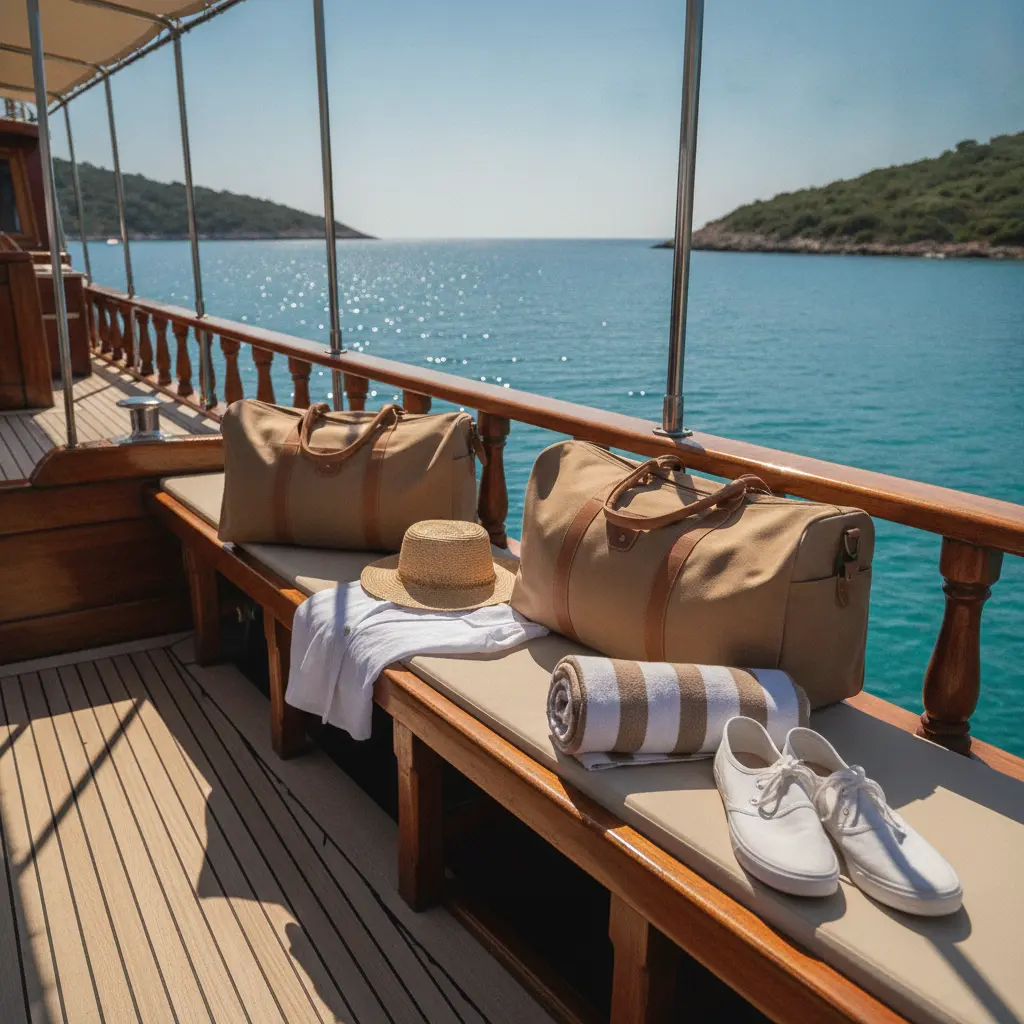
In a hotel room you can open a suitcase on the bed, spread out, repack. A yacht cabin gives you a bed, a small locker and a shelf. That is the whole footprint. The first rule therefore has nothing to do with fashion: bring a soft, collapsible bag, not a hard case. A duffel that flattens when empty and slides under the bunk is worth more square metres than any clever garment.
A realistic benchmark for a one-week Aegean or Mediterranean cruise is 40–50 litres per person. That is roughly a large cabin bag. Traditional wooden gulets usually offer a little more stowage; motor yachts are tighter, so discipline matters more. Nobody has ever been turned away for bringing too little.
- Main bag: a 40–50 litre soft duffel or travel pack.
- Day bag: a 15–20 litre pack for going ashore in bays.
- Dry bag: 5–10 litres for phone, wallet and medication — the hardest-working item you will bring.
- Folding spare: for gifts and laundry on the way home; takes up no space at all.
Crew often carry bags to cabins on boarding day. Arriving with one manageable piece per person rather than three half-open bags is a small courtesy that sets the tone for the week.
Your group type changes the packing list
Most online yacht packing lists are written for one imaginary traveller: thirty-something, travelling as a couple, organised enough to remember sunscreen. Real charters put four different packing profiles on the same deck. The distinctions below are where first-time yacht charter bag and clothing preparation actually differ.
Families with children: think refresh rate, not volume
With children, the magic number is changes of clothes rather than total items. For a week, four or five tops and three bottoms per child is plenty, because children get wet three times a day and refuse to put on a damp swimsuit. Two swimsuits, two towels and one light long-sleeved top cover most situations. Water shoes are not a luxury here — pebble beaches genuinely hurt. Ask the operator about child life jackets rather than assuming every size is on board. Nappies, wipes and sunscreen should be bought before the marina, because small anchorages have no shops.
Couples: fewer items, more outfit changes
On a two-person charter the trap is dinner. Meals are served on deck, sometimes ashore, and the instinct is to pack “something nice” three times over. One genuinely smart, crease-resistant evening outfit plus one relaxed backup is enough. Light linen blends travel well and need no iron. Travellers who wear makeup should bring a dark hand towel; foundation marks on white yacht linen are the surprise owners dislike most. Decanting toiletries into 100 ml bottles saves space in the cabin and keeps you compliant with flight rules at the same time.
Friends: agree a shared kit before you pack
Four to six friends on one boat will otherwise arrive with six sunscreens, six insect repellents and six speakers. A week before departure, assign the shared kit: who brings sunscreen, who brings the first-aid pouch, who brings the small speaker, who brings cards or a board game, who brings the beach reads. Individual bags then drop to around 35 litres and cabins stop feeling like storage units. Do the shared shop the day before, not at the marina.
Company groups: replace ambiguity with one clear code
Corporate charters rarely fail on clothing; they fail on unclear clothing. If everyone guesses, you end up with two people in blazers and eight in swimwear at the same table. Whoever organises the trip should send a single short paragraph: swimwear and t-shirts during the day, linen shirts and long trousers for dinner, one pair of trainers for evening walks ashore. If anyone needs to work, a waterproof laptop sleeve and one power bank are sufficient — sockets on board are fewer than at home and cannot charge everyone at once.
The three-layer rule: swim, day, evening
Yacht dressing tends to swing between two extremes: swimwear only, or an entire wardrobe. The reality sits in between and comes down to layers, because a day on the water passes through three temperatures — early afternoon heat, a softer late afternoon, and a breezy evening.
- Layer one (water): two swimsuits or two pairs of swim shorts. One is never enough, because nothing dries in time.
- Layer two (day): three or four t-shirts, one or two light linen shirts, shorts, one pair of thin long trousers. Linen and cotton dry fast and forgive creases.
- Layer three (evening): one light cardigan or sweatshirt and one thin windproof jacket. This is the layer sceptics use most.
An honest note on white clothing: on deck, white is a risk for the owner and a disappointment for you. Sunscreen, rust and rope marks leave permanent traces. Dark and ecru tones survive better. Keep one dark towel specifically for swimwear so nobody has to ask which towel is whose.
Shoes: the one rule that is never negotiable
Owners are strict about shoes, and it has nothing to do with style. Black rubber soles leave marks on teak that take hours to remove. That is why almost every yacht repeats the same sentence: no shoes on deck. In practice: two pairs maximum, both light-soled.
- Pair one — flat sandals or trainers: marina walks, restaurants ashore, sightseeing.
- Pair two — water shoes: for pebble and rocky bays. The most useful and most frequently forgotten item on the list.
- Leave behind: heels, platform sandals, brand-new leather shoes, heavy boots. Heels are unsafe on a moving deck and never actually needed at dinner.
Most guests go barefoot on board. That is a safety convention rather than a formality — a non-slip sole matters more than a stylish one.
Beyond clothing: the small technical kit
These items weigh very little and can rescue an entire day.
- Sunscreen, SPF 50, water-resistant: two small bottles beat one large one. Apply on the pontoon, not on teak — cream leaves permanent marks on wood.
- Hat and sunglasses: a wide-brimmed hat plus a spare. Wind takes hats; this is not a joke, it is statistics.
- Light fleece or windbreaker: the most-used item on evening passages.
- Lip balm and after-sun: salt and wind dry skin faster than expected.
- Personal medication plus seasickness tablets or bands: action on day one protects day two.
- Insect repellent: useful in sheltered anchorages close to shore.
- Waterproof phone pouch and power bank: sockets are limited; a power bank helps you and half the group.
- Earplugs: for generators, halyards and neighbouring music. Experienced guests pack them first.
Cabin order: unpacking a 40-litre bag in five minutes
Most first-timers open their bag in the cabin and spread everything across every surface. Three days later, nothing can be found. A few habits from home prevent this entirely.
- Use packing cubes. Three: tops, bottoms, swim and wet. Wet items always go in the same cube.
- Keep the evening outfit on top, folded flat, so you are not hunting for an iron on night one.
- Set aside a small dry bag for swimsuits and towels. Damp fabric turns musty faster at sea than anywhere else.
- Put medication and valuables in one clear pouch that everyone knows about.
- Keep shoes in a cloth bag by the companionway — the one thing you remove before stepping on deck.
One realistic expectation: laundry availability varies. Gulets often offer a laundry service; motor yachts and day charters usually do not. Asking before departure settles the five-shirts-or-seven question in a single email.
What not to bring: empty space is the most valuable item
- Hard-shell or oversized suitcases: they cannot be opened in a cabin and dominate the deck.
- Hair dryer and straighteners: yacht electrical systems are not domestic ones; ask the captain before assuming.
- Glass bottles and glassware: a smashed glass on deck is the least relaxing accident of the week. Many yachts do not allow glass at all.
- Heels and black-soled shoes: they mark, they slip, they stay in the bag.
- Stacks of books: one paperback and an e-reader are enough; deck reading happens in shade and needs no weight.
- Expensive jewellery: easy to lose over water and unnecessary on board.
- Large speakers: sound carries across a bay. A small shared speaker is the sociable choice.
Boarding day: what to wear and how to arrive
Boarding day is when your preparation is most visible — and most often got wrong. Arriving in swimwear is impractical: bag drop, welcome briefing and settling in can take an hour, sometimes in full sun, sometimes in an air-conditioned office. The right combination is a light t-shirt, linen trousers, flat shoes and a hat within reach.
Getting luggage to the marina is usually left unplanned. With six people, everyone's bags will not fit in one car. Booking premium car rental ahead of time solves both the luggage split and the arrival timing, and turns the most logistically awkward hour of the trip into an easy one.
The order of events on arrival is simple: shoes off before stepping aboard, bags where the captain indicates, a quick look at your cabin, then water on deck. Rushing the first hour is the most reliable way to spoil it.
Gulet or motor yacht: same list, different emphasis
Boat type changes your bag more than you would expect. Gulets are wooden, broad and heavier under way, with larger cabins and mostly natural ventilation; evenings are noticeably cooler, so one extra top and a warmer layer earn their place. Motor yachts are faster and air-conditioned, closer to a hotel in feel — the evening dress expectation creeps up slightly, but you need fewer daytime items because drying space is limited.
Day cruises are a different exercise entirely: no cabin, one day out. A 15-litre bag with a towel, swimwear, sunscreen, a hat, water and a spare t-shirt is genuinely sufficient. A plastic bag for wet swimwear is the detail that keeps the return journey comfortable.
Season and route: the same bag does not work every month
The Turkish charter season runs from May to October, but May and August are not the same holiday. In May and October the sea is cooler, evenings are genuinely chilly and the wind is more present; that third layer becomes essential. In July and August the challenge is sun — a wide brim, high-factor sunscreen and a habit of sitting in shade. September is the connoisseur's month: warm water, fewer boats, but still a need for something light after dark.
Route matters too. Open Aegean anchorages are windier, the Sea of Marmara cools down quickly in the evening, and the Mediterranean brings humidity — cotton stays damp, while linen and technical blends dry faster. A single dark cloth bag for sunglasses, hats and wet swimwear works on every route.
The 48-hour pre-departure checklist
- Weigh your bag in litres: if you are over 40–50 per person, remove something.
- Count shoes: more than two pairs means fewer pairs.
- Ask the operator three questions: laundry service, towels provided, power and voltage on board.
- Move sunscreen, medication, hat and water shoes into a separate day bag.
- Confirm your marina transfer time and luggage capacity.
- Pack two cloth bags and a dry bag for wet items.
- Charge the power bank and download offline maps.
- Send the shared kit list to your group one last time.
Conclusion: less stuff, the right stuff, realistic expectations
Packing for a first yacht charter is really an exercise in honesty: what you actually need versus what you carry “just in case”. The best part of a week at sea is how little it takes to enjoy it. Two swimsuits, three t-shirts, one linen shirt, a light layer, two pairs of shoes and a good hat is, for most people, the true contents of a week in the Aegean.
Whatever your group type, three rules hold: a soft bag, limited shoes, layered clothing. Get those right and everything else — which bay you swim in, where you eat dinner — takes care of itself. If you want to plan the boarding-day logistics properly as well, the premium car rental page is a practical place to start splitting luggage and arriving at the marina relaxed.
A final honest note: no list is perfect. What you forget is almost always available at the marina or the next harbour. What is not available is calm — so leave a little empty space in the bag. That space is there for the souvenirs, and for a much lighter case on the way home.