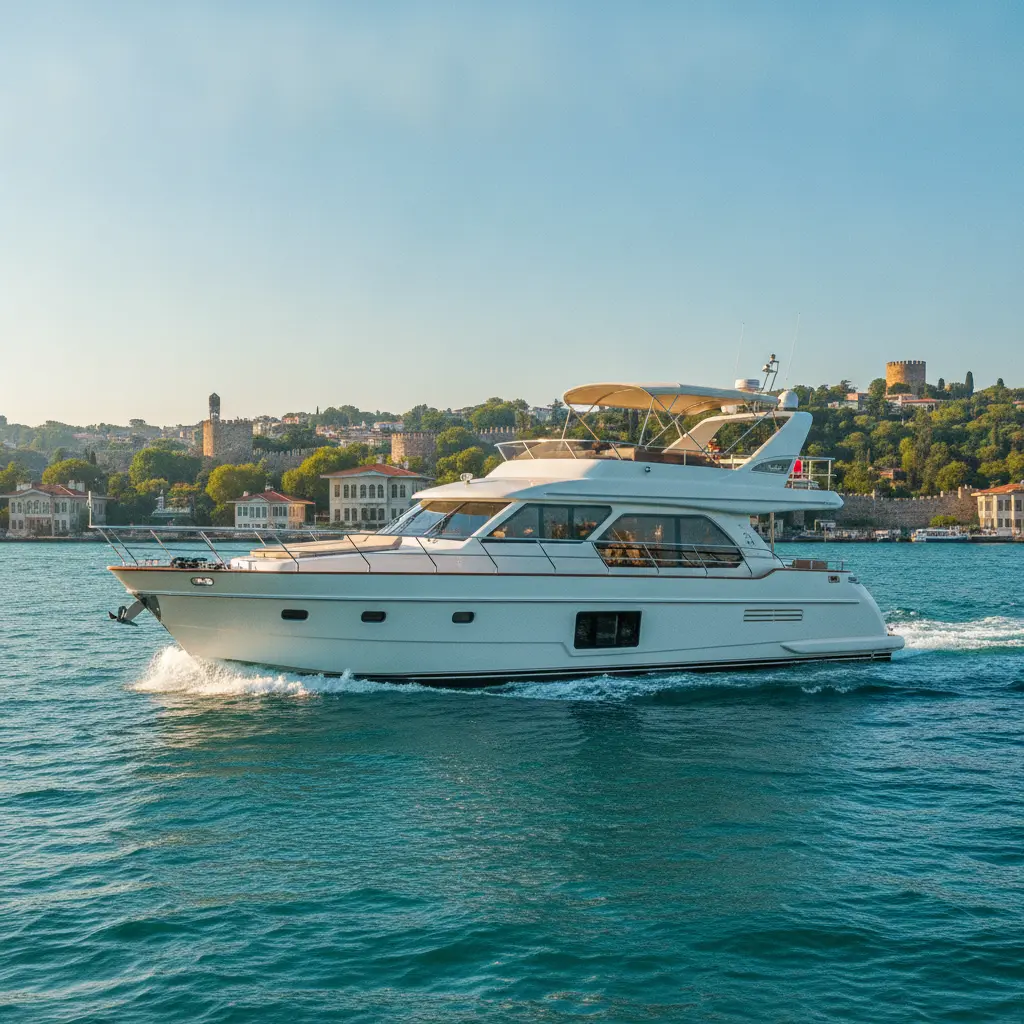
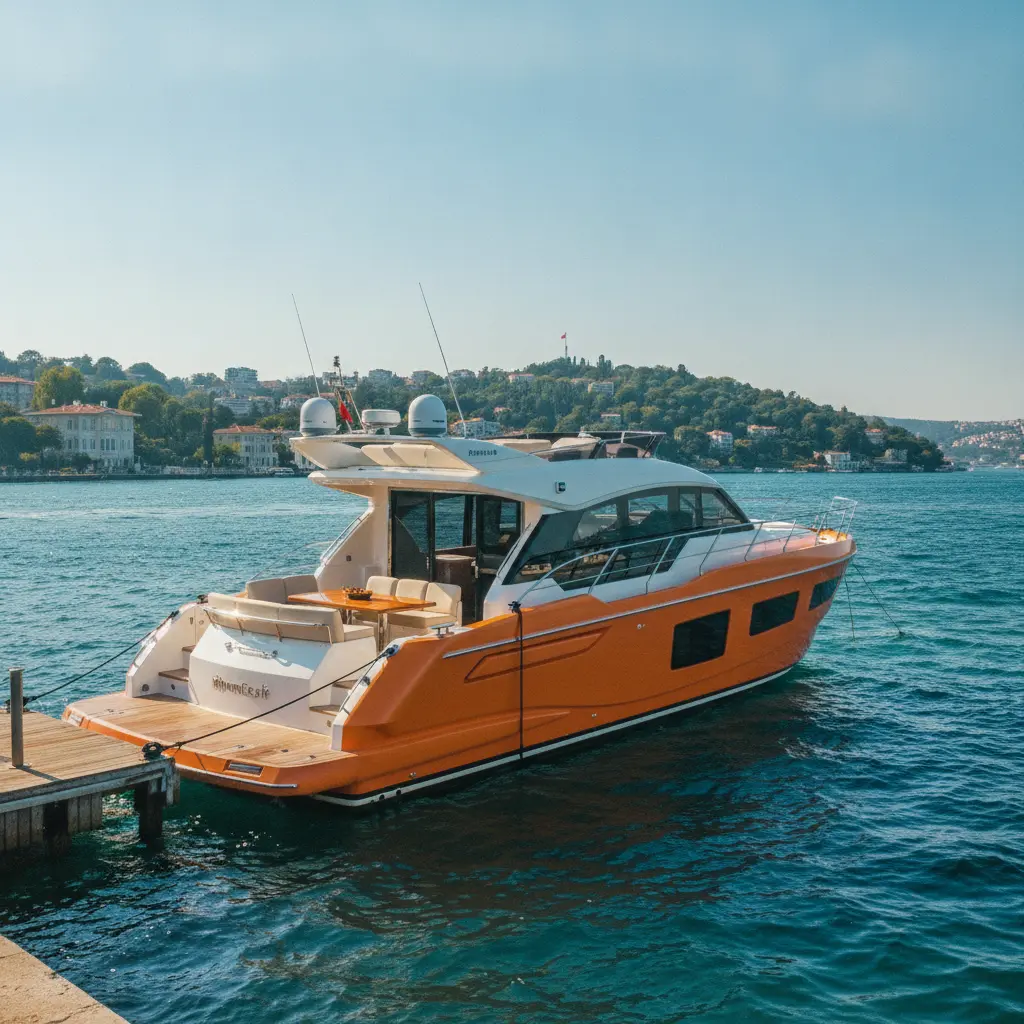
Luxury Yacht Rental Istanbul: Lounge & Dining Boat Checklist
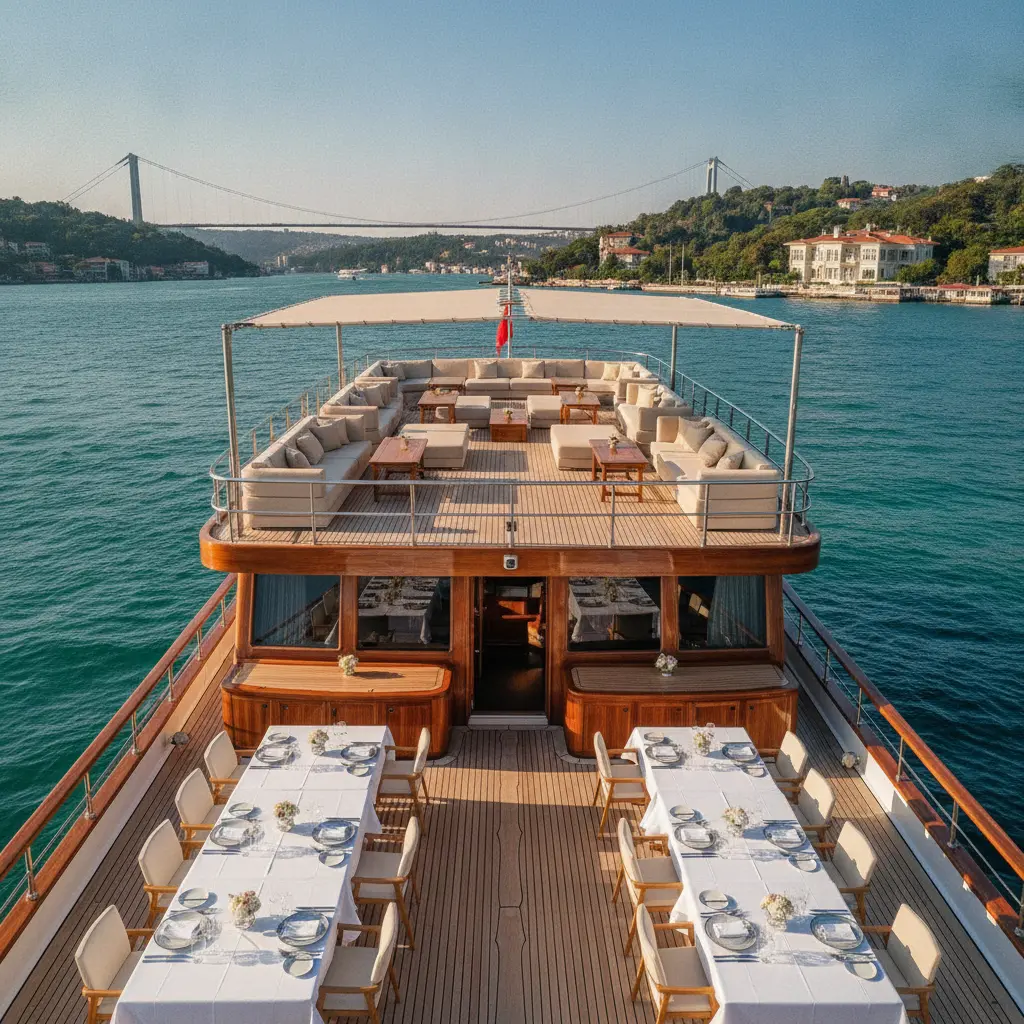
If your guest list runs to 300 people, choosing a boat is not a beauty contest. Three numbers decide almost everything: how many guests are actually coming, how many hours you want to be on the water, and how many of those guests expect to eat sitting down. The Şık Lounge Alanlı Lüks Yemekli Tur Teknesi — a 36-metre event boat departing from İstinye Marina — is built for exactly the moment when those three answers turn out to be large. Up to 300 guests, a lounge-led deck plan and a layout designed around hosted events rather than sightseeing runs.
This article is not a sales pitch. It is a decision guide: which kinds of groups will genuinely enjoy this boat, which will regret booking it, and what you need to ask before signing anything. I will stick to the verified listing data — 36 metres, 300 guests, TRY 30,000 per hour, İstinye Marina — and where the listing is silent, I will tell you to confirm rather than invent a number. At this scale, one missing service station or one hour of unplanned boarding time becomes the story of the night.
Suggested alt text for the hero image: "36-metre luxury event yacht with a wide upper terrace and wooden lounge seating, moored at İstinye Marina on the Bosphorus"
The numbers first: what this boat does and does not give you
The listing states 36 metres of length and capacity for up to 300 guests. It is classified as a "davet teknesi" — an event boat — which tells you the design brief is hospitality, not passenger transport. Three features are highlighted: a minimalist, high-volume interior; a dedicated lighting system built for evening events; and a large upper terrace with an uninterrupted Bosphorus view. Wooden lounge seating and a spacious dining arrangement are mentioned in the same breath.
The practical takeaway is this: the boat's core proposition is hosting a standing cocktail reception and a seated dinner in the same evening, without one ruining the other. With 300 guests, seating everyone at once is physically impossible anyway, so the quality of the lounge area matters as much as the quality of the dining area. That is the thread I will pull on throughout this guide.
On price, the listing shows TRY 30,000 per hour. No daily rate is published. That is a gap worth closing early, because a four-hour evening and an eight-hour full-day charter do not differ only in boat time — crew, fuel and service staffing all scale with the clock. The listing also has no guest reviews yet, which makes reference-checking more important than usual. More on that below.
Which group types this boat actually fits
A good boat and a suitable boat are different things. A 300-guest event vessel sits at the top of the capacity range in the Turkish charter market, and its natural audience is correspondingly specific: large hosted events, corporate functions and milestone celebrations. Here are four group types, with an honest read on where each one wins and where it struggles.
Corporate events: galas, launches and incentive nights
Corporate is this boat's most natural fit, and not only because of capacity. A corporate event lives or dies on flow: at any given moment, some guests are watching a speech from the standing area, some are on the terrace taking photos, some have moved toward the dining deck. A large upper terrace plus separate lounge seating allows those activities to run in parallel. On a single-deck boat with one open space, you cannot do three things at once; at 36 metres, you can.
Two things need checking. First, brand visibility: ask whether the boat's own sound and lighting infrastructure can support a screen, a stage, microphones and a presentation — the listing mentions a lighting system but not channel counts, output or DJ equipment. Second, access control. With a 300-name guest list, a single boarding point can become a bottleneck; ask how many boarding points the vessel can operate at the quay.
The most common corporate mistake is treating the boat as the venue and the marina as the car park. In reality, 300 people arriving, being checked in and spreading across the decks can take 45 to 60 minutes. Build the run sheet around that, or your welcome speech will compete with guests still walking up the gangway. For smaller corporate gatherings, a 50-guest Bosphorus boat charter in Istanbul is usually a more efficient use of both budget and attention.
Friends' groups: big celebrations and milestone parties
A 100 to 250-person circle gathering for a birthday, an engagement follow-up, a graduation or a major anniversary is the second natural use case. The advantage here is social physics: in any large group, people want different things at the same speed. Some want the music loud, some want a corner where conversation is possible. Lounge area, upper terrace and dining deck let you satisfy both on the same night.
The real risk with friends' groups is not budget, it is coordination. Collecting money from 300 people, absorbing last-minute dropouts and getting a firm headcount is genuinely hard. So ask the operator how headcount changes are handled: at what number does the capacity guarantee start, does the price drop if 20 people cancel, what is added per extra guest? That single question resolves half of the budget argument before it starts.
One expectation to reset: do not plan on everyone at one long table. At this scale, dinner will be a buffet or a split-service arrangement. The useful question is not "how many tables" but "how far apart are they, and how wide are the service lanes between them?"
Families: multi-generational gatherings and special occasions
A large family — three generations, 80 to 200 people — can host a milestone here comfortably. Two details matter most. The first is circulation: when elderly guests and small children share a deck, you want wide, step-free, hand-railed walking routes. Thirty-six metres gives you that, but ask how many steps sit between the quay and the main deck, and what the handrails are like, especially if anyone in your party uses a walking aid.
The second is safety with children aboard. A luxury event boat is styled for aesthetics first, and decorative railings are not always tall enough for a curious four-year-old. This is an event vessel, not a family excursion boat: do not assume kids' activities, entertainers or a play area. Plan that yourself, and ask directly about railing height and access to open water edges.
Timing matters for families too. An evening departure is elegant for adults and exhausting for parents of young children. An afternoon start that runs into sunset gives you the best light and an earlier finish. If you are comparing timings, the premium yacht charter options page is a useful place to see how duration and departure windows vary across the fleet.
Couples: an honest answer
For a romantic evening for two, a 300-guest event boat is the wrong booking, and it is worth saying plainly because a mismatched charter wastes everyone's evening. The economics assume a crowd: TRY 30,000 per hour split between two people is an absurd cost per head. The atmosphere is mismatched too — large decks, a full service brigade and a banquet layout do not create intimacy.
There is exactly one scenario where a couple belongs on this boat: as part of a larger celebration, using it as a stage rather than the whole show — a proposal during a big family party, or an engagement held on board. If what you actually want is a dinner for two on the water, start instead with a Bosphorus dinner and entertainment cruise in Istanbul. It is a far better match for the brief.
Judging the lounge: six things to inspect before you book
"Lounge area" is one of the loosest phrases in charter marketing. Two armchairs and a side table technically qualify; so does a terrace where 60 people can sit and talk at once. At 300 guests, that difference shapes the entire evening. Ask about each of the following in writing.
1. Seated capacity — get a number, not an adjective
This is the most commonly skipped question. If total capacity is 300, how many of those are seated and how many standing? If that split is not in the contract, you will be arguing about it on the night. Ask for lounge seating and dining seating as two separate figures. The listing does not publish a seated number, so make this your first email.
2. Terrace continuity — is the view uninterrupted, really?
The description promises an upper terrace with an uninterrupted Bosphorus view. Verify it, either in person or with photos from several angles. Part of a terrace can be swallowed by an awning, a service station or the wheelhouse structure. A terrace that photographs beautifully can be effectively split in two. Since you will be mapping your reception, photos and cocktails onto these zones, know the geometry first.
3. Shade and wind — the two things that decide comfort on the Bosphorus
On an open deck, comfort comes down to direct sun and wind. For an afternoon departure in July, the amount of shaded area is critical. For an evening departure, wind direction and strength dictate how tables can be laid out. Ask what proportion of the deck is covered by awning, and whether there are side panels or wind screens. It sounds like a décor question; it is a guest-comfort question.
4. Deck surfaces and service lanes
Event boat decking is usually chosen for looks — timber, composite, sometimes carpet. But two things happen on that surface simultaneously: guests walk, and staff carry plates. You want non-slip surfaces, visible step edges and a service route that is separated from guest circulation. The listing highlights wooden detailing; timber is handsome and can be slippery when wet. Ask how they manage that during peak service.
5. Evening lighting — what does the system actually support?
The listing mentions a lighting system designed for evening events, which is a good sign, but two sub-questions remain: can scenes be adjusted (bright for dinner, low for dancing), and is there a separate lighting rig for stage or DJ use? If you are bringing a photographer, ask whether the boat's own lighting casts a strong colour shift in images. At a 300-guest celebration, the photos are the most-shared output of the night.
6. A quiet corner — every large party needs one
Nobody writes this into a contract, but experience says that at 200-plus guests, a portion of the party will spend the evening looking for a place where conversation is possible. Ask how acoustically isolated the upper terrace is, and whether there is an enclosed salon. In mixed-age crowds — family, friends and work contacts in one room — this single detail decides whether people stay until the end.
Dining on board: ask about service flow before you ask about the menu
Everyone asks about the menu. In a 300-cover service, the flow matters as much as the food, sometimes more. Do the arithmetic: how many service stations, how many staff, and how many minutes to serve 300 hot plates? If those three numbers are vague, the menu is irrelevant — the food will arrive cold.
The listing mentions a spacious dining arrangement, which usually means reasonable space between tables and workable service lanes. Still, get three things confirmed in writing:
- Service style: buffet, plated table service, or cocktail stations? Each has a different staffing and time requirement.
- Service duration: how long will the main course take? At 300 guests, the difference between 20 and 60 minutes shifts the whole run sheet.
- Galley capacity: is food prepared on board or loaded at the quay? If prepared on board, how are hot holding and cold chain managed?
On the menu itself, be realistic. At this volume, a short menu executed consistently beats an ambitious one executed unevenly. Ask about allergies and dietary needs — vegetarian, gluten-free, halal requirements — in writing at proposal stage, because verbal messages get lost in a 300-person operation. On drinks, confirm whether it is an open bar, a package or a per-person unlimited arrangement: this is the line item that inflates budgets fastest.
Capacity maths: fitting 300 guests onto 36 metres
Three hundred is an abstraction until you picture it. On deck at the same time, you have three social masses: people seated at dinner, people standing and moving in the cocktail area, and people on the upper terrace taking photos. A good plan moves those masses through the evening in sequence. A bad plan stacks all three in the same place at the same moment.
A practical method: for an invitation-only event, plan for 75 to 85 percent attendance. Send 300 invitations and 225 to 255 will typically arrive. That buys breathing room — but only if you have not already planned to fill the boat to its ceiling. Conversely, if 300 are genuinely confirmed, build seating and service for 300 and do not push past the vessel's true limit.
Build boarding and disembarking time into the schedule too. Moving 300 people from quay to deck through a single point can take 45 to 60 minutes. Fix your departure time to the clock, not to "when everyone arrives" — otherwise a 20-minute delay quietly eats into the hours you paid for. At this scale, time is the only thing you are actually buying.
Reading the TRY 30,000 hourly rate
The listing shows TRY 30,000 per hour, with no daily rate. Three distinctions matter. First, what is included: crew, fuel, cleaning, quay fees? Second, minimum charter length — many event vessels impose a three or four-hour floor. Third, VAT and service charge: in or out?
The healthy way to read the total is to have each of these lines written down separately:
- Vessel charter (hourly rate × duration, with the minimum-length rule applied)
- Fuel — a short Bosphorus loop and a run out toward the Black Sea do not burn the same amount
- Food and beverage (per head, service style, drinks package)
- Crew and service (waiters, galley team, security)
- Quay and marina fees
- Extras: sound, DJ, décor, photography, cake, transfers
- Taxes and any service fee
Getting this table from two different operators tells you far more than evaluating a single quote. Ask for cancellation terms in writing as well: what happens at 30 days out, at 7 days out, and in the event of bad weather? Those three answers are not the same, and the gap between them is where disputes live.
Departing from İstinye Marina: logistics is half the programme
İstinye Marina is reasonably accessible from both the European and Asian sides, which for a 300-guest event is a real advantage: one meeting point simplifies everything. It also concentrates arrivals into a single wave.
Clarify these before you print the invitations: is there a dedicated waiting area inside the marina for guests? How much parking is realistically available for a 300-person event? Will there be valet or wayfinding staff? How far is the walk from public transport? The answers directly shape the "please arrive at" time you put on the invitation.
Then think about the return. At 23:00, 300 people leaving the marina car park simultaneously can take longer than disembarking the boat. Staggering departure times or organising shuttles protects the last link in the guest experience. Give transfers their own planning track: however good the vessel is, the thing guests remember will not be the boat if they spent 40 minutes standing in a marina waiting for a car.
Designing the evening: light, sound, timing
The listing emphasises evening events, and that is no accident. The Bosphorus after dark is a different stage: lights come on, the water changes colour, the skyline becomes something else. Build your run sheet around that transition and you use the boat at its strongest.
A flow that works: the first 45 minutes for welcome drinks on the upper terrace while there is still daylight, then dinner as the sky darkens, then music and dancing. This sequence gives you the best light for photographs and the calmest window for service. Do it the other way round — straight to the tables — and your guests spend the most beautiful hour of the evening looking at a plate.
On sound, ask two things upfront: can the volume be lowered during dinner service, and is there a curfew or decibel limit? Marina and Bosphorus regulations can impose restrictions late at night. At a 300-person party, a sudden cut in the music is a bad moment; find out in advance and design around it.
Twelve questions to send before you sign
Since the listing has no reviews yet, your proposal-stage questions carry extra weight. Send this list by email as it stands; a written answer is always safer than a phone call.
- Of the 300-guest capacity, how many are seated and how many standing? Can you give separate figures for lounge and dining?
- What is the minimum charter duration, and what is the price difference between 4 and 8 hours?
- What does the TRY 30,000 hourly rate include — fuel, crew, quay fees, cleaning?
- Is food priced per head or as a package? Are drinks unlimited?
- How many service staff will be assigned, and how many service stations?
- Can you share a written menu, and what allergy and dietary options exist?
- What do the sound and lighting systems technically support? May we bring our own DJ or host?
- How high are the deck railings, and how are transitions managed for guests using walking aids?
- What is the protocol for bad weather — alternative date, refund, or a land-based alternative?
- What are the cancellation terms at 30, 14 and 7 days out?
- How many boarding points operate at İstinye Marina, and what are the waiting area and parking arrangements?
- Can you share references or photos from two comparable events in the last 12 months?
Seasonality: what each month actually delivers
Istanbul's charter season is long, but no two months feel the same. May and June: mild, with a cool edge in the evening — the most comfortable window for long spells on an open deck. July and August: hot and busy, making shade and drink service critical, and an evening departure noticeably more pleasant than a daytime one. September and October: sea still warm, light softer — arguably the most balanced months for both photography and hosting. November to April: long programmes on an open deck become a challenge, and events shift toward enclosed spaces.
Wind deserves its own line. On some days, a northerly on the Bosphorus makes open-deck seating uncomfortable regardless of temperature. Check the forecast in the final days and agree a plan B with the operator — moving the reception to an enclosed area rather than cancelling. At this scale, that is standard practice, not paranoia.
Common mistakes
- Treating capacity as a target: a 300-guest boat does not automatically deliver 300-guest comfort. Seating layout and service flow decide that.
- Leaving boarding time out of the run sheet: your charter starts at the quay, not on deck.
- Asking about the menu but not the service: at 300 covers, service duration drives the evening more than the dishes do.
- Treating photography as an afterthought: without a light and space plan, the best moments disappear.
- Comparing a single headline price: total cost is the sum of seven lines, and one number is always misleading.
- Skipping references: when a listing has no reviews, photos from past events are the most concrete evidence available.
- Ignoring the return journey: moving 300 people out of a marina at night is its own operation.
Alternatives for smaller groups
If your group is closer to 50–120 than 300, this vessel is bigger and more expensive than the brief requires. At that scale the goal is the same elegance at a more efficient budget. The 50-guest Bosphorus boat charter is a better-balanced option for mid-sized events, while a Bosphorus dinner and entertainment cruise suits anyone who wants a ready-made programme rather than a blank canvas. For a wider view of the fleet, start with the premium yacht charter options page.
The bottom line: right group, right boat
A 36-metre, 300-guest event vessel departing from İstinye Marina is a strong foundation for corporate galas and launches, large friends' celebrations and multi-generational family gatherings. Its real advantage is that lounge space, a generous upper terrace and a dining deck let a big crowd do different things on the same night. Its weakness is the scale itself: for small groups and romantic evenings it is both economically illogical and atmospherically wrong.
When you decide, hold onto one question: what will my guests remember at the end of the night? If the answer is the view and the food, focus on lounge quality and service flow. If it is being together, focus on how the space is zoned. If it is flawless organisation, focus on the contract details. You can review the full listing and current pricing for the Şık Lounge Alanlı Lüks Yemekli Tur Teknesi on Turlago, and send the twelve questions above straight to the operator. Ask the right questions and a 300-guest event stops being an unmanageable crowd and becomes the evening you actually planned.