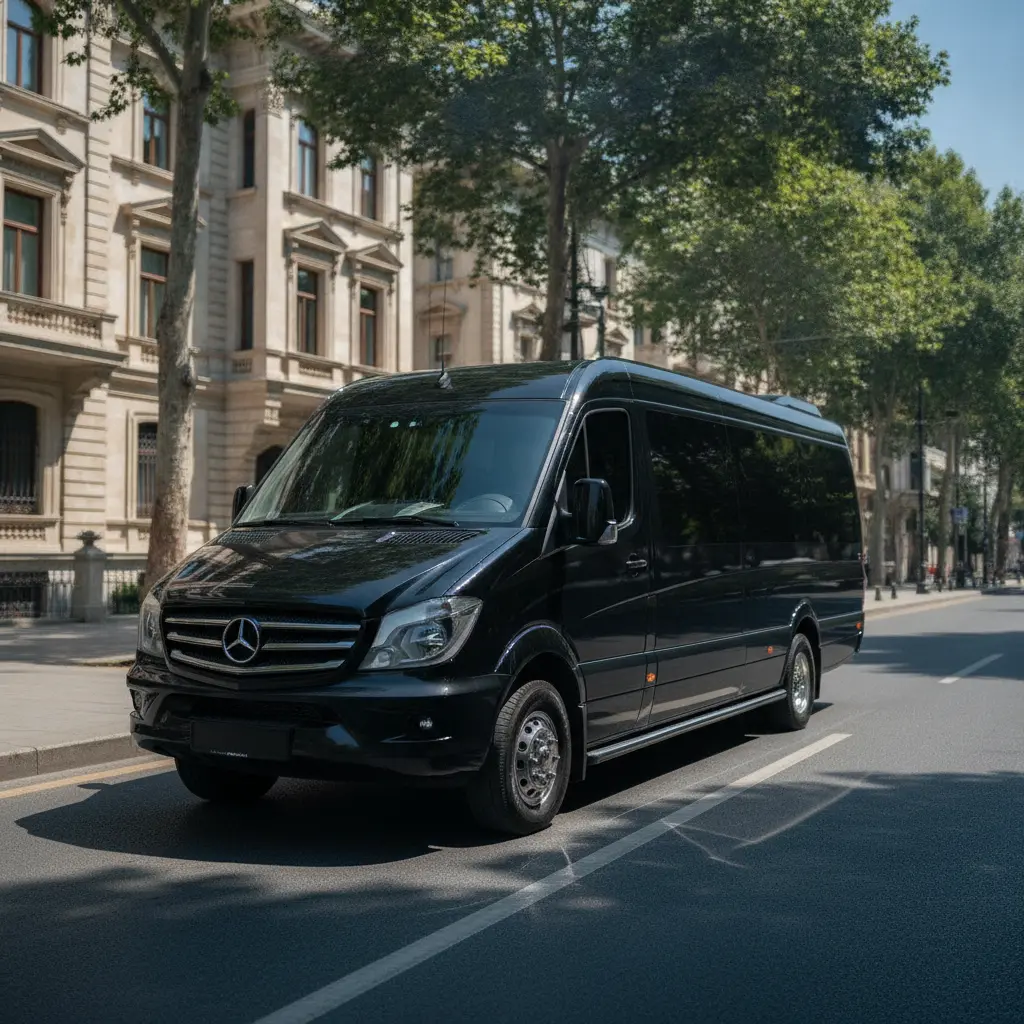
Mercedes Sprinter 8+1 VIP Limousine: First-Timer Rental & Price Guide

If this is the first time you are arranging a vehicle for a group and an 8+1 Sprinter has landed on your shortlist, three questions usually decide everything: how many people actually sit comfortably, what makes the price move, and which lines on the quote you should check before paying. This guide answers those three questions in plain terms. You can also view the Mercedes Sprinter 8+1 VIP limousine listing on Turlago to see capacity and service scope in one place.
What 8+1 actually means, and why it matters first
In rental listings, 8+1 describes seating capacity: eight passenger seats and one driver seat. The vehicle carries nine people in total, but one of them is the driver, so your group can never exceed eight. That extra one is not a spare seat you can sell to a ninth friend, and it is not a child seat. The most common first-timer mistake is booking an 8+1 van for a nine-person party and discovering the problem at the kerb, with luggage already unloaded. Confirm the headcount in writing before you pay.
Luggage is discussed far less than seating but causes far more trouble. Eight adults with eight large suitcases plus carry-ons will not fit into a standard Sprinter cargo area without compromise. If part of the luggage ends up at people’s feet, an airport transfer becomes uncomfortable within twenty minutes. When you enquire, state the number of checked bags, their approximate size and whether a stroller or golf bag is coming. A good operator will either confirm the fit or propose a longer-wheelbase vehicle rather than say yes to everything.
The word VIP is not a regulated standard. Every operator defines it differently. Some treat leather upholstery and ambient lighting as sufficient; others mean captain chairs, a small fridge, privacy curtains, a sound system and charging points at every row. Read the equipment list line by line and ask how the seating is arranged: two rows facing forward, 2+1 or 2+2, and whether three passengers sit shoulder to shoulder at the back. Brochure photos usually show the most flattering angle, so request an interior shot that includes the boot.
The seven line items that build the price
A VIP 8+1 rental price is never a single number. It is the sum of several components, and the gap between two quotes usually hides in the details below.
- Minimum booking block: Many operators apply a three- to four-hour floor even for a short city job. A 45-minute airport run may still be charged as a full block. Ask explicitly.
- Included mileage: Some quotes include a daily kilometre allowance and charge for every kilometre beyond it. A 40 km city loop and a 250 km intercity run are not the same product.
- Driver cost and overtime: Drivers have a defined working day. Returns after midnight commonly trigger an overtime rate.
- Fuel: Is it bundled into the rate, or is the tank settled on collection and return? On long routes this line matters more than people expect.
- Tolls, bridges and parking: On cross-city or Bosphorus-heavy itineraries, confirm who pays. If the contract is silent, you probably do.
- Tax and service fee: VAT included or excluded? A service fee added after the fact destroys any comparison you thought you had.
- Season and time band: Peak dates, weekends, public holidays and late-night departures can carry their own tariff.
The only reliable way to compare is to ask one identical question of every operator: for this date, this departure time, this route, eight passengers and this much luggage, what is the all-in total? Three answers to that question give you a real shortlist. A sentence like “our hourly rate is competitive” is an invitation, not information.
Hourly, daily or point-to-point: pick by the shape of your day
The right model depends on how much waiting is involved. Hourly hire means the vehicle and driver stay with you, which is the most flexible and the most expensive option, because the van cannot take other work during that window. A point-to-point transfer covers A to B and then releases the vehicle, which lowers the unit cost but leaves you without transport if plans change mid-day.
- Airport to hotel: Point-to-point wins. Fixed price, luggage assistance included, no waiting time to argue about. If your return flight is after midnight, ask about the night rate up front.
- A four-hour city loop: Hourly block. Enough for the historic peninsula, a Bosphorus stretch or a compact two-continent route.
- A full day out: Daily hire. Hotel pickup in the morning, two or three stops, return in the evening. This is the most common choice for weddings, corporate hosting and day trips.
- Multi-day or intercity: Daily hire plus driver accommodation and expenses. Here the mileage cap and the driver’s rest periods become the key contract clauses.
A practical rule: if the vehicle will stand idle for more than two hours, hourly makes sense; if the stops are fixed and the distance between them is clear, transfers are cheaper. When you need three separate drops and pickups in one day, a single daily block usually beats two separate transfers on both price and stress.
How to read the quote you receive
Before you approve anything, scan for these six items. When all six are present, the chance of a surprise charge drops sharply.
- Total price: One figure, taxes included, in writing. If it says plus VAT, do the arithmetic yourself.
- Scope: Date, time, pickup and drop-off points, passenger count and luggage count all stated.
- Mileage: Included kilometres and the per-kilometre overage written as numbers.
- Waiting policy: How many minutes are free if a flight is delayed, and the hourly rate after that.
- Cancellation and changes: The cut-off for a refund and the rules for moving a date.
- Vehicle and driver details: Model, model year, seat layout and a driver contact before the booking date.
Written terms bind the operator as much as they protect you. A price agreed over a messaging app is still an agreement, but when details are disputed, the document in your inbox is what counts. A short confirmation email settles most future arguments before they start.
Hidden costs that appear when you do not ask
People budget for the hourly rate and fuel, then get surprised by the side items. The list below covers the charges that typically appear on an invoice when they were never discussed at the quote stage.
- Waiting time: Traffic delays, flight delays or a group that comes down late from the hotel.
- Night tariff: Usually applied to returns after midnight.
- Extra stop: A fifteen-minute detour that falls outside the agreed itinerary.
- Parking and hotel access fees: Common in central hotels and historic districts.
- Bridge and motorway tolls: Often itemised on intercity jobs.
- Driver accommodation and meals: Required on overnight trips; it belongs in the contract.
- Overtime rate: The per-hour charge when a programme runs long, which is sometimes higher than the standard hourly rate.
- Cleaning fee: Smoking, pets or spillages inside the cabin.
- Deposit: Some operators place a card hold; the release period should be stated.
- Cross-border extras: Green card insurance, border permits and additional paperwork.
None of these is inherently unfair; most are normal in the industry. The problem is silence at the quotation stage. An operator who volunteers these lines before you ask is giving you a genuine signal about how the rest of the job will be handled.
Planning realistic routes and timings in Istanbul
Time planning is where rental budgets leak fastest. A 20 km journey that looks trivial on a map can take seventy minutes between 17:00 and 19:30. Build your programme around traffic windows rather than clock hours: keep short hops for the morning and evening peaks, and push long crossings outside them.
Airport choice changes the first leg of the day. Istanbul Airport is usually the shorter run for hotels on the European side, Sabiha Gökçen for the Asian side, but your arrival time and direction of travel can reverse that. Share the full hotel address and parking situation during booking. Some streets in the historic peninsula restrict large vehicles, and the van may have to drop you a couple of hundred metres away; with luggage and eight people, that detail stops being a footnote.
- Airport to a central hotel: Plan as a one-way transfer including luggage handling and check-in time.
- Historic peninsula, Bosphorus, Asian side: A single four-hour block comfortably covers three stops.
- Hotel to venue and back: A daily block is usually cheaper than keeping an hourly vehicle on standby until late evening.
- Intercity day trips: If you plan to return the same day, set the departure earlier than feels necessary and budget the return traffic.
Twelve questions to ask before you confirm
This is not a negotiation tactic; it is a checklist for blind spots. Get the answers in writing.
- Exactly which model and model year is the vehicle?
- How many seat rows, and is the rear bench a three-seater?
- How many large suitcases fit in the boot, and will a stroller fit?
- How many hours is the price based on, and is there a minimum?
- How many kilometres are included and what is the overage rate?
- Is driver waiting time included, and how is extra waiting charged?
- Who pays tolls, bridges and parking?
- Is VAT included in the quoted figure?
- What is the waiting policy if the flight is delayed?
- What are the cancellation and date-change terms?
- Can a child seat be provided, and is it free?
- Will the driver’s language ability and contact details be shared before pickup?
If half of these questions go unanswered, take another quote regardless of how attractive the price looks. An opaque quote rarely turns into a transparent service on the day.
Setting the right expectations inside the cabin
The word limousine suggests a stretched executive saloon. An 8+1 VIP Sprinter is a high-roof passenger van with captain chairs. There is no hot tub, no standing room to walk around and no party lighting rig. Knowing that in advance prevents the small disappointment of a group expecting a nightclub on wheels. Correct expectations make the actual experience better.
- Air conditioning: With eight people aboard, the rear row cools more slowly than the front. In summer, ask for the cabin to be pre-cooled ten minutes before departure.
- Boot access: If you will need the luggage area during the day, ask for cases to be loaded to one side rather than packed to the rear wall.
- Charging: Not every row has USB ports; bring a power bank.
- Sound system: Ask which connection types are supported: Bluetooth, aux or USB.
- Food and drink: Onboard refreshments vary by operator; check the rules on glass bottles and messy snacks.
- Smoking and pets: Prohibited by default; any exception should be agreed in writing.
- Child seats: Can be requested, but are not always stocked. Ask early.
- Reduced mobility: Mention step height and whether a ramp is needed at the booking stage.
8+1 versus 14+1 versus a Vito-class van
Vehicle choice is not about booking one seat more than your headcount; it is a balance between comfort and luggage. For eight people, an 8+1 is fully loaded: every seat is used and the boot is tight. Moving the same group into a 14+1 lowers the cost per person and adds space, but makes city parking and tight-street manoeuvring harder.
- 8+1 VIP Sprinter: Five to eight passengers, city work and airport transfers, corporate hosting. High comfort, limited luggage.
- 14+1 minibus: Nine to fourteen passengers, large families and teams. Lower cost per head, clumsier in old-town streets.
- Vito class (6+1): Three to five passengers with light luggage. The most practical and cheapest option.
- Midibus or coach: Twenty passengers and above. Needs separate parking permissions and route planning.
A useful tip: if you are eight with heavy luggage, price a 14+1 before trimming the group to seven. Occasionally the larger vehicle lands at the same total or below it, and the comfort gain is obvious.
Chauffeur-driven or self-drive: paperwork and insurance
For commercial passenger transport, the operator should hold a transport authorisation certificate and the driver a professional competence certificate. With self-drive, you are the driver: your licence class must match the vehicle weight, and the commercial insurance excess and exclusions become your problem. For a first rental, chauffeur-driven is almost always the lower-risk route, because traffic, parking, routing and penalties stay with the operator.
Whichever model you choose, ask for these documents before booking: vehicle registration and its suitability for hire or transport, passenger seat insurance, commercial comprehensive policy, driver documents and a sample contract. “We are insured” is not enough. Which policy, what limit, what excess? The amount that leaves your pocket after an incident is written on the excess line.
- On chauffeur-driven hire, fuel, tolls and parking usually sit with the operator; confirm this in the contract.
- On self-drive, traffic fines and damage excess pass to you.
- Cross-border trips need green card insurance and border permits, which can take days to arrange.
- Corporate bookings should settle invoicing, contract and payment terms as separate items.
Budgeting multi-day and intercity rentals
Price does not scale linearly with days. On longer hires, operators typically discount the daily rate, but new cost lines appear: driver accommodation, meals and legally required rest periods. When requesting a quote for a week-long programme, give the full picture at once: how many days, roughly how many kilometres, how many cities and how many overnight stops. A single all-in figure is far easier to compare across two operators than a list of unit rates.
On intercity jobs, the mileage cap is the most important clause. A phrase like three hundred kilometres per day included can generate a significant extra charge on a nine-hundred-kilometre three-day route. Driver rest periods are also legally defined; programmes that require a second driver cost more but are safer. Put both items on the table at the same time rather than discovering the second one later.
Three variables that move the price most: season, day and hour
Same vehicle, same route, same duration, different date, different price. Demand drives it. Summer months, public holidays, wedding season and major event weeks strain fleet capacity. Prices rise and the specific specification you want becomes harder to find, which makes early booking an availability decision as much as a financial one.
Weekday versus weekend and time of day matter just as much. A Friday evening start and a Tuesday morning start are not priced alike, and returns after midnight attract overtime. If your dates are flexible, shifting by a single day sometimes produces a noticeable saving. Ask for that option when you request the quote.
How to assess the listing on Turlago
Do not judge a listing by the photograph and the price alone. Check whether capacity is stated separately for passengers and luggage, whether the service scope (driver, fuel, waiting time) is spelled out, and whether cancellation terms are visible. On the Mercedes Sprinter 8+1 VIP limousine page you can review that information on one screen and check availability against your own dates and headcount.
If the vehicle will do more than shuttle between two points, combining plans reduces the total cost. When the same day includes both a transfer and an evening programme, one daily block usually beats two separate bookings. If you are planning the Bosphorus dinner and entertainment cruise, for example, structure the van around hotel-to-pier and pier-to-hotel legs. If a different kind of evening appeals, you can also weigh the private yacht charter alternative in Istanbul, but leave at least forty-five minutes of buffer between the two programmes. Anyone building an outbound itinerary should price the airport leg separately, even on packaged trips such as this flight-inclusive Baku tour.
Five mistakes first-timers make
- Treating the +1 as a passenger: an 8+1 does not carry nine guests. State the headcount clearly.
- Not mentioning luggage: if bag numbers are not in writing, you will be solving it at the kerb.
- Comparing hourly rates only: without minimum blocks, mileage and VAT, the comparison is meaningless.
- Ignoring waiting and night charges: one delayed flight or one late-finishing wedding changes the budget in a single line.
- Skipping the written quote: a verbal agreement will not protect you when details are disputed.
The short version
Do it in three steps: settle the group and the luggage first, write the programme out as times and stops second, and only then compare all-in totals from three operators. Once those three steps are done, the question shifts from “did I overpay?” to a simple table you can actually read.
A VIP 8+1 Sprinter, planned properly, lets a group run an entire day with one vehicle and one invoice. You can check the Mercedes Sprinter 8+1 VIP limousine rental on Turlago, enter your date and party size, and confirm availability. Sending the twelve questions above along with your enquiry shortens the whole process considerably.