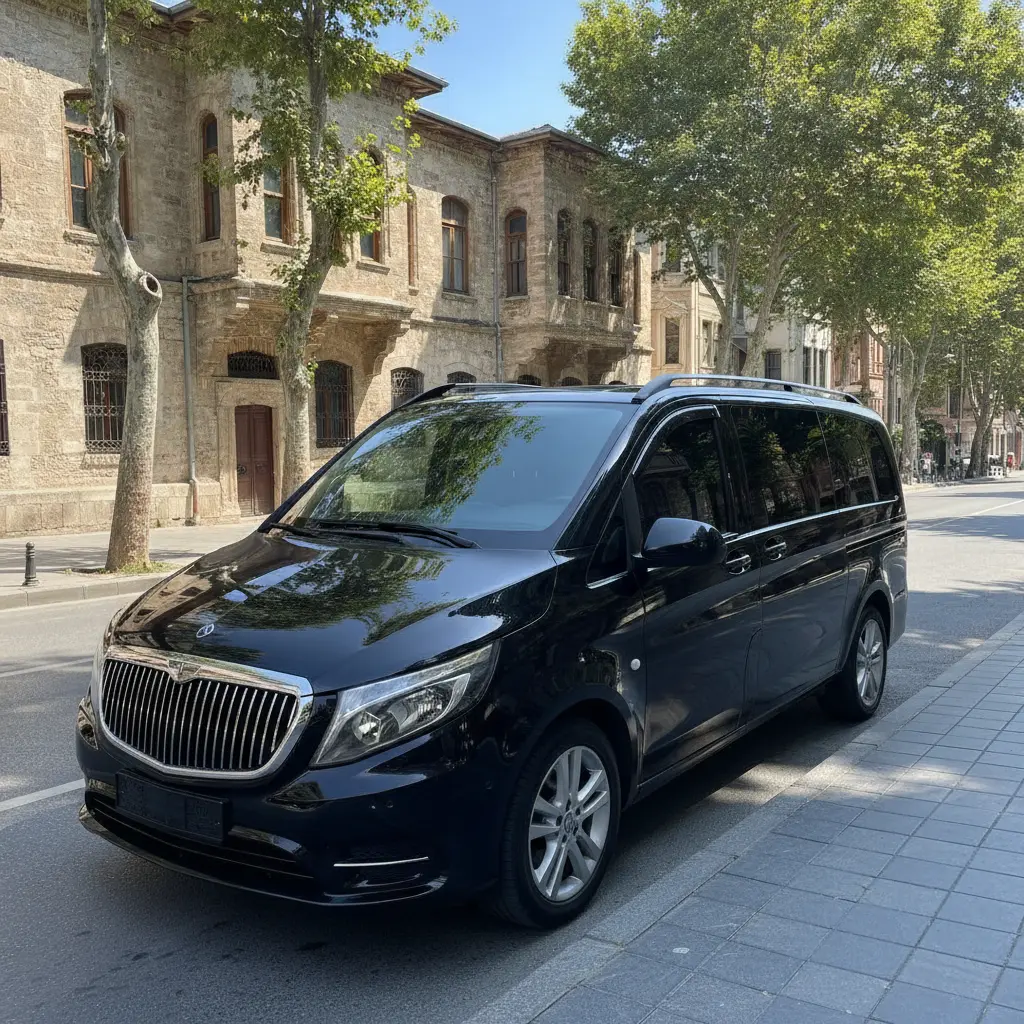
Mercedes Vito 4+1 with Driver: Transfer or Day Hire?
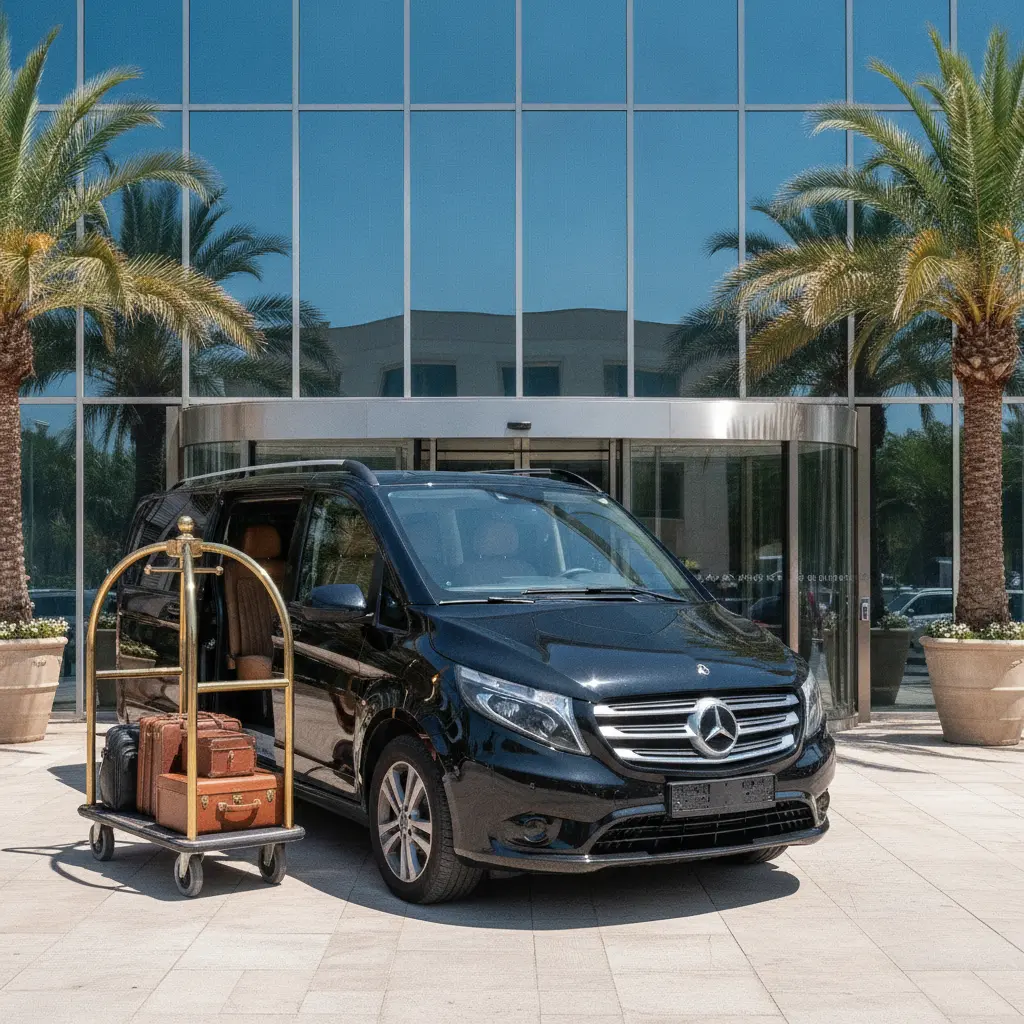
The short answer: transfer for one leg, day hire for several
When you price a chauffeured Mercedes Vito 4+1, the number that moves the total is not the vehicle class. It is how many times you move during the day. If you are picked up in one place and dropped in another — airport to hotel, hotel to a meeting — a point-to-point transfer is almost always the cheaper option, because you are paying for distance and driver time, not for the exclusive use of a vehicle all day.
Reverse that logic and the picture flips. Two, three or four separate legs with waiting in between, and an hourly or full-day package starts to do more work for the same money. The vehicle and driver are blocked for you, so the second and third stops cost little or nothing extra. This guide compares the two models through their pricing logic: what actually builds the quote, how to find your own break-even point, and which questions to ask before you commit. You can review the service scope and current options on the Vito 4+1 chauffeur-driven vehicle rental page on Turlago.
Compressed to three lines:
- One stop, one drop-off, heavy luggage: transfer.
- Three or more stops with waiting in between: hourly or day hire.
- Two stops, short total time: whichever quote has the lower all-in total — and the deciding factor is usually how transparent each line item is, not the headline number.
The rest of this article unpacks that. I deliberately do not quote fixed prices: rates shift with date, route, vehicle age and season. What follows is the method that lets you put two quotes side by side and choose correctly.
The seven items that build a chauffeured Vito quote
Two quotes can look identical and be completely different services. To see why, break the price into its components and ask about each one separately.
1. Distance and route
On point-to-point transfers, kilometres are the backbone of the price. Even within one city, an airport run, a city-centre hop and a distant resort area sit in different brackets. Day hire usually includes a mileage allowance; exceed it and per-kilometre charges apply. A "full day" quote with no stated mileage limit is a red flag — on a long out-of-town itinerary it can quietly become the most expensive option on your shortlist.
2. Time and waiting
Transfer quotes are typically priced without waiting time. If your flight is delayed or check-out runs late, the meter starts. On a day hire, waiting is already inside the price. That single difference decides the total in any itinerary where a one-to-three-hour delay is plausible.
3. Driver hours and night rates
Driver time is a finite resource. A 05:00 airport pickup and a 14:00 pickup do not cost the same to operate. Night windows, public holidays and religious holiday periods commonly carry a surcharge. "Is there a night rate for this time?" is a one-sentence question with real budget consequences.
4. Fuel, tolls and parking
Fuel is usually included. Motorway and bridge tolls, airport access fees and hotel or mall parking often are not. Day hire accumulates these faster: every shopping centre stop is a parking fee, every cross-city run is a toll. Asking "are tolls and parking included?" is what makes two quotes genuinely comparable.
5. Season and demand
The same route costs differently in high summer, during a congress week or across a public holiday, because vehicle and driver supply is fixed while demand is not. If your dates are flexible, shifting by a single day can change the economics of the same service.
6. Vehicle class and extras
4+1 is a class definition, but inside that class you will find differences in vehicle age, seating layout, leather trim, Wi-Fi and onboard refreshments. These raise the price and, in business travel or hosting scenarios, they do shape perception. If the budget is tight, this is the first place to trim: the core job — arriving on time, clean and safe — does not depend on these extras.
7. Invoicing and tax
The most commonly skipped item for corporate bookers. Is VAT included or added? A properly invoiced price and a cash price are not the same figure, and mixing them destroys the comparison. If you are booking on a company account, ask for the "invoiced, VAT-inclusive total" from the start; retrofitting it later is difficult and sometimes impossible.
Where the meter runs: the real difference between the two models
One sentence separates them. On a transfer, the meter runs on distance. On a day hire, it runs on time. Everything else follows from that.
With a transfer, the driver collects you, drops you, and the job ends. The vehicle was never reserved for your day; it can take other work. That is why a single leg is competitively priced. But when the job ends, the vehicle leaves. Need a second leg and you are booking again, with a new wait risk and a new price.
With day hire you block the vehicle and driver for a window. Because the meter runs on time, the second and third stops carry marginal — often zero — additional cost. Compare three separate transfer quotes against one day-hire quote on a three-stop day and the gap usually opens clearly in favour of day hire. The critical threshold tends to be the second stop: at one stop, transfer wins; at two, they converge; at three, day hire wins.
To apply that to your own itinerary you need both quotes on equal terms. The method below does exactly that.
Find your break-even in four steps
- List the legs. Write out every movement in the day: 09:00 leave hotel, 10:30 meeting, 13:00 lunch, 16:00 hotel, 19:30 dinner, 23:00 return. The list alone usually settles which model you should be discussing.
- Price each leg as a separate transfer. Add waiting charges, night rates, parking and tolls. Do not stop at the base fare.
- Get one day-hire quote with a defined scope. How many hours, how many kilometres, is waiting included, are tolls and parking included, and who covers the driver's meal and accommodation?
- Compare like with like. If the day-hire quote excludes parking, add parking to the transfer total. If the transfer total includes VAT, request the day-hire quote VAT-inclusive.
Two numbers come out of this and they make the decision. One caveat: if the gap is small, flexibility wins. When the two models land close together and your schedule might change, day hire is the smarter buy — a plan change costs you nothing extra.
Scenario-by-scenario: which one wins where
Airport to hotel, one way
The classic transfer case: one leg, heavy luggage, arrival time uncertain because flights slip. Booking day hire here is almost never sensible — you would be paying for the vehicle to sit idle while your flight is delayed. The only critical questions are how much free waiting is included after landing, and how the hourly wait charge is calculated afterwards.
Hotel → meeting → lunch → hotel
Four legs with gaps. The two quotes usually land close, and waiting time decides it. If the meeting overruns by an hour, the transfer model starts charging; the day hire does not move. That predictability is why corporate travel tends to default to day hire.
Weddings and milestone events
Here cost matters, but schedule discipline matters more. One day can involve five or six movements: home, salon, photo location, ceremony, venue, return. Pricing each as a separate transfer is both expensive and fragile — one delay cascades through everything. A day hire absorbs delay because the vehicle is already standing by. If you are moving guests onto an evening Bosphorus programme afterwards, put that leg into the same day plan; you can view private event boat options on Turlago and build a single timeline for road and water.
Full-day out-of-town itinerary
The mileage limit decides everything here. Fuel, tolls and driver hours all grow together once you leave the city. "How many kilometres are included, and how is the excess calculated?" is the single question that most affects your total. If the driver has to return the same evening, that return trip is also working time — clarify it upfront.
Three days of hosting guests
Keeping a vehicle and driver on standby for three days looks like the most expensive option per day. But compare on the total number of movements across those three days: morning pickups, midday programmes, evening returns, a different district each day. At that density, the transfer model becomes both costly and operationally tiring. This is where multi-day packages take over and the per-day cost drops.
Twelve questions to ask before you compare quotes
- Is VAT included in this price?
- Are hotel and mall parking, bridge and motorway tolls included?
- Is the airport access fee a separate line?
- How much free waiting is included if my flight is delayed?
- How is waiting charged after that — by minute or by hour?
- When does the night rate start and end?
- Is there a surcharge on public holidays?
- How many hours and kilometres does the day package include?
- What are the per-hour and per-kilometre charges beyond those limits?
- Who covers the driver's meals and, if relevant, accommodation?
- Is an extra stop (pharmacy, ATM, second address) chargeable?
- What are the cancellation and amendment terms, and until when are they free?
Six of these are about price and six are about risk. The second group never looks like money on the quote, yet it is where the expensive surprises come from.
What "4+1" actually means: capacity and luggage planning
In the industry, 4+1 generally means four passengers plus one driver. The fact that the vehicle itself can carry more seats does not make the four-passenger guideline arbitrary: for comfortable travel with luggage, it is the practical limit. Three things deserve attention.
Passenger count
Four adults sit comfortably in the rear on a long intercity run; add a fifth and both the seating layout and the luggage bay get tight. For larger families or work teams, the alternatives are a second vehicle on the same booking or a move up to a larger minibus class. Comparing the combined cost of two vehicles against the larger class is where genuine savings appear.
Luggage volume
On airport runs the bottleneck is luggage, not seats. Four travellers with four large suitcases plus carry-ons need that declared at booking. Get a clear answer to "how many large cases, how many cabin bags?" If the luggage does not fit, the fallback is a second vehicle — and at short notice that vehicle may not exist.
Child seats and special requirements
Child seats and boosters are usually available on request, but ask whether they are free or chargeable. Strollers, wheelchairs and sports equipment belong in the luggage calculation too. Last-minute requests of this kind are among the most common causes of booking-day friction.
Does multi-day hire beat day hire on price?
Usually yes — but only if your utilisation is high enough. The logic: a single-day package carries fixed costs such as vehicle preparation, cleaning and reserving the driver for that day. Take the same vehicle and driver for three to five consecutive days and those fixed costs are spread across more days, so the per-day rate falls.
An honest caveat: multi-day hire only wins if you are using full days. If two of your three days need the car for only two hours, booking those as individual transfers may be cheaper. The correct approach is to label each day: full day, half day, single leg. Put full days into the multi-day package and single legs into transfers. A mixed plan is almost always cheaper than either pure option, and more travellers do this than you would expect.
For multi-day bookings, also settle driver accommodation, vehicle parking and the average daily mileage in advance. If overnight stays outside the city are involved, that item is usually separate and can be a meaningful share of the budget.
Timing: when should you actually book?
Chauffeured vehicles do not behave like airfares. Pricing is not dynamic in the same way, but supply is finite — so "it will get cheaper last minute" does not hold here. It works the other way. In summer, during congress and trade-fair weeks, and around public holidays and New Year, fleets fill early and whatever remains is priced higher.
- Airport transfer: one to two weeks ahead is enough; booking much earlier rarely buys you a better rate.
- Day hire (weddings, events, corporate): three to six weeks ahead, and lock the date.
- Multi-day / long-term: one to two months ahead; early booking is what secures the same vehicle and driver throughout.
- Peak season (July–August, public holidays): one month ahead regardless of the model.
If your dates are flexible, ask about the weekday versus weekend difference. Events and weddings cluster at weekends, while corporate demand stacks up on weekdays — which days are quieter varies by city, and it is a one-minute question at booking.
A quick comparison with self-drive rental
The obvious budget question is whether driving yourself would be cheaper. Sometimes yes, often no. On a self-drive rental, fuel, tolls, parking, the time spent hunting for a space and the energy spent in traffic all become yours. In a dense city centre, parking fees and search time add an invisible layer to the total. Add unfamiliar road rules and an unknown route network, and on a short city programme the price gap to a chauffeured service closes quickly.
Self-drive makes more sense on longer stays and for travellers with a daily routine. On short visits, with a group and a tight schedule, a chauffeured vehicle buys back time — and time is the most concrete line item in this whole comparison.
Filling the gaps: making the waiting time work for you
The financial advantage of day hire is that standing time costs nothing extra. Using that time well is the most practical way to get more out of the same budget. If your dinner reservation is at 20:00, the vehicle can collect you at 18:00, drop you at the venue, wait while you eat and take you back afterwards. That sequence is cheaper and calmer than summoning separate transfers in each direction.
If you are planning an evening in Istanbul, building the road plan around the event makes sense: pair a Bosphorus dinner and entertainment cruise with your vehicle leg and the arrival and return times line up. For a quieter, more personal evening, a private-table Bosphorus dinner with a Turkish night programme slots into the same day plan just as easily — pickup, drop-off and return managed on a single timeline.
An eight-question decision checklist
- How many separate stops will I make today? (3+ → day hire)
- Will I wait more than an hour between stops? (Yes → day hire)
- Would a flight delay wreck my plan? (Yes → transfer is safer)
- Do I have more than four large suitcases? (Yes → declare capacity at booking)
- Could my schedule change during the day? (Yes → day hire)
- Is there a late-night return? (Yes → ask about the night rate)
- Do I need an invoice? (Yes → request a VAT-inclusive quote)
- Might a second vehicle be needed? (Yes → recalculate the total)
If four or more answers point to day hire, stop collecting transfer quotes. If most point the other way, paying for a full day to cover one leg is simply wasted budget.
Conclusion: the answer is the shape of your day
There is no single cheaper option in chauffeured Mercedes Vito 4+1 rental. The answer sits in how many legs your day has. One stop, one drop-off and uncertain waiting: a transfer is both cheaper and more predictable. Three or more stops, long waits and a schedule that may shift: day hire does far more work for the same money. The mixed plan is usually smartest — full days into a package, single legs into transfers.
Compare scope, not just the headline figure: VAT, parking, tolls, waiting, night rates and the mileage limit. Until those six items are clear, no two quotes are genuinely comparable. Equalise the scope first, then talk about the total.
To see the vehicle, the inclusions and the booking terms, view the Vito 4+1 chauffeur-driven vehicle rental on Turlago and settle the transfer-versus-day-hire question for your own dates. Writing your itinerary down a day in advance is what lets you ask for the right scope — and avoid paying for line items you never needed.