25-Person Comfortable Yacht Charter: Which Group Fits?
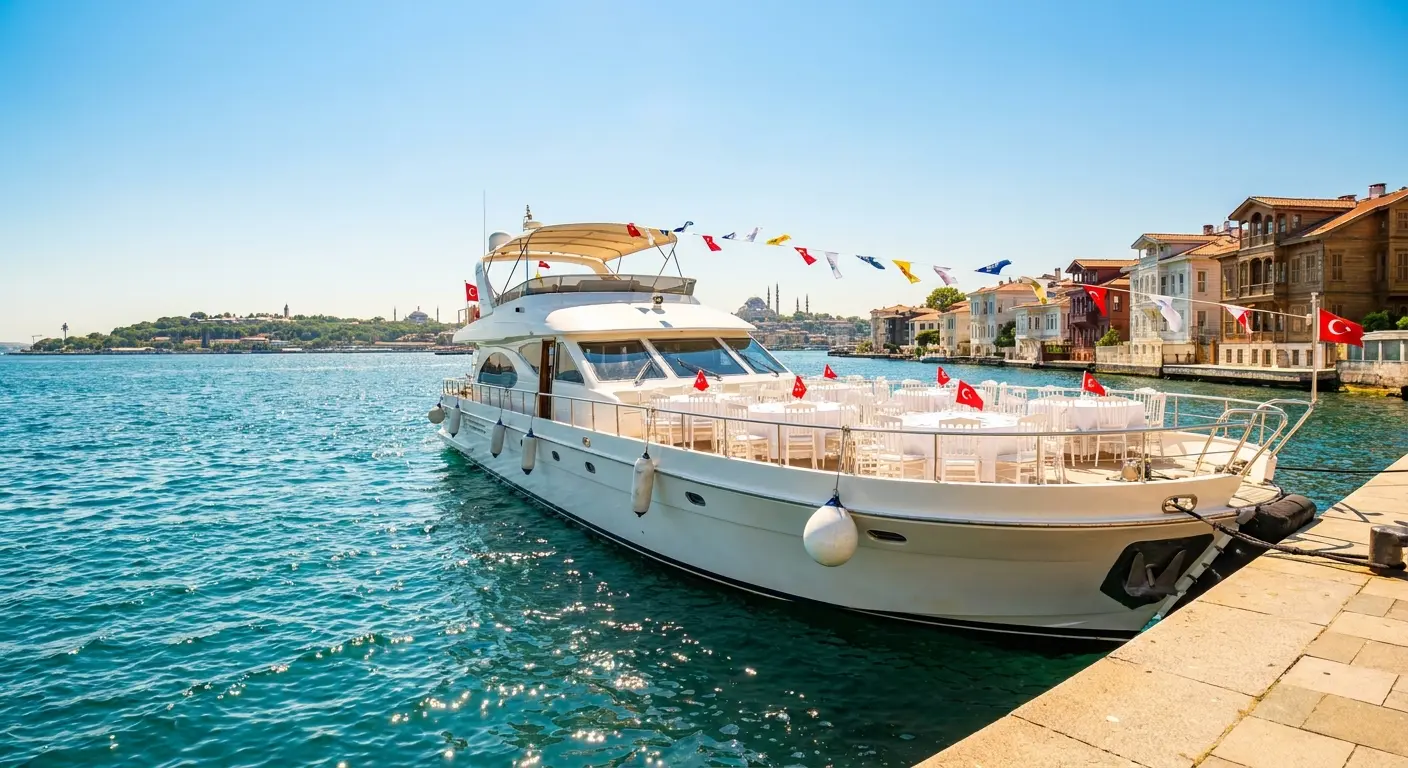
The short answer: a 25-person yacht is close to perfect when your group is somewhere between 18 and 25 people, and it is oversized and overpriced when your group is between six and ten. The real decision, then, is not about the boat at all. It is about how your group intends to spend the day. This guide uses one specific vessel as the reference point — the 25-person comfortable yacht charter you can view on Turlago, a 19-metre motor yacht departing from Ayvansaray Pier — and compares it against other yacht types on the criteria that actually change the outcome: capacity, onboard equipment, charter duration, food arrangements and cost per person.
The most expensive mistake in boat chartering is not picking the wrong vessel. It is filling the right vessel with the wrong group. Booking a 25-person capacity for eight guests wastes your budget on empty deck space. Forcing 25 guests onto a 12-person boat ruins the day before it starts. The space between those two errors can be navigated with a handful of clear criteria.
The capacity maths: is 25 people actually comfortable on a 19-metre boat?
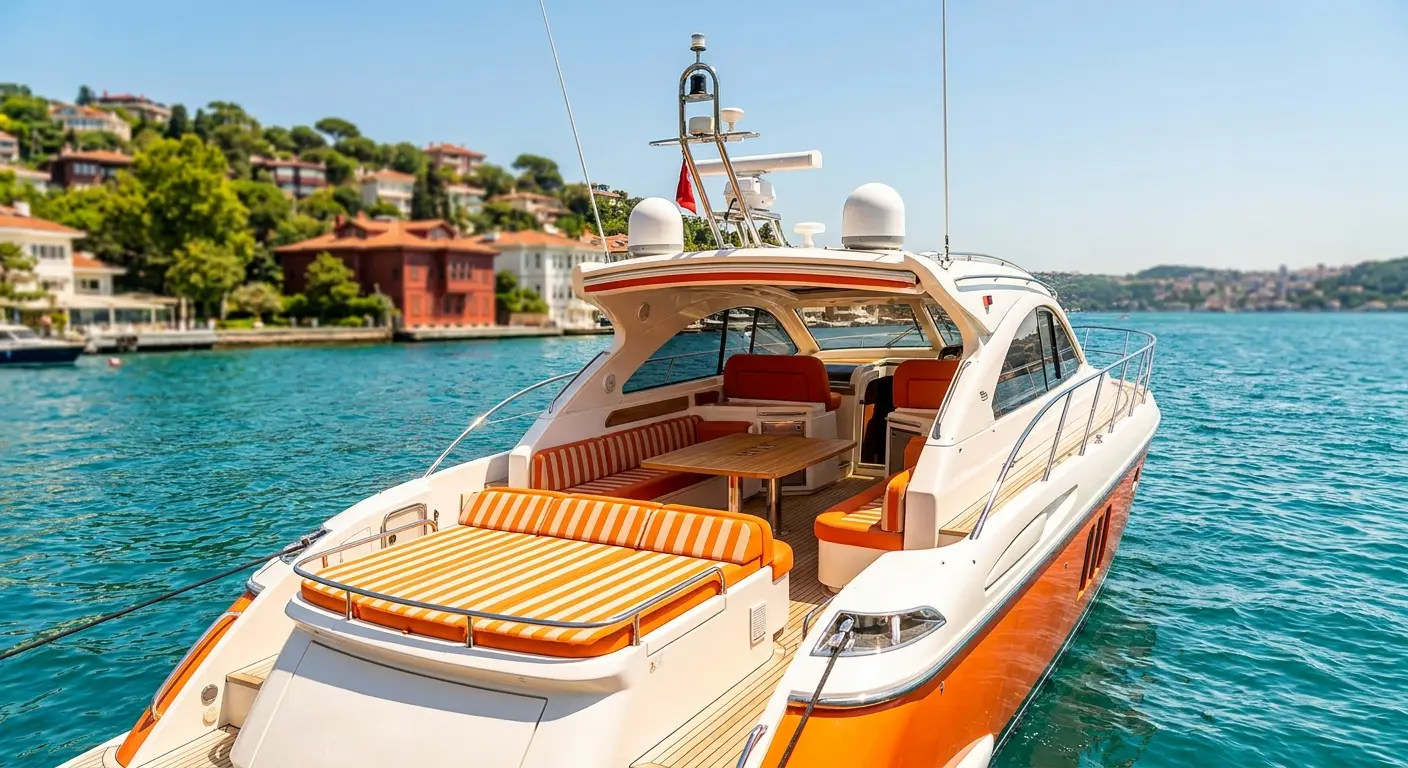
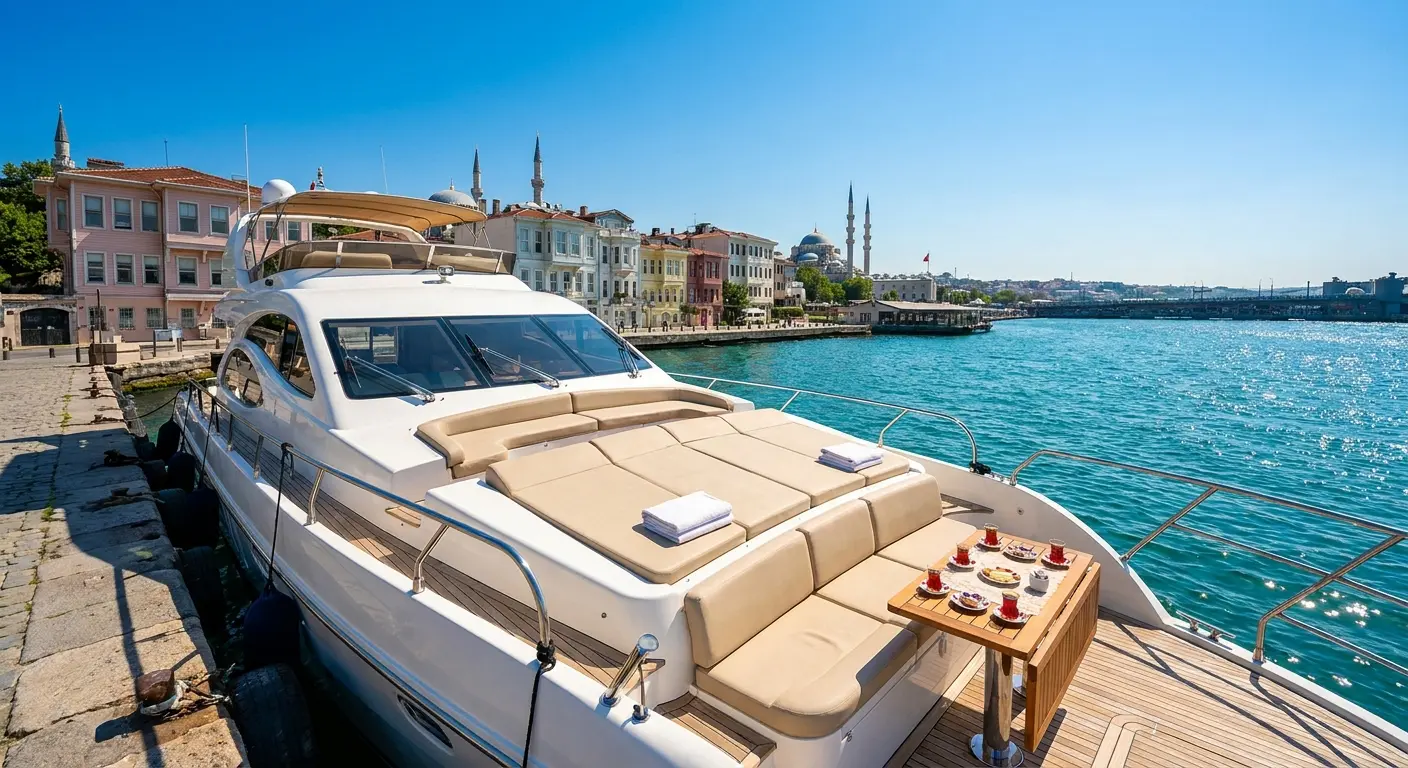
Never judge a boat by its headline number alone. Two figures matter together here: capacity of 25 guests and a length of 19 metres. On a 19-metre motor yacht, 25 people does not mean a single crowded crush of bodies, because the boat is not one open space. It is layered:
- Spacious sun deck: where guests who want sun, lounging and photographs naturally settle.
- Enclosed seating area: a separate zone for sitting around a table, talking, or staying out of the wind.
- Swim ladder and platform: swimmers and deck-sitters physically separate, which is the single biggest reason 25 guests do not feel like 25 guests.
When you plan, put three numbers side by side: your guest count, your charter type and your duration. Twenty-five people is not one fixed experience; density changes with the format:
- 25 guests on a catered cruise: the tightest scenario, because everyone needs to sit at the same time and service has to be sequenced.
- 25 guests on a swimming cruise: the most comfortable format, since the group constantly redistributes between the water, the deck and the saloon.
- 25 guests at full capacity: a limit case. Kitchen access, the bathroom and the service flow all need to be planned around it.
One honest note about this listing: it does not yet carry customer reviews. Treat that as a reason to lean on the declared equipment list and on a proper pre-booking conversation with the operator rather than on social proof. In practice, a newly listed boat often comes with more flexible pricing and more available time slots than a fully booked one, so early bookers get the better deal.
What is actually onboard: the equipment inventory, item by item
Compare boats on concrete features, not on atmosphere adjectives. This vessel declares the following:
- Spacious sun deck
- Enclosed seating area
- Television
- Sound system
- Heater, making the boat usable in cooler months
- Bathroom (WC)
- Swim ladder
- Dedicated shower area for swimming cruises
- Free use of the kitchen
- Complimentary tea and coffee
- Barbecue service available at an extra charge
- Pets welcome
Three items carry more decision weight than the rest. First, the heater: Istanbul's boating season stretches from late April into mid-October, but a 9 a.m. departure in April or October can be chilly on deck. A heater keeps the group inside and the trip salvageable. Second, free kitchen access: preparing your own food is the fastest way to cut cost per person. Third, the swim ladder and dedicated shower area: for any group planning to swim, these two decide whether the day works at all.
Then there are the things that are not on the list and that you should ask about directly: the number of life jackets, including child sizes; how much shaded area exists; whether you can pair your own playlist to the sound system; and how many crew members will be aboard. Those four answers shape the day more than any brochure photo.
Group-by-group decision guide
The same boat means different things to different groups. Find the scenario below that resembles yours and the decision becomes fast.
Families and multi-generational groups
The most natural user of a 25-person capacity is an extended family. When grandparents, parents and children share one boat, the core requirement is accommodating different speeds and different comfort expectations at the same time. This vessel solves it with two separate zones: the enclosed seating area and the upper sun deck. Older guests sit in the shade while children move around on deck and enter the water during swim stops.
Two practical details decide family trips. The first is the bathroom and shower: with children and three generations aboard, this matters far more than most people assume, and having it available is a genuine advantage. The second is free kitchen access: families usually prefer to bring their own food and give children something familiar. This boat does not restrict that. For families who want to bring a pet, the fact that pets are welcomed onboard is an underrated differentiator that rarely appears in comparison articles.
Couples and small groups: this boat is probably too much
Let us be candid. A couple, or a group of six to eight friends, spends most of its budget on space it will never use. An hourly rate of 3,750 TRY is very reasonable for a 25-person capacity — but that same money buys a far more intimate, more boutique experience for eight guests. The right question for small groups is this: Is this a transport-and-sightseeing decision, or a privacy decision?
If privacy is the goal, a classic and elegant lobster motor yacht delivers more character with fewer people. If a large, loud celebration is the goal, the 25-person boat is the right address. Groups of ten to fifteen sit in between, and the tie-breaker is simply how many hours you intend to spend standing on deck.
There are exceptions worth naming. Small groups sometimes deliberately charter a bigger boat: a working kitchen, an enclosed saloon and a television all act as insurance against weather changes. Sudden wind shifts on the Bosphorus are not rare, and being able to retreat into an empty saloon instead of huddling on a crowded deck is exactly what some groups are paying the extra money for.
Corporate events and client hosting
For corporate groups, capacity alone is not a criterion. Controllability of the presentation is. A team or client group of 25 sits comfortably thanks to the enclosed seating area, the sound system allows announcements or short presentations, and complimentary tea and coffee means refreshment rounds do not surprise your budget line.
Three things need attention in corporate use. First, outside food, drinks and alcohol may be brought aboard, but service is charged separately. Settling that line item in advance prevents an awkward invoice at the end of an event. Second, pets are accepted, which rarely matters for client hosting but is a genuine plus for employee events. Third, at full capacity the bathroom and service flow need to be scheduled sensibly. A two-hour block is usually too short for 25 people once boarding, greeting and seating traffic is counted; three to four hours is the practical minimum for corporate groups.
Friend groups and celebrations
Birthdays, bachelorette parties, graduations, anniversaries, or simply a large weekend reunion: a 25-person capacity gives friend groups the widest possible range of movement. Combining a swimming cruise with a catered cruise on the same day is realistic here, and so is adding barbecue service to an evening meal on deck.
What decides success in friend groups is not the boat but the schedule. Expecting 25 people to be entertained simultaneously is unrealistic. Build two or three activity islands across the day instead: music and deck time on departure, a swim stop in the middle, food at the end. Groups that achieve this rhythm never feel crowded, even at full capacity.
If your day leans heavily towards party energy, it is worth comparing this 19-metre motor yacht against a party-equipped 23-metre yacht before committing. If you want something smaller and calmer, look at a private occasion party boat as well. The same budget buys very different atmospheres across boat types, and that difference is the whole point of comparing.
The decision checklist: five questions, five answers
- Is your group between 18 and 25 people? Then you are using the capacity efficiently and cost per person drops to its lowest level.
- Will you organise the food yourselves? Free kitchen access and permission to bring outside food make this boat a strong choice for catered trips.
- Do you plan to swim? With a swim ladder and a dedicated shower area, the plan runs smoothly. Without them, swimming becomes uncomfortable fast.
- Is it a shoulder-season date? A heater and an enclosed seating area are the two features that rescue a trip in April or October.
- Privacy or crowd energy? Small groups seeking privacy are better served by more boutique vessels; large celebrations are best served by a 25-person capacity.
Read these together and the strengths of the 25-person comfortable yacht become clear: extended families, corporate teams, charters of four hours and up, catered events, and swimming-focused days. Its single weakness is equally clear: short trips booked by small groups who want privacy.
Reading the 3,750 TRY hourly rate correctly
Pricing here is hourly, at 3,750 TRY per hour. The correct way to evaluate that number is to divide it by the people on board. At full capacity — 25 guests — you are looking at roughly 150 TRY per person per hour. For a large group in Istanbul, that is extremely competitive; a dinner for 25 in a restaurant often costs more.
Run the same sum for ten guests and the cost climbs to roughly 375 TRY per person per hour. That gap is the clearest possible argument that this boat is not economical for small groups:
- 25 guests: roughly 150 TRY per person per hour — peak efficiency.
- 18 guests: roughly 208 TRY per person per hour — still a strong choice.
- 12 guests: roughly 313 TRY per person per hour — borderline.
- 8 guests: roughly 469 TRY per person per hour — compare boutique alternatives at this price.
Do not plan your budget around the charter fee alone. The full picture usually includes the boat rental, the food and drinks you bring, the service charge if you want serving staff, barbecue service at an extra cost, and personal spending. Complimentary tea and coffee removes a small but frequently repeated expense, and on a long, crowded day that adds up to a real saving.
Handling the food yourself increases the advantage further. Because kitchen use is free, cold plates and simple mezze prepared for 25 guests is both the most economical and the most time-efficient route. For formal corporate or client events, paying for service lets you stay in the host role all day rather than running a kitchen.
Duration: what two, four and eight hours actually buy you
Duration shapes quality more than most people expect, and the effect grows with group size — because 25 guests take time to board, settle, greet and serve.
- Two hours: enough for a short taste of the water. Do not plan a swim stop; with 25 people, departure and return consume nearly the whole window.
- Three hours: the practical minimum for corporate gatherings and light celebrations. One swim stop fits, tightly.
- Four hours: the best balance for larger groups that want both a swim stop and a meal schedule. The group settles, the rhythm forms, nobody rushes.
- Full day: for groups that want the catered cruise, the swimming cruise and full-capacity use all in one. Ideal for extended families and friend groups.
Ask yourself one practical question: at what point in the day will half of a 25-person group be sitting down and talking? If your answer is under three hours, your charter is too short.
Season by season: what each month means for this boat
The heater and enclosed seating area make this yacht usable well beyond midsummer. Set expectations accordingly:
- April and October: daytime temperatures swing. The heater and saloon rescue the trip; confirm sea and weather conditions with the operator if you plan a swim stop.
- May and June: the most balanced period, with the sun deck and saloon complementing each other. The most efficient window for large groups.
- July and August: the true season for swimming cruises and the shower area. Boats and time slots disappear quickly on busy dates, so book early.
- September: still warm enough to swim, with smaller crowds. Often the smartest combination of price flexibility and comfort.
Shoulder months are consistently more flexible on price and availability. For large groups, that flexibility translates directly into more hours on the water for the same budget.
Ten questions to ask before you book
- What is the recommended minimum duration for our group size?
- How many life jackets are aboard, and are child sizes available?
- On a catered cruise, how is the table set up, and how many seated places are there?
- What does barbecue service cost, and how many guests does it cover?
- How is the service charge calculated if we bring our own food and drinks?
- Which kitchen equipment is available: fridge, stove, plates and cutlery?
- Can we connect our own playlist to the sound system?
- How many crew members will be on board?
- If we plan a swim stop, where and for how long?
- Are there any restrictions for bringing a pet?
Groups that ask these ten questions in advance almost never encounter a surprise. Groups that skip them tend to complain not about the vessel but about unclear expectations they never set in the first place.
The five most common booking mistakes
- Choosing capacity instead of choosing a headcount. A 25-person boat does not require you to bring 25 people.
- Cutting duration too short. On large groups, a two-hour charter shrinks dramatically once boarding and service traffic are counted.
- Leaving the food plan to the last day. Free kitchen access is a big advantage, but only if someone plans the shopping and prep.
- Assuming pet policies rather than confirming them. Pets are welcomed on this boat, yet confirming before you arrive is always the smarter move.
- Booking a crowd when you wanted privacy. Groups looking for a calm, intimate day will not find it on a 25-person vessel.
Conclusion: which group should make which call
Simplify the decision. If your group is 18 to 25 people, if you are planning a catered or swimming-focused day, and if you intend to stay out for at least four hours, this is the right boat — and the 3,750 TRY hourly rate reaches its most efficient form per person. Extended families, corporate teams and large friend groups all fit that profile.
If your group is under ten people, or if the day is really about privacy and a boutique atmosphere, a smaller and more characterful vessel will serve you better at the same budget. For milestones such as birthdays, anniversaries or engagements, that balance matters most of all; comparing occasion-focused boats is the step that sets the tone of the celebration.
Wherever you land, the final step is the same: state your expectations to the operator openly, and build the schedule around the duration rather than squeezing the duration around the schedule. Used by the right group with the right plan, this 19-metre motor yacht comfortably carries a large Istanbul day on the water. To see the full details, current pricing and availability, view the 25-person comfortable yacht charter on Turlago and plan your reservation directly on the platform.