Antalya Airport to Hotel Transfer: Planning for a Big Family

The Yildiz family booked their holiday early this year: ten days in Belek, at a resort right on the water. The holiday itself was never the problem. The beginning was. Their flight lands at Antalya Airport at 23:40, and the group is not small: two grandparents, two parents, a nine-year-old, a six-year-old, and a toddler of eighteen months. The luggage tally is equally unhelpful: four large suitcases, two cabin bags, a stroller, and a folded buggy they refused to leave behind. That means seven people, nine pieces of luggage, and roughly thirty-five kilometres of road at midnight.
What follows is not a generic explainer about airport transfers in Turkey. It is the actual decision sequence the Yildiz family worked through, in order, including the part where they almost got it wrong. Because an Antalya airport to hotel transfer for a big family is not simply a two-person transfer scaled up. It is a chain of dependent decisions: luggage volume, terminal building, child seats, arrival buffer, and the return leg. Follow their case and you can build your own plan.
The case: a 23:40 landing, seven people, nine bags
The family's first mistake was assuming they would "sort the transfer after the tickets." For a group landing late, carrying too much luggage and travelling with a toddler, the transfer is not an afterthought — it is as critical as the flight itself. At close to midnight, a taxi queue, a missing luggage trolley, sleepy children and one wrong terminal detail can turn the first night of a holiday into an endurance test.
So the first thing they did, three weeks before departure, was to write a single page of planning. It had four headings: flight and terminal information, luggage inventory, vehicle requirement, and return timing. No booking was made until all four were settled.
Step 1 — Nail down the flight data before anything else
Antalya Airport handles domestic and international traffic in separate buildings, and international flights can arrive at different terminal buildings depending on the airline and the schedule. On paper this looks like a minor detail. In practice, it determines the meeting point and therefore the first ten minutes of your transfer. The Yildiz family gathered the flight number, airline and terminal into one message and sent it verbatim to their transfer provider.
Which terminal? This single question reshapes the plan
A driver waiting at the wrong building loses fifteen to twenty minutes relocating. Late at night, with children, that is real fatigue. Baggage reclaim can also take thirty to forty-five minutes on some arrivals. The family therefore added a note to their plan: "we expect to be curbside about 45 minutes after touchdown." That way the driver's waiting window was calculated from baggage delivery rather than from the landing time itself.
Step 2 — Do the luggage maths before the seat maths
The most common mistake large families make is choosing a vehicle by headcount alone. Seven people does not mean "seven seats is enough," because the suitcases, the stroller and the hand luggage all need somewhere to go. The Yildiz inventory came out as follows: four large checked cases, two cabin bags, one stroller, two backpacks and one folded buggy. That comfortably exceeds the boot space of a seven-seat vehicle.
A useful rule of thumb: add two people's worth of luggage allowance to your headcount. A family of seven should be thinking in terms of nine seats' worth of luggage volume. Transfers where bags are stacked in the aisle or on laps may survive a short hop, but on a forty-minute run to Belek or an hour to Kemer it means children riding with a suitcase under their feet.
Step 3 — Vehicle class: one van or two cars?
This was the real decision on the family's table. Three options existed: a spacious VIP minivan, two separate sedans, or the hotel's group shuttle. They narrowed it down with three questions.
- Does all the luggage fit in one vehicle? If not, you will be splitting bags across two cars, which adds coordination.
- Can the group tolerate splitting up on arrival? With elderly travellers and a toddler, keeping everyone in one vehicle noticeably improves comfort.
- Will the same vehicle handle the return? One vehicle means one booking and one point of contact on the way back.
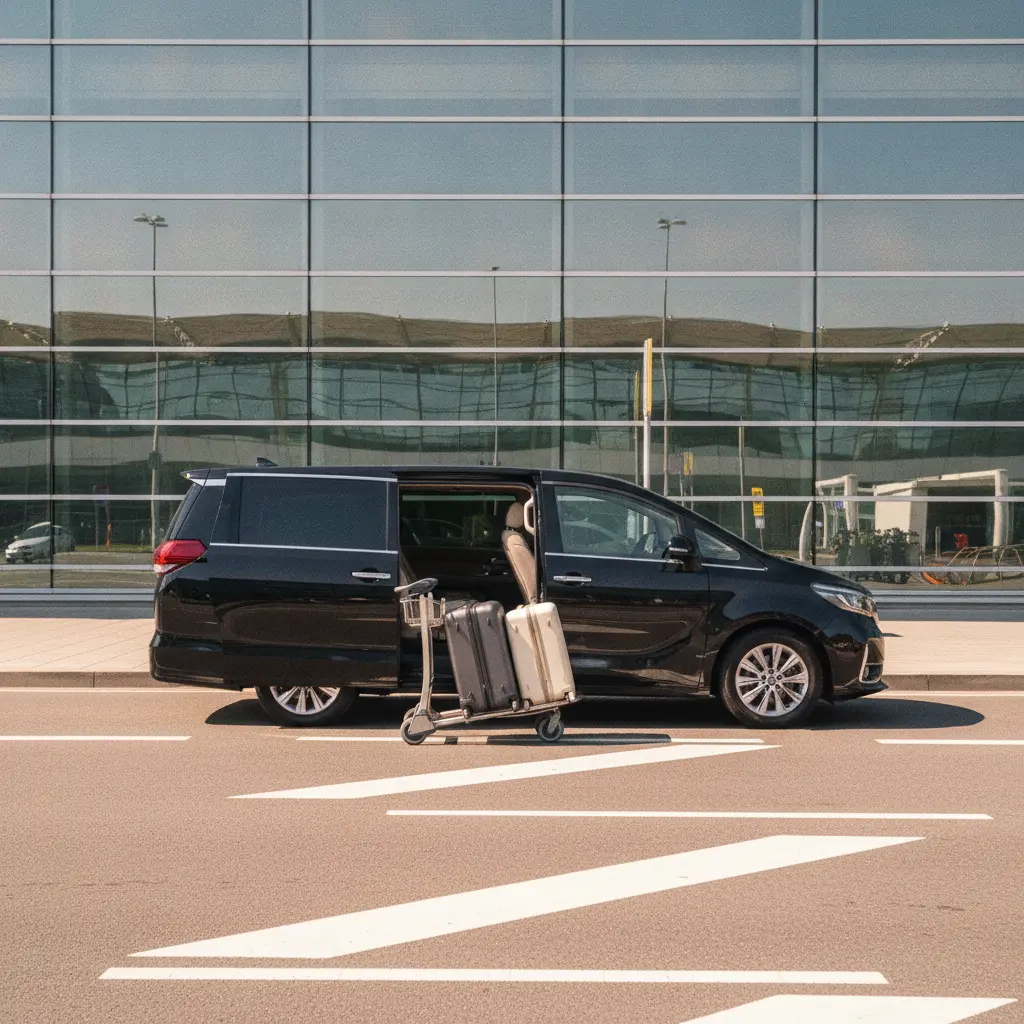
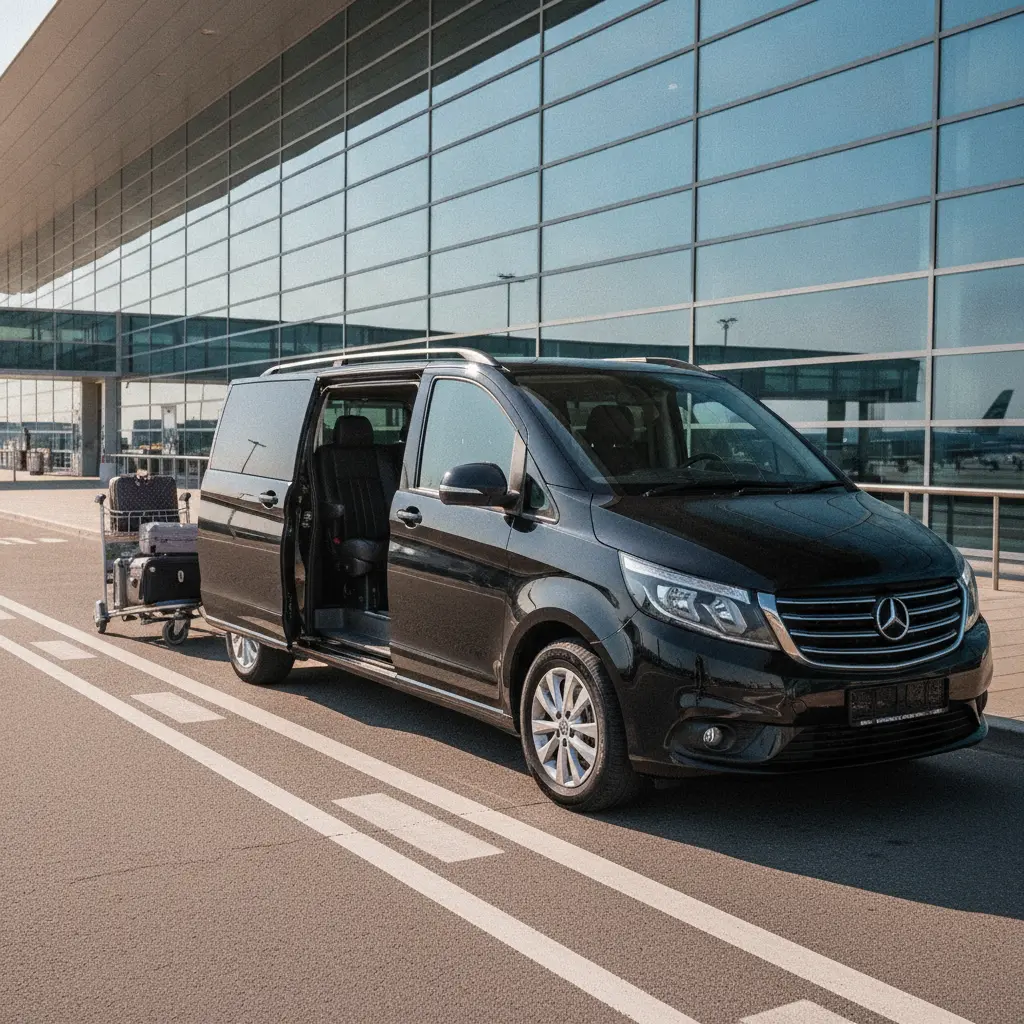
They settled on a single minivan, because splitting into two cars would have meant dividing children and suitcases at the airport exit. At this stage, browsing chauffeur-driven private car rental options makes it easier to compare vehicle classes and luggage capacities for larger groups in one place.
Three technical details worth checking
First, seat layout: if a child seat is going in, an ISOFIX anchor in the middle row makes the installation straightforward. Second, door type: sliding doors make an enormous difference when you are unloading children in a tight car park. Third, small but genuinely useful details for a night arrival — air conditioning that works on the rear row, and interior lighting in the boot area.
Step 4 — The meeting point and the name board
The moment you walk out of arrivals and start looking for a vehicle is the most stressful part of any transfer. The Yildiz family therefore took the meeting details in writing in advance: which exit door to use, what name would appear on the board, and which phone number the driver would call from. Without those three pieces of information, seven people circling a crowded exit at midnight is entirely plausible.
A practical tip: let the calmest person in the group carry the phone and the booking reference, while the other adults handle the children and the bags. Everyone then has a job and the panic level drops. Pre-booking a luggage trolley for extra items such as the stroller saves the same few minutes.
Step 5 — Child seats and the comfort of older travellers
The most frequently overlooked item in a big-family transfer is the child seat. Turkish rules on child restraints vary by age and height, but in practice a toddler of eighteen months needs a proper car seat, and a six-year-old needs a booster. Requesting both days before the flight removes the "I hope they have one" uncertainty at the curb.
Comfort for older passengers is a different matter entirely. On a thirty-five to forty-minute run to Belek, legroom and a step-free entry genuinely matter to a seventy-five-year-old. The family therefore loaded grandparents and the baby first, put the children in the middle row, and nobody had to squeeze past anyone on arrival.
Step 6 — Distance, duration and realistic expectations
Antalya Airport sits close to the city, but the distances to the resort areas vary enormously. The family checked which region their hotel was in and noted the approximate drive time, because on a night arrival the answer to "how long on the road" directly determines the children's bedtime.
Approximate drive times from Antalya Airport
- Lara and Kundu: roughly 10–20 minutes; the shortest run, and the easiest option for late landings.
- Antalya centre and Kaleiçi: roughly 20–30 minutes, depending on traffic.
- Belek and Kadriye: roughly 35–50 minutes; the Yildiz route.
- Beldibi and Göynük: roughly 50–65 minutes.
- Kemer: roughly 55–75 minutes, with a mountain road that demands care at night.
- Side and Manavgat: roughly 60–80 minutes.
- Alanya: roughly 1.5–2 hours; plan a break with a large family.
These times shift with traffic, season and weather, so plan in ranges rather than exact minutes. The Yildiz family reached their Belek hotel close to 01:00, which is why they confirmed in advance that reception was staffed around the clock. On a night arrival, that one confirmation removes the risk of standing outside a locked lobby.
Step 7 — Late landings and the delay scenario
Flight delays are the least predictable part of transfer planning. With a good provider, the driver tracks the flight live and updates the pickup time automatically when the landing time moves. The Yildiz family therefore confirmed two things at booking: would the flight number be shared, and how is waiting time handled if the flight is late?
The second critical issue on night arrivals is payment and communication. They chose to fix the transfer price in advance so there would be no discussion at the curb. Hunting for cash outside arrivals, especially late at night with children, is an unnecessary source of tension.
Step 8 — When should you lock in the return transfer?
Most families plan the outbound transfer carefully and leave the return until the last day. Yet the return is arguably more critical, because it is tied to a flight departure. The Yildiz family booked both legs in the same reservation and set their hotel departure at roughly three and a half hours before wheels-up: forty to fifty minutes from Belek, two hours for baggage and security, and a buffer for traffic.
With a large family there is also the "last suitcase" problem on departure day. Packing the night before the transfer means leaving without a morning panic. The family planned the departure day around the children's breakfast, not the other way round.
Step 9 — A framework for comparing your options
For an Antalya airport to hotel transfer with a big family, the options generally fall into four buckets: shared shuttles, the hotel's own transfer, airport taxis, and private (VIP) transfers. Price should not be the only measure. Compare on these points:
- Is it door to door? Shared shuttles may drop at several hotels first, which is a real time cost on a night arrival.
- Is luggage capacity guaranteed? If the vehicle class is vague, part of your luggage ends up on laps.
- Are child seats available? On request, or as standard?
- Is the flight tracked? Does the pickup time update automatically when the flight is delayed?
- Is the pricing transparent? Are night surcharges, luggage fees and waiting time stated upfront?
The Yildiz conclusion: with seven people and nine bags, a combination of shared shuttle plus two taxis was both more complicated and less predictable. One vehicle, one booking, one fixed price saved the first night of the holiday.
Six mistakes big families make most often
- Choosing a vehicle by headcount. Ignore luggage volume and the suitcases ride on laps.
- Not sharing the terminal. A driver waiting at the wrong building costs twenty minutes.
- Treating landing time as pickup time. Immigration and baggage reclaim add real minutes.
- Requesting child seats at the last minute. The right seat may not be available.
- Postponing the return transfer. Last-day bookings leave no flexibility on timing.
- Not getting the price in writing. Night surcharges and waiting fees then arrive as a surprise.
The 24-hour checklist
The most useful tool for any family is a short list reviewed the day before the flight. Here is theirs:
- Have the flight number, terminal and landing time been sent to the provider?
- Are the vehicle class, passenger count and luggage count confirmed in their final form?
- Has the child seat and booster request been approved?
- Do you have the meeting point and name board details in writing?
- Is the driver's contact number saved on your phone?
- Have the return pickup time been given to both the hotel reception and the provider?
- Are the payment method and total amount clear?
- Is boot space reserved for the stroller and buggy?
Conclusion: a well-planned transfer saves day one
By the time the Yildiz family reached their hotel it was nearly one in the morning, and nobody was tense. The children had fallen asleep in the van, the suitcases came out in one trip, and the grandparents stepped down without a single stair. Day one of a ten-day holiday began with an early breakfast rather than an hour of stress at the airport exit. The difference came down to one thing: they did not leave the transfer to the last minute.
If you are planning an Antalya airport to hotel transfer for a large family, work through the same sequence: confirm the flight and terminal, build the luggage inventory, choose the vehicle class around the bags, get the meeting details in writing, request child seats in advance, and lock the return leg into the original booking. To compare vehicle classes and capacities for group transfers, take a look at chauffeur-driven private car rental and build your own scenario with these steps. The best transfer is not the one your family talks about afterwards — it is the one nobody mentions at all.