Baku Adventure Tour 2026: Best Time to Go & 4-Day Plan
Most people planning a Baku Adventure Tour start in the wrong place: they open a flight search, pick the cheapest date, and then find themselves walking a stone city in 36-degree heat or leaning into a November gale on the Caspian promenade. In Baku, the week you choose shapes the trip more than the hotel category does. This guide is built around that idea — a month-by-month read on weather and crowds, a four-day plan that actually fits the seasons, the cost drivers worth interrogating before you pay, and the practical details that make the difference on the ground. If you want to see current departures and inclusions, view the Baku Adventure Tour on Turlago.
The Short Answer: Two Windows Beat the Rest
If you want one recommendation: late April to early June, and late September to mid-October. In both windows the temperature supports walking, the waterfront is fully awake, terraces are open, and the city is neither overrun by holiday crowds nor shut down for winter.
That said, a single answer hides a lot. Someone chasing heat, someone travelling with a seven-year-old, someone photographing architecture and someone trying to keep costs down will each be happiest in a different month. What follows is a decision aid, not a verdict.
Baku Month by Month: What the Weather and Crowds Actually Do
March: Wind, Empty Streets, Low Prices
Baku is called the City of Winds, and March is when that nickname earns itself. Days sit around 8–13°C; evenings are noticeably colder. The upside is solitude. You can walk the Old City's limestone lanes almost alone, photograph the Maiden Tower without a queue, and pay close to the year's lowest hotel rates.
The trade-off is that some outdoor cafés have not reopened and the seaside boulevard demands a proper coat. One more thing: Novruz, the spring festival, lands around 20 March. The city becomes a celebration of fire, music and sweets — genuinely worth seeing — but hotels fill early and some businesses close for a few days. Choose that week on purpose, or avoid it on purpose. Don't stumble into it.
April and May: The Balanced Window
Expect 15–23°C, less rain, and a boulevard turning green. This is the most requested period for the Baku Adventure Tour for an obvious reason: you are never too cold and never too hot. Day trips to Gobustan are comfortable, indoor stops such as the Heydar Aliyev Center and the Carpet Museum feel like a pleasure rather than a refuge, and dinner can be eaten outside.
Crowds are still moderate. Flight prices have not peaked, though from mid-May onward, public holidays and school breaks in source markets start pushing demand up. Booking early in this window pays off more than in any other.
June: Long Days, Late Evenings
Expect 25–30°C and a sunset near nine in the evening. Baku's long summer evenings effectively double your usable hours: museums in the morning, the Old City in the afternoon, a waterfront walk at dusk, dinner around the fountain square well after dark. Outdoor concerts and seaside events cluster in this period.
The catch is shade. Open sites such as Gobustan and Yanar Dag offer almost none at midday. Splitting the day into an early block and a late-afternoon block is not a stylistic preference here — it is how the city works in summer.
July and August: Hot, but Entirely Manageable
Daytime highs can reach 32–37°C. That does not make Baku unvisitable; it makes it a city with a different rhythm. Locals do the same thing you should: outdoors from 07:00 to 11:00, indoors over lunch, back outside after 18:00.
The hidden advantage is the Caspian. The waterfront and the beaches north and south of the city take the edge off the afternoon, and because humidity is lower than in most Mediterranean destinations, 35°C here feels less punishing than the number suggests. The disadvantage is domestic tourism season and higher room rates.
September and October: The Golden Window
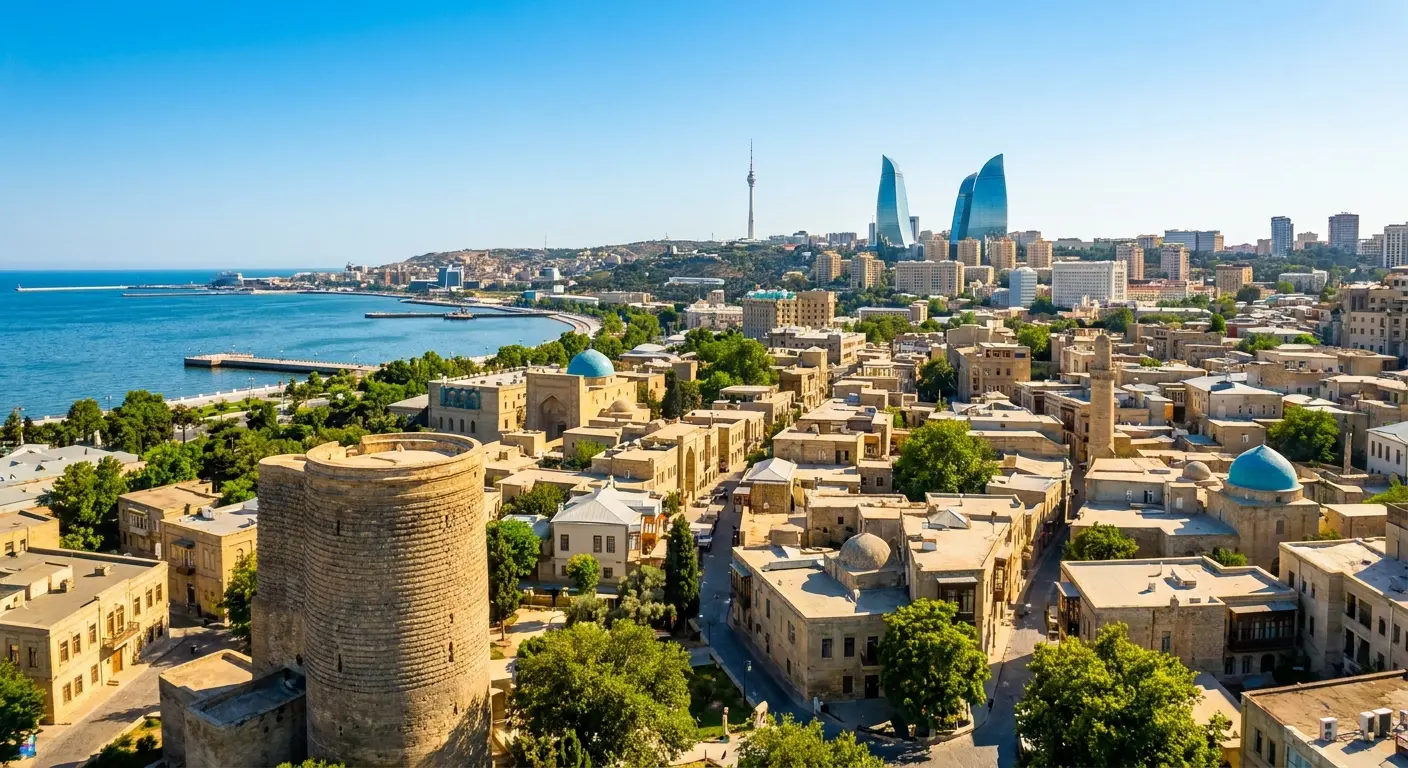
September runs 24–28°C, October 18–22°C. The sea is still warm, the city has not emptied, and the light is arguably at its best all year — the Old City's honey-coloured stone reaches its richest tone in the late afternoon. Photographers, this is your stretch.
One warning: Baku has hosted a Formula 1 street race in September in recent years. During that week, central streets close, hotel rates jump and restaurants require reservations. Check the race calendar before locking a date; the same itinerary can cost dramatically more if you land on it by accident.
November to February: Winter, Seen from the Inside
Temperatures sit around 3–9°C, wind is sharp and rain is frequent. Even so, winter has real value: museums are quiet, guides have time to talk, and the hammam and tea-house culture is at its most appropriate. Over the New Year period, Nizami Street and the fountain square are lit up and the city takes on a completely different character.
If you take the tour in winter, restructure it: open sites such as Gobustan in the morning, museums, covered markets and tea houses in the afternoon. A windproof outer layer matters more here than a warm coat.
Dates Worth Avoiding
- Novruz week (around 20–24 March): Hotels full, some businesses closed, prices up.
- Formula 1 week (usually September): Road closures in the centre and inflated accommodation rates.
- New Year (30 December–2 January): Peak demand in central hotels.
- Long public holiday weekends: Flight prices climb fastest on these dates.
Four Days in Baku: A Plan That Fits the Seasons
This itinerary covers old and new Baku, the city and its surroundings, without turning the trip into a checklist sprint. Times are suggestions; small shifts are normal on a guided tour.
Day 1: The Old City and Its Stone Memory
Start at 10:00 inside Icherisheher, the walled old town on the UNESCO list. First stop is the Maiden Tower, the eight-storey cylinder that has become the city's signature silhouette. Then the Palace of the Shirvanshahs and the adjacent bathhouse ruins. Give these two about two and a half hours; rushing them defeats the point.
Lunch in the courtyard of a historic caravanserai is one of Baku's most characteristic experiences. In the afternoon, get deliberately lost: carpet shops, copper workshops, small tea rooms. Around 16:00, stop for tea — it arrives with fig, quince or walnut jam, and it is not a quick affair.
In the evening, move to Nizami Street and the fountain square. This is the city's liveliest pedestrian zone with plenty of dinner options. Ending day one early protects the energy you will need tomorrow.
Day 2: Modern Baku and Its Architecture
Be at the Heydar Aliyev Center by 09:30. Zaha Hadid's building is worth the visit for its own geometry, independent of whatever exhibition is running — the curves alone will absorb half an hour. Allow two hours in total including the galleries.
After lunch, look at the Flame Towers from outside, then walk to the Carpet Museum nearby. The building is shaped like a rolled carpet; the collection inside tells the centuries-long story of Caucasian weaving and is far more engaging than the name suggests.
From 16:00, head down to the Baku Boulevard. Stretching along the Caspian, it is the city's most democratic space: families, runners, cyclists, tea vendors. Dinner at one of the seaside restaurants is a natural way to close the day.
Day 3: Land of Fire and Gobustan
This day starts early. Leave the hotel at 08:30 and head first to Ateshgah, the fire temple where a naturally burning gas vent underpins centuries of pilgrimage. Then Yanar Dag, where a hillside has been burning continuously for as long as anyone records — especially striking in late-afternoon photographs.
After lunch, Gobustan National Park. Its petroglyphs are UNESCO-listed and stretch back as far as 10,000 BCE: hunting scenes, rituals, reed boats. The same route passes the mud volcanoes, a concentration found in very few places on earth.
Practical note: Gobustan has no shade. Hat, water and sunscreen are not optional. Part of the access road to the mud volcanoes can be rough, so vehicle choice matters. Aim to be back in the city by around 17:00.
Day 4: North to the Mountains, or Deeper into the City
Two options. First, a day trip north towards Quba and Gusar: roughly two hours of driving, mountain scenery, apple orchards and Caucasus villages. Second, stay in Baku and go deeper — Teze Bazar for the food hall experience, a carpet workshop, and a proper hammam.
On a short trip, I would take the second option. Chasing three regions in four days produces fatigue rather than memories. At the local market, pomegranate juice, dried fruit and spices make the most honest souvenirs. Finish with a farewell tea in an Old City tea house.
Is Four Days Enough, or Should You Add a Fifth?
For Baku itself, four days is right. If you want to see Azerbaijan beyond the capital, add a day or book a separate trip: Sheki's Silk Road heritage, the mountains around Gabala, or Lahij with its copper workshops. At that point the question stops being about a city and starts being about a country.
What a Baku Adventure Tour Actually Costs in 2026
Two travellers can experience the same four days at very different prices, and the reason is almost never the destination — it is what the package includes. Knowing the cost drivers, and roughly how much weight each carries, is your best comparison tool.
- Flights: The most volatile component. Shift your dates by two or three weeks and the same route can reprice substantially, which means date flexibility is effectively a discount.
- Accommodation: A boutique stone hotel inside the Old City and a chain property on the boulevard sit far apart per night. Location also decides how much time you spend commuting each day.
- Meal plan: Half board versus bed and breakfast changes your daily comfort more than it changes the headline price.
- Museum and site entries: Often excluded. Gobustan, Ateshgah, Yanar Dag, the Carpet Museum and the Heydar Aliyev Center add up to a real line item.
- Day trips: Gobustan and Quba days are sometimes included, sometimes extra. Confirm in writing which one applies.
- Transfers: Airport-to-hotel included or not, and shared versus private vehicle.
- Group size and guide language: Small groups and a guide in your own language cost more, and change the feel of the day entirely.
- Insurance and cancellation terms: A cheap-looking package can carry strict cancellation conditions. Read them before paying.
Eight questions to ask before you book:
- Are flights included, on which airline, and what is the baggage allowance?
- What is the hotel name and neighbourhood?
- Are breakfast and dinner included?
- Who pays the museum and site entries?
- Are the Gobustan and Quba days inside the package?
- Is the airport transfer included, shared or private?
- How large is the group, and in which language does the guide speak?
- What are the cancellation and change conditions?
Once you have those eight answers, comparing two packages becomes meaningful rather than cosmetic. Current dates and pricing are listed on the Baku Adventure Tour page.
Entry, Money and Everyday Practicalities
ID Cards and Entry Rules
Türkiye and Azerbaijan have arrangements that have at times allowed travel on biometric national ID cards rather than passports. Rules are updated periodically, so confirm with official sources and your airline before departure. A passport valid for at least six months makes life easier in every scenario.
Currency and Cards
The local currency is the Azerbaijani manat. Cards are widely accepted in hotels, restaurants and larger shops; small businesses, markets and some taxis still prefer cash. Rather than changing a large sum at the airport, use city exchange offices, which are generally better value. Keep some small notes on you.
Language, Time and Connectivity
Azerbaijani is the local language. Turkish speakers manage remarkably well, though identical-sounding words occasionally carry different meanings — treat that as charm rather than obstacle. The time zone is one hour ahead of Türkiye. Sockets are type C and F at 220 volts. An eSIM or roaming plan covers a short trip; a local SIM makes sense for longer stays.
Getting Around
The metro is cheap and fast, and the Icherisheher station is worth a look for its architecture alone. Ride-hailing apps are widely used and inexpensive over city distances. The boulevard and the centre are compact enough to walk. The airport sits roughly 25–30 km from the centre, served by bus and taxi; on a package with transfers included, that is already solved.
What to Eat: An Eight-Stop Food Route
- Plov: Saffron rice layered with meat and dried fruit. Shah plov is served as a small performance.
- Dolma: Vine leaves stuffed with meat and rice; lighter versions with yoghurt appear in summer.
- Qutab: Thin flatbread folded over meat, cheese or herbs — the best street-level snack in the city.
- Dushbara: Tiny dumplings served in broth, a winter staple.
- Lavangi: Chicken or fish baked with a nut and onion stuffing; done well at seaside restaurants.
- Saj: Meat and vegetables cooked on a convex iron plate, practical for groups.
- Pakhlava, shekerbura, shorgogal: The Novruz trio, available in bakeries year-round.
- Tea and jam: Served with fig, quince or walnut jam. In Baku, tea is a ritual rather than a drink.
Dinner starts late. Restaurants begin filling around 19:00 and peak later. Tipping generally lands between five and ten percent. The historic caravanserai courtyards in the Old City and the boulevard strip are reliable for both atmosphere and food.
Where to Stay: Four Areas, Four Different Trips
- Old City (Icherisheher): Boutique hotels in stone buildings and unbeatable atmosphere. Expect some noise and parking friction, but everything is walkable.
- Nizami Street and the fountain square: Central, dense with restaurants and shops, easiest for transport. The safest first-time choice.
- The boulevard: Newer hotels, sea views, morning walks. Fifteen to twenty minutes on foot from the centre.
- Around the Flame Towers: Upper-tier properties, business travel, and views over the whole city.
Seven Things Worth Knowing Before You Go
- Do not schedule Gobustan for midday; there is no shade.
- Do not combine Gobustan and Quba on the same day — they point in opposite directions.
- Check weekly closing days for museums; holiday schedules shift.
- Do not stay only in the centre; give one afternoon to a local market.
- Pack a light windproof layer even in summer — evenings on the Caspian are cooler than they look.
- Carry small notes for markets and small cafés.
- Structure each day in two outdoor blocks with an indoor middle: morning outside, midday inside, late afternoon outside again.
Who Is This Tour For?
First-time international travellers will find Baku one of the easiest introductions: a short flight, a language that feels familiar, and predictable day-to-day costs. Families with children benefit from the boulevard, the parks and the short distances, though the plan should be capped at two main stops per day. Couples tend to remember the Old City at dusk and the seaside restaurants. Photographers get the contrast between Gobustan's ancient rock art and the Flame Towers skyline. Business travellers can use the final day to go deeper into the city rather than squeezing in another region.
Frequently Asked Questions
When is the best month to visit Baku?
For most travellers, late April to early June and late September to mid-October are the most balanced. Temperatures support walking, the city is lively, and crowds are manageable.
Is four days enough for Baku?
For the city itself, yes. Add Gobustan and the Absheron Peninsula and four days fills completely. To reach Sheki, Gabala or Lahij, you need extra days or a separate trip.
How much should I budget per day in Baku?
Daily spending varies enormously with how much you eat out and how many sites you enter, so a single figure would mislead. The practical approach is to confirm exactly what the package covers, then budget only for personal spending.
Is Baku safe for solo travellers?
Baku is generally comfortable for solo travel, including for women. Evening walks in the centre are normal. As in any city, stay attentive in quiet side streets late at night.
Can I manage with Turkish?
Largely yes, though direct translations occasionally misfire. Learning a handful of Azerbaijani words improves both communication and the experience.
The Takeaway: In Baku, the Date Is Half the Itinerary
Baku works in every season, but it does not offer the same thing in every season. Choose the right week and four days can hold the Old City's stone lanes, the surreal landscape of the fire sites, cool evenings on the Caspian and a quiet hour in a tea house. Choose the wrong one and the same itinerary turns into a endurance test.
So when you book a Baku Adventure Tour, settle the calendar first, the inclusions second, and the price last. If the dates fit, everything else falls into place. For current programmes, departure dates and pricing, compare the Baku Adventure Tour on Turlago and pick the window that suits you.