Balkan Dream Tour 9 Countries: Best Time to Go (2026)
Two travellers board the same coach on the same eight-day Balkan circuit. One leaves in late June, the other in early October. They visit the same nine countries in the same order, walk the same cobbled streets and cross the same borders — yet they come home describing what sounds like two completely different holidays. That is not an exaggeration; it is the direct result of how this itinerary is built. Nine countries in eight days, long coach transfers, a chain of land border crossings, and city tours that keep you outdoors for hours at a time. This guide is not a route description. It answers a single question: when should you actually travel this circuit so that it feels rewarding rather than exhausting? You can review the full day-by-day program, the listed inclusions and the current price on the Balkan Dream Tour 9 Countries page on Turlago.
Why this itinerary is a calendar decision, not just a destination choice
On a typical city break, the season only tells you whether to pack a jacket. Here, it shapes how far you can walk, how long you wait at borders, how much daylight you still have when the coach arrives, and how much energy you have left by dinner. Five structural facts explain why:
- Density: The tour covers nine countries — Greece, North Macedonia, Kosovo, Albania, Montenegro, Croatia, Bosnia and Herzegovina, Serbia and Bulgaria. Turkey is the departure country, which is why the marketing name says nine.
- Coach-based travel: Transport is listed as travel in luxury coaches. A meaningful part of each day is spent on board, and how comfortable that feels depends as much on outside temperature as on your seat.
- Outdoor-heavy sightseeing: The walk through Matka Canyon, the Kravica waterfalls, the cobbled lanes of Počitelj, the panoramic drives past Budva and Kotor, the stone streets of Mostar, the Belgrade fortress walk and the Sofia panoramic tour all happen outside.
- Multiple land borders: From Ipsala on the Turkish border to Kapıkule on the way home, the route crosses Greek–Macedonian, Macedonian–Kosovan, Albanian–Montenegrin and Bosnian–Serbian frontiers. Crossing times vary enormously by season and by day.
- Daylight dependence: Panoramic city tours, photo stops and free time all depend on light. In high summer you can still be walking through a Balkan old town at nine in the evening; in November, the same schedule ends in the dark.
Night one is on the coach — factor that into your dates too
The most overlooked detail of the program is day one. Departure is in the evening from Istanbul and the first night is spent on the road. The pick-up points listed on the tour are spread across the city and its western outskirts:
- 21:00 — Kadıköy Wedding Hall car park
- 21:30 — Mecidiyeköy, in front of Ziraat Bank
- 22:00 — İncirli, Ömür Plaza bus stop
- 22:30 — Beylikdüzü, Marmara Park Havaist stop
- 23:15 — Silivri, in front of 5M Vega Shopping Centre
- 23:55 — Yenice Aytemiz service area
- 00:25 — Namık Kemal Yaypet rest area
The coach then follows the Malkara–Keşan route to the Ipsala border, where passport and customs formalities are completed before the overnight drive continues. Day two begins with a free breakfast in Kavala. In other words, the pace of the trip starts immediately after a night of limited sleep, which is exactly why weather on day two matters so much. Walking around Kavala and Thessaloniki in dry, mild conditions is a pleasure; doing it in steady rain after a sleepless night is not.
Month by month: what each travel window actually delivers
The assessment below is based on the geography of the route and the daily rhythm of the program. Treat it as a decision framework, not a weather forecast.
April and May: cool, comfortable and made for walking
Spring keeps most of the route temperate, which is ideal when your itinerary is essentially a series of walking tours. Thessaloniki, Bitola, Ohrid, Prizren and Mostar all become genuinely pleasant to explore on foot. Two trade-offs apply. First, evenings can still be chilly, so a light jacket is non-negotiable. Second, the Adriatic section — Budva and Kotor — is a scenic drive rather than a beach experience, and that is true of the tour in any month, since both towns are seen panoramically from the coach. If your priority is covering ground and seeing a lot without overheating, spring is the most balanced window of the year.
June: the month the itinerary was designed around
June behaves like the natural season for this route. Days are long and evenings stay bright, which means the evening elements of the program — the dinner at a local restaurant in Sarajevo, the musical Macedonian Night in Skopje — land exactly as intended. It also sits just before the Turkish school holidays push demand into July and August, so you get many of the benefits of peak season with noticeably less pressure. Temperatures are climbing by then, so a hat, sunglasses and a refillable water bottle move from optional to essential.
July and August: warmest, busiest, most alive
Mid-summer is when the Balkan street scene is at its most vibrant. Mostar, Sarajevo, Budva and Kotor are full of life, cafés spill onto pavements, and late-evening walks are a highlight in themselves. Three things are worth accepting before you book:
- Heat: The Adriatic coast and the Herzegovina region are distinctly hot at the height of summer. Combined with a dense itinerary, midday outdoor walking becomes the hardest part of the day.
- Crowds: Dubrovnik and Kotor both absorb heavy tourist and cruise traffic in July and August. Build flexibility into your free time and photo stops.
- Border traffic: This is the busiest period for regional holiday travel, so land crossings, rest stops and service areas are all more congested.
The upside is genuine: long daylight hours and the liveliest version of every town on the route. If cafés, evening atmosphere and late sunlight matter more to you than quiet, summer delivers.
September: the sweet spot
Ask experienced Balkan travellers and most will point to September. The logic is simple. The sea and the coast are still warm, the cities are still lively, but the return of the school term visibly thins the crowds. Daylight is still generous, so panoramic tours and evening activities fit comfortably into the schedule. For a tour with this much ground to cover, September offers the best balance between atmosphere and breathing room. The catch is on the booking side: it is the most requested window, and with a capacity of 100 passengers per departure, places can disappear early.
October and November: quieter and cheaper, but shorter
October suits travellers who dislike crowds. Towns calm down, photo stops stop being queues, and museums and archaeological sites become far more enjoyable. Two warnings come with it: daylight shortens noticeably and the chance of rain increases. Since free time and panoramic tours depend on light, an October departure may simply see less, not more, for the same number of days. November is a borderline choice for this route — mountain and highland sections can affect driving comfort and the overall experience.
December to March: why this route sits lower on the list in winter
The Balkans are beautiful in winter, but this particular program is not built for it. A coach-based tour with several outdoor stops and multiple border crossings per day loses both time and comfort in snow and fog. Inland Bosnia and Serbia also get genuinely cold, with low temperatures around Sarajevo and Belgrade. If you want the Balkans in winter, a better strategy is to postpone this nine-country circuit to spring and choose a different, more compact itinerary for the cold months.
Where the Turkish holiday calendar collides with demand
Multi-country coach tours like this one are heavily influenced by public holidays in the departure market. Religious holidays, the school summer break, the mid-term break and the New Year week all push demand sharply upward for specific departures. Two practical consequences follow:
- Price and availability pressure: During peak weeks, seats become harder to find and early-booking advantages largely disappear.
- Busier pick-up points: With seven meeting points spread between 21:00 and 00:25, boarding nights are more chaotic in high season. Arriving a little early for luggage loading and seat allocation is always worth it.
Conversely, midweek departures outside the holiday calendar are calmer and more flexible. If your dates are not fixed, travelling Tuesday to Thursday generally means a smoother start.
The rhythm of the eight days, and how the season changes each one
The day-by-day structure is where seasonal effects show up most clearly. Following the actual itinerary listed for the tour:
Day 1 — Istanbul departure and overnight drive
This day is pure travel regardless of season. The only thing you can control is how rested you are before the border formalities begin.
Day 2 — Kavala, Thessaloniki, Bitola (Manastır), Ohrid
The first real sightseeing day, covering Greece and North Macedonia. Free breakfast in Kavala, a taste of the town's famous kurabiye biscuits, then Thessaloniki and the house where Mustafa Kemal Atatürk was born. After the Greek–Macedonian border, the coach reaches Bitola, where the walking tour includes the military high school — which also houses the Atatürk Memorial Room and the city's archaeology museum — Širok Sokak, the New Mosque and Eleni Karinte's balcony. This is a full outdoor walking day. It is delightful in spring and autumn, and demanding at the height of summer without a hat and water.
Day 3 — Ohrid, Tetovo, Skopje
Hotel breakfast and check-out, a short stop in Straza, then the Painted Mosque in Tetovo, where the courtyard fountain offers famously cold mountain water. The day ends in Skopje with a city exploration and the musical Macedonian Night. Because there is an evening event, this is the day when a mild night makes the biggest difference — another point in favour of June through September.
Day 4 — Matka Canyon, Prizren, Pristina, Shkodër
One of the most intense days on the program. A morning walk through the nature of Matka Canyon, then the Kosovan border and a walking tour of Prizren covering the Sinan Pasha Mosque, the Arasta Mosque minaret, the Ottoman hamam and the stone bridge. The canyon walk is entirely weather-dependent: in rain it turns from a highlight into a slog.
Day 5 — Shkodër, Budva, Kotor, Dubrovnik, Medjugorje area
The Montenegro and Croatia coastal stretch. The drive passes Podgorica, Sutomore and Petrovac, with a photo stop at a viewpoint overlooking Sveti Stefan, followed by the panoramic drive through Budva and the arrival in Kotor. This is the day with the most time by the sea air, so a windproof outer layer earns its place in your bag.
Day 6 — Medjugorje, Kravica, Počitelj, Mostar, Sarajevo
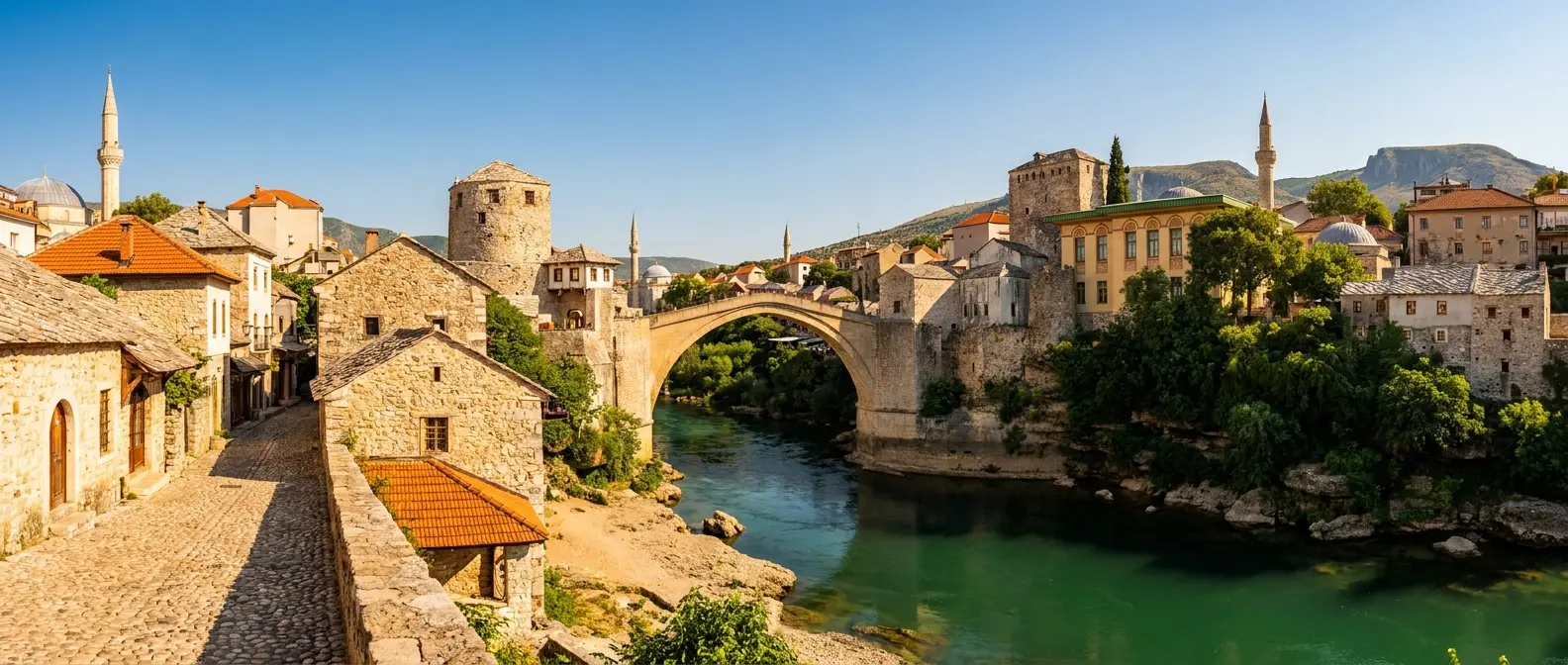
The Kravica waterfalls with free time, then Počitelj — an Ottoman-era garrison village with historic houses, a hamam, a mosque and cobbled alleys, plus a pause for Turkish tea and Bosnian coffee. Then Mostar and Sarajevo. This day is almost entirely outdoors, which makes footwear choice critical.
Day 7 — Sarajevo to Belgrade
A scenic drive through Bosnian highlands and villages, crossing the Drina river border into Serbia, before Belgrade's walking tour: Knez Mihailova street, Kalemegdan, the Monument of Gratitude to France, the Istanbul Gate, the Damat Ali Pasha Turbe, the panorama point and the Victor statue. A long transfer combined with a long walk is much easier when the days are long.
Day 8 — Sofia and return to Istanbul
Breakfast, check-out and a panoramic tour of Sofia, taking in Alexander Nevsky Cathedral, the Russian Church, Saint Sophia Church, the Rotunda, the Archaeological Museum, the Presidency, the Council of Ministers and the Banya Bashi Mosque. After free time, the coach heads for the Kapıkule border and re-entry into Turkey. In winter, this day feels considerably heavier because it finishes in the dark.
Visas, insurance and border timing
The listing states clearly that a multiple-entry Schengen visa (220 EUR) and mandatory travel health insurance (20 EUR) are not included in the price. Those two items should sit at the centre of your scheduling, because:
- Schengen appointment availability tightens sharply in the summer months. Check appointment calendars before you commit to a departure date, not after.
- The multiple-entry requirement follows from the route itself: Greece and Croatia are inside the Schengen area, and the itinerary enters and exits both.
- If you already hold a valid multiple-entry Schengen visa, that cost simply drops out of your budget, which materially changes the total price of the trip.
- Border crossing times vary with the season, and queues lengthen around public holidays. Follow the guide's timings and meeting points strictly.
Budget for the other excluded items as well: lunches, drinks with meals, museum and site entrance fees, the Turkish exit tax, optional extra excursions and voluntary tips for guide and driver. Included, by contrast, are luxury coach transport, six nights in 4-star hotels, six hotel breakfasts, four hotel dinners, one dinner at a local restaurant in Sarajevo, the musical Macedonian Night in Skopje, all intercity transfers and excursions explicitly marked as included, professional Turkish-speaking guiding, local guiding where required, and checkpoint and parking fees. Always confirm the current inclusion list on the tour page before booking.
Seasonal packing: the items that actually change your trip
On a route like this, comfort comes largely from preparation. The following works year-round:
- Layers, not one heavy coat: Cool mornings, warm middays and cool evenings are normal across the route.
- Cushioned, grippy walking shoes: The stone surfaces of Počitelj, Mostar and Bitola demand it.
- Power bank and a long cable: Long coach days drain a phone battery quickly.
- Neck pillow and earplugs: Night one is spent on the coach, and sleep quality directly determines your energy on day two.
- A small cash reserve: Several currencies appear along the route, and cash is useful at rest stops and small businesses.
- Reusable water bottle: In summer you may drink several litres a day.
- A basic medical kit: Painkillers, stomach medicine, plasters and any regular medication. Finding a pharmacy during fast intercity legs is not always simple.
Price, capacity and the right moment to book
The listed starting price is 26,499 TRY and capacity is 100 passengers. Read together, those two numbers suggest a clear strategy:
- Move early for peak dates: Departures that overlap with school holidays and public holidays fill quickly at 100 seats.
- Use the shoulder season: May, early June and late September into early October offer the best combination of weather, manageable crowds and slightly more booking flexibility.
- Sort the visa first: Because visa and insurance costs sit outside the tour price, resolve your total budget before you pay a deposit.
- Travelling solo: Room-sharing arrangements matter on coach tours, so clarify your room type at the time of booking.
Prices, availability and itinerary details can be updated periodically, so check the tour page for the current information.
Which window suits which traveller?
First-time visitors to the Balkans
Late May to June, or September. Daylight is long, temperatures are manageable and the cities are lively. It is the window least likely to leave you feeling you missed something.
Photographers
June and September. Long daylight lets you catch late-afternoon light in Mostar and Sarajevo without crowds ruining your frames.
Travellers who dislike heat, and older guests
Late April to May, and late September to early October. The itinerary includes stretches of three to five hours on your feet; milder weather reduces that load considerably.
Anyone avoiding crowds
October. Towns quieten, museums breathe, photo stops stop being queues. The cost is shorter days.
Those who want atmosphere and company
July and August. Café culture, street life and evening activity are at their peak, provided you can handle the heat and the crowds.
Frequently asked questions
How long is the Balkan Dream Tour and how many nights are in hotels?
It runs for eight days and includes six nights of hotel accommodation. The first night is spent on the coach after the Istanbul departure. Hotels are listed as 4-star, and six breakfasts are included.
Which countries does it visit?
According to the listed program: Greece, North Macedonia, Kosovo, Albania, Montenegro, Croatia, Bosnia and Herzegovina, Serbia and Bulgaria — nine countries in total. Turkey is the departure and return country.
Do I need a visa?
The listing includes a multiple-entry Schengen visa (220 EUR) and mandatory travel health insurance (20 EUR) among the services not included in the price. Plan on needing a multiple-entry Schengen visa for this route, and check appointment availability well in advance.
How much walking is involved?
Considerable. The city walking tours and the nature sections — the Matka Canyon walk, Počitelj, Mostar, the Belgrade walking tour, the Sofia panoramic tour and others — all require steady walking. Daily distance depends on your own pace, but comfortable shoes and layered clothing are essential on this tour, not optional.
Can I do this tour in winter?
It is possible, but the route is not designed for winter. On a coach-based, multi-stop, multi-border itinerary, short daylight and harsh weather conditions drag the experience down. There are better Balkan options for travellers with flexible winter dates.
How large is the group?
The listed capacity is 100 passengers. Combined with professional Turkish-speaking guiding, that tells you this is a large-scale operation. If you are looking for a small-group experience, it is worth knowing that from the outset.
The bottom line: the right dates are half the trip
As a route, the Balkan Dream Tour 9 Countries already delivers. From Belgrade to Sarajevo, from Matka Canyon to the Kravica waterfalls, from Atatürk's house in Thessaloniki to the Macedonian Night in Skopje, the program is ambitious in the best sense. That is precisely why the real question is not whether to go, but when. The short answer: June and September strike the best balance for most travellers, while late April to May and October suit anyone sensitive to heat and crowds. Midsummer gives you the liveliest version of every town but demands that you manage heat and congestion. Winter is simply not this route's season.
When you pick your dates, line up three things: your visa appointment timeline, your expectation of long daylight, and your tolerance for walking. If all three align, book early — you can review the full itinerary, the current price and the complete list of included and excluded services on the Balkan Dream Tour 9 Countries page on Turlago.