Bavarian & Alpine Christmas Markets: 2026 Timing Guide
Almost every Christmas market trip that disappoints was booked for the wrong week. The markets themselves rarely change; the crowds, the prices, the light and even the weather swing dramatically between late November and Christmas Eve. This guide treats timing as the main decision, and it works through the real itinerary of the Bavaria and the Alps Christmas Markets Tale tour on Turlago — a four-day, three-night programme departing Istanbul on 9 December, based entirely in and around Munich, priced from 22,304 TRY per person with a 100-guest cap.
The structure is deliberately compact: a scheduled AJet flight from Istanbul Sabiha Gökçen to Munich, three nights in 3-star and/or 4-star hotels on a bed-and-breakfast basis, a guided Munich city tour included in the price, and two optional full-day extensions sold locally. What matters for planning is not the list of inclusions but where those four days land in the Advent calendar. That is what this article unpacks.
The Christmas market season is four different weeks, not one
Contrary to popular belief, the big markets do not all open on the same day. Munich's Christkindlmarkt on Marienplatz, Nuremberg's Christkindlesmarkt and the markets scattered across Salzburg's historic squares typically start trading in the final week of November and shut down around 23–24 December. That leaves roughly a four-week window, and each week sells a different experience.
- Week one (late November to early December): Stalls are freshly built, decorations are pristine, and crowds are at their lightest. The trade-off is that a few smaller square markets may not have opened yet, and evening temperatures drop fast.
- Week two (early to mid-December): The sweet spot. Every market is running, the evening illuminations are at full strength, and the crowds are still manageable. The 9 December departure falls squarely inside this band.
- Week three (mid to late December): Locals start their gift shopping, and weekends become genuinely difficult to navigate. The atmosphere is at its most electric; hotel rates are at their highest.
- Week four (the final days before 24 December): Markets close one by one and stalls switch to clearing stock. It looks romantic on paper, but arrive too late and you will find empty squares.
The practical conclusion: the balance between atmosphere and comfort peaks in the first half of December. An early-December departure is not an arbitrary calendar choice.
Why 9 December is a smart date, by the numbers
In the 2026 calendar, 9 December falls on a Wednesday. That matters twice over. First, a midweek start means you can walk between stalls in Munich and Nuremberg without the weekend crush. Second, because day one is a Wednesday, the heaviest day of the itinerary — Nuremberg — lands on a Friday, immediately before the local weekend surge.
The second factor is Advent itself. The emotional core of a Christmas market trip is not 24 December; it is the four weeks of anticipation leading up to it. In early December, alpine towns such as Hallstatt and Salzburg are fully dressed, lights are lit, and the exhaustion and congestion of the final week have not yet arrived. It is the most comfortable window for photography, for browsing, and for actually getting to the counter for a hot drink.
The third factor is availability. From mid-December, hotels push rates up for the Christmas week and flight seats largely sell out. An early-December departure leaves more room on both fronts, and with group capacity capped at 100 guests, booking early has a concrete payoff.
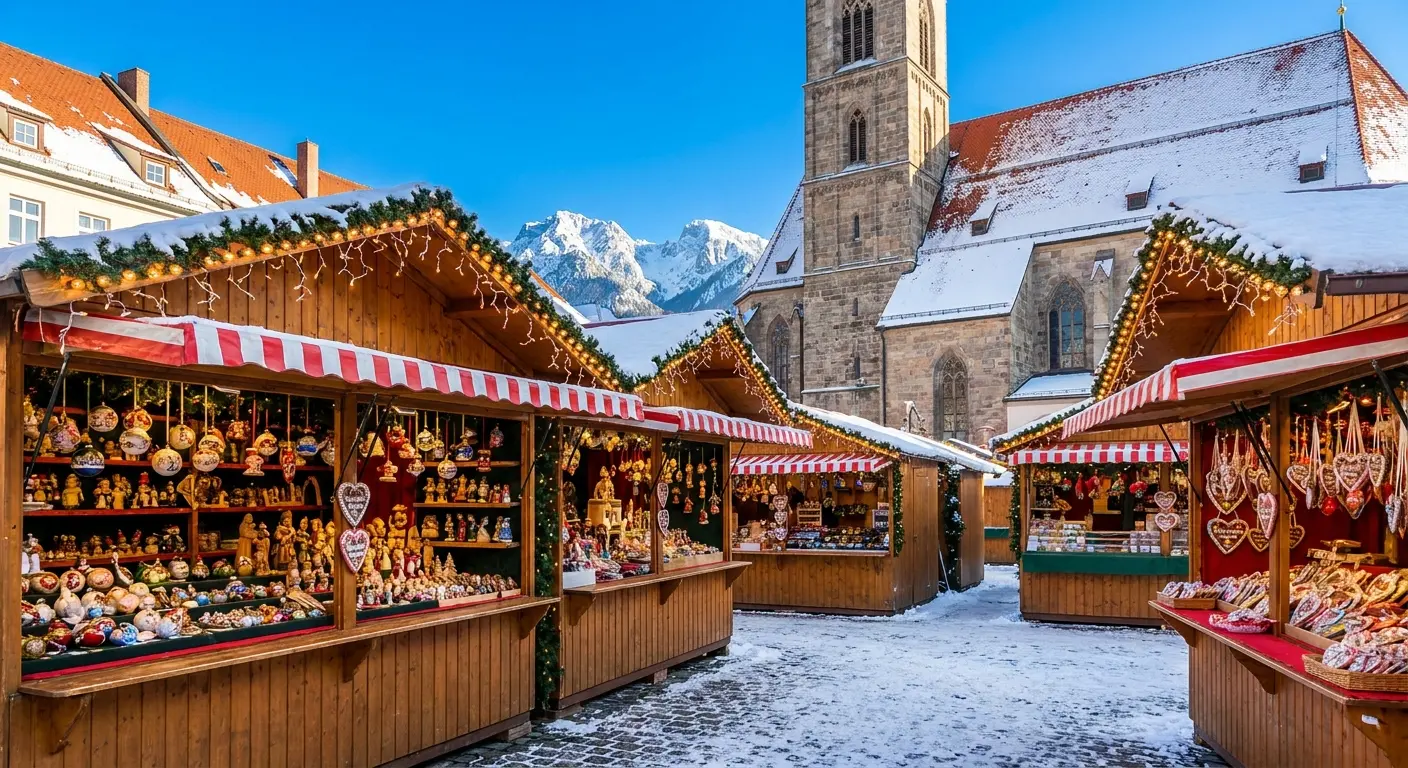
Suggested image alt text: Christmas market stalls and festive lighting on Marienplatz in Munich during the first half of December.
Day by day: what four days in Bavaria and the Alps look like
The flow below is the official itinerary. Knowing how much of each day is scheduled and how much is free is what makes the timing decision concrete.
Day 1 — Istanbul, Munich and the Marienplatz Christmas market
The group meets at Istanbul Sabiha Gökçen International Departures. After baggage and passport formalities, AJet flight VF 41 departs for Munich at 11:45. On arrival, a private coach takes the group into the heart of Bavaria's capital, where the included Munich city tour begins: historic architecture, grand squares and the Bavarian character written into the city's streetscape, all with a Turkish-speaking guide.
The day closes at the Christmas market on Marienplatz. Reaching a market on the very first day is a bigger advantage than it sounds — it means arrival day is not written off entirely to transport. Once the evening lights come on, the square delivers exactly the postcard image people travel for.
Day 2 — Salzburg and Hallstatt (optional, 130 EUR)
After breakfast at the hotel, the day is free. Guests who want more can join the guide's optional Salzburg and Hallstatt Christmas market excursion for an extra fee. The route runs from Salzburg into the Salzkammergut region and on to Hallstatt.
Hallstatt sits on a turquoise lake between Alpine peaks, is home to one of the world's oldest salt mines, and holds UNESCO World Heritage status. In winter, the stillness of the water, the snow line on the mountains and the narrow lanes create a completely different mood from the city markets. This is the nature half of the programme, and it is where expectations split: some travellers want stalls, others want landscapes.
One timing detail worth knowing: this is a full day. Guests who skip the excursion spend it as free time in Munich, which is a perfectly reasonable alternative for Christmas shopping or slower exploration.
Day 3 — Nuremberg Christkindlesmarkt and Ingolstadt Outlet (optional, 95 EUR)
Another free day after breakfast, anchored by the guide's optional Nuremberg Christkindlesmarkt and outlet excursion. The programme stops first at Ingolstadt Village, one of Europe's better-known outlet centres, where free time is allocated for browsing international brands and taking a break in its restaurants and cafés.
From there the group continues to Nuremberg, one of Bavaria's historic cities, still wrapped in medieval walls. Its Christkindlesmarkt is among Germany's best-known Christmas markets. Scheduling this day on a Friday is the itinerary's smartest crowd-management decision: you see one of Europe's most famous markets before the weekend flood arrives.
Day 4 — Munich to Istanbul
After an early breakfast, the group checks out, transfers to the airport, completes baggage, passport and customs formalities, and departs on AJet flight VF 42 at 13:30 for Istanbul Sabiha Gökçen. Because the return is in the early afternoon, the final morning is unhurried — a small detail that makes a noticeable difference to how you feel on landing.
Why a Munich basecamp saves you time
Spending all three nights in 3-star and/or 4-star hotels in and around Munich, on a bed-and-breakfast basis, sounds like a modest detail. In a short Christmas market trip, it is the single biggest time saver.
- No packing treadmill: Instead of repacking and moving city every morning, you stay in one room. In winter, that is physical and mental comfort you will actually notice.
- Optional days stay optional: The Salzburg–Hallstatt and Nuremberg days work as one-way day trips from the base, so skipping them does not strand you; you simply keep Munich as your playground.
- Dinner freedom: Lunches and dinners are not included, which means every evening is a chance to try a different Bavarian kitchen rather than a fixed hotel menu.
The only real trade-off is longer coach time on the far-flung days. Across a four-day programme, that is a small price compared with the hours lost to changing hotels.
The crowd rhythm: the best hours to visit each market
Christmas markets follow a predictable daily curve. Reading it correctly can double the enjoyment you get out of the same square.
- 10:00–12:00: The quietest stretch. Stalls are opening, decorations are visible in daylight, and photography is easiest. Queues for hot drinks are almost non-existent.
- 12:00–16:00: Lunch-break and shopping traffic. The square comes alive and food stalls fill up.
- 16:30–18:00: The golden hour, when lights come on but the crowd has not yet saturated. This is the ideal slot for the Marienplatz visit.
- 18:00–21:00: Busy even on weekdays, close to impassable at weekends. Families with small children and large groups arrive in this window.
- After 21:00: Stalls begin to close, leaving quiet squares and a calm finish.
Starting on a Wednesday, as this departure does, gives you access to the best slices of that curve. A weekend-start itinerary simply cannot offer the same flexibility.
What December weather in Bavaria and the Alps actually feels like
December in Bavaria and the Alpine region is colder and more changeable than most visitors from Turkey expect. A sunny morning can turn into light snowfall by mid-afternoon. City centres hover around freezing, while higher towns such as Hallstatt run a few degrees colder.
Three rules for layering
- Base layer: A thin, non-sweat-retaining thermal top. Merino is ideal; a cotton t-shirt traps sweat and then chills you.
- Mid layer: Fleece or a light wool jumper — something you can peel off and stuff in a bag during walks between squares.
- Outer layer: A wind- and moisture-resistant jacket with a hood. A hood beats an umbrella, because wind across open squares makes umbrellas useless.
Footwear deserves its own paragraph. Cobbled squares and the risk of ice mean you need waterproof boots with a grippy sole. Pack gloves, a hat and a scarf at the top of your suitcase; in an evening market, your fingers will thank you when you are paying by card at a stall.
Packing checklist for an early-December departure
- Waterproof, insulated boots with grip
- Merino or thermal base layers (two sets)
- Fleece mid layer and a hooded winter jacket
- Gloves, beanie, scarf, and a spare pair of gloves
- Small backpack for layers, camera and purchases
- Some euro cash in small notes for stalls and deposits
- Portable power bank — cold drains phone batteries fast
Are the two optional tours worth it?
The most common question about this itinerary is whether to add Salzburg–Hallstatt (130 EUR) and Nuremberg–Ingolstadt (95 EUR). The answer depends on what you are actually chasing.
Salzburg and Hallstatt (130 EUR): for landscape seekers
This day is about scenery and small-town atmosphere. Hallstatt's lakeside silhouette, ringed by Alpine peaks and protected by UNESCO status, is a strong argument if you care more about photography and landscapes than about stall-hopping. The counterweight is the distance: it is a long day with substantial coach time, and travellers whose only goal is Christmas markets may find free time in Munich more productive.
Nuremberg and Ingolstadt (95 EUR): for market lovers who also want to shop
This day does two jobs. It delivers Nuremberg's Christkindlesmarkt, one of Germany's most famous Christmas markets, and adds outlet shopping at Ingolstadt Village. For anyone combining gift buying with travel, the value proposition is strong. Nuremberg's medieval core feels distinctly different from Munich's grand-city energy, so you get two readings of Bavaria in one trip.
Remember that both excursions are paid locally and are not part of the tour price. If you plan to do both, budget roughly 225 EUR per person on top of the package. If you are choosing only one, the Nuremberg day tends to generate higher satisfaction because it balances city atmosphere with shopping.
Budget breakdown: what is covered and what you will spend on top
The 22,304 TRY per-person price covers the major fixed costs. Knowing exactly where the line falls is essential for building an honest travel budget.
Included in the price
- Economy-class return flights on AJet's scheduled service between Istanbul Sabiha Gökçen and Munich
- Airport taxes
- Luxury coach transport and all intercity transfers explicitly listed in the programme
- Professional Turkish-speaking guiding plus local guides where required
- Three nights bed-and-breakfast in 3-star and/or 4-star hotels in and around Munich, with three morning breakfasts
- All tours and excursions marked as included, plus the Munich city tour
- Parking fees, overseas travel health insurance and professional liability insurance
Not included, and a realistic extra budget
- Schengen visa: Not required for green passport holders; others should budget the visa fee and service charge.
- Lunches and dinners: Across four days this is typically the largest additional cost. In Munich, the gap between a simple dinner and a mid-range restaurant is worth thinking through in advance.
- Overseas exit fee and museum or heritage site entrance fees.
- Optional excursions: 130 EUR plus 95 EUR if you join both.
- Tips and personal spending: Guide and driver gratuities are optional.
One practical tip: cards are widely accepted, but small stalls still move faster with cash. Carrying small euro notes helps with mug deposits at drink stalls and with handmade souvenirs.
Visa and paperwork timing
For a December European departure, the most common failure point is a late visa appointment. On a programme covering Germany and Austria, the application country is determined by where you spend the most nights; since all three nights here are in and around Munich, the application goes through Germany.
- Aim to secure an appointment at least six to eight weeks before departure. December is peak season at consulates.
- Green passport holders are exempt from the visa requirement, but should still budget for the overseas exit fee.
- Hotel confirmation and flight tickets are standard parts of the visa file; when you buy a package, the operator supplies these documents, which speeds things up considerably.
- Travel health insurance is included in the price, but read the policy details before you travel.
When to book
Demand for Christmas market tours does not follow the calendar of the season; seats start disappearing in September and October, not December. The reasons are straightforward. December is among the busiest travel periods in Europe for both domestic and international visitors. Hotel inventory around Munich is blocked by group tours months ahead. And a 100-guest cap is a small number when airport and hotel blocks are limited.
The practical takeaway: book as soon as your dates are firm. Last-minute planners often cannot find their preferred date or hotel category, and when they can, the price difference is noticeable.
Considering different dates? Three questions to ask
- How much crowd can I tolerate? Low tolerance points to early December; high tolerance with atmosphere as the priority points to mid-December.
- Do I want snow and landscapes, or city markets? Snow probability in Alpine towns rises through December, but so does the difficulty of road conditions.
- How flexible is my budget? The closer you get to Christmas week, the sharper the increase in hotel and flight costs.
On a four-day trip, timing is almost as decisive as destination. Take the same route in the wrong week and you lose the experience to the crowd. Take it in the right week and you stroll between stalls with a warm drink in hand, exactly as the postcards promised.
Frequently asked questions
When exactly are the Christmas markets open in 2026?
Major markets in Bavaria and Austria generally open in the last week of November and close around 23–24 December. Exact opening and closing dates shift by a few days from city to city and year to year, which is why placing your trip in the first half of December is the safest choice.
Is four days enough for a Christmas market trip?
It is enough to see two or three market cities and dedicate a day to Alpine scenery. Adding more cities increases coach time and reduces the hours you actually spend in markets. Four days is a reasonable balance.
Why are lunches and dinners not included?
The best part of a Christmas market trip is using the stalls themselves as your restaurant. Bratwurst, kartoffelpuffer, roasted almonds and mulled wine are part of the experience; leaving meals free preserves that flexibility.
Can I join as a solo traveller?
Yes. The format is a guided group tour, which makes it practical for people travelling alone, while the free time within each day lets you follow your own plan.
Is it suitable for children?
Markets are visually magical for children, but evening crowds and cold can be demanding. A plan focused on daylight hours generally produces a much smoother family experience.
Final thoughts: the right week matters as much as the right route
Christmas markets in Bavaria and the Alps are unusually sensitive to timing. The second week of December is the balance point: all markets open, lights at full strength, crowds intense but not yet overwhelming. This four-day, three-night programme based in Munich aims directly at that balance point — Marienplatz on day one, Salzburg and Hallstatt on day two, Nuremberg's Christkindlesmarkt and Ingolstadt on day three, home on day four.
Keep the season's brevity in mind as you decide. Christmas markets exist for about four weeks a year, and the most comfortable stretch of those weeks fills up fast. To compare dates, routing and pricing, view the Bavaria and the Alps Christmas Markets Tale tour on Turlago — and remember that capacity is capped at 100 guests and December demand closes early.