Istanbul Airport Transfer for Elderly Couples: Assisted Arrival

When a routine airport transfer is not routine at all
Margaret is 78 and Robert is 81. They are flying into Istanbul Airport from London with two large suitcases, one cabin bag, a walking stick and a folding walker. Margaret can walk short distances but struggles with long terminal corridors. Robert has had knee replacement surgery and does not want to climb into a high vehicle without help. Their daughter booked an airport transfer online. A driver will be waiting, the car will take them to their hotel in Sultanahmet, and that is supposed to be enough. On paper, it sounds simple. In reality, the important question is different: Who will help them from the moment they step off the plane until they are inside their hotel room?
This article uses Margaret and Robert's journey to show how an assisted arrival scenario for an elderly couple at Istanbul Airport should be planned. The focus is not only on the vehicle. It is on the sequence of small, practical steps that turn a potentially exhausting arrival into a calm one: meeting at the right point, handling luggage, choosing a walkable route, selecting the right vehicle, and coordinating with the hotel. For a broader look at private vehicle options, you can explore Turlago private vehicle rental and match the service to the passenger's real needs.
Why a standard airport transfer can fall short for older travellers
For a young, mobile traveller, Istanbul Airport is a large but manageable building. For an elderly couple, the same space can become a series of obstacles. The walk from the gate to passport control is long. The baggage belt involves standing and waiting. The exit area is busy. The vehicle may be parked on another level. Each step is solvable on its own, but together they create fatigue, confusion and a sense of vulnerability.
In Margaret and Robert's case, the first booking was too vague. It included the flight number and the hotel address, but nothing about mobility, luggage handling or the meeting point. That is a common mistake. For an elderly couple, an airport transfer should not be treated as a simple A-to-B car service. It should be treated as assisted arrival: a person meets the passengers, helps with bags, guides them through the terminal, stays with them until they are seated in the vehicle, and hands them over safely at the hotel.
It helps to separate the service into three layers: terminal assistance, luggage and vehicle transfer, and in-car comfort. If one layer is missing, the service may still look like a VIP transfer on paper, but it will feel incomplete on the day.
Build a needs profile before you book
A good transfer plan starts with a simple question: what can the passenger not do comfortably? For Margaret and Robert, the needs profile looked like this:
- Mobility: Robert uses a walking stick and sometimes a folding walker. Margaret can walk but needs to avoid stairs and long distances.
- Walking speed: Slow, with frequent pauses. A ten-minute walk in a terminal may take much longer and may require a rest stop.
- Luggage: Two large suitcases, one cabin bag, one walker. The bags have wheels, but they still need to be lifted, watched and loaded.
- Health and medication: Regular medication is in the cabin bag, with prescriptions. Water and a small snack are kept within reach.
- Toilet stop: After a flight, this is a priority. The location of accessible toilets near the exit should be known in advance.
- Communication: Margaret has a charged mobile phone. Their daughter in London is reachable on WhatsApp and can relay messages if needed.
- Hotel access: The hotel has a lift, but the entrance has two steps. The room is on the second floor. The transfer driver should know this before arrival.
Write this profile down and send it with the booking. Verbal instructions over the phone are easily forgotten. A short written note helps the operator assign the right vehicle, brief the right driver and plan the meeting point.
Choosing the right transfer format
There is no single “VIP transfer” standard. For an elderly couple, it helps to compare three broad formats:
1. Standard private transfer
The vehicle waits at the airport and takes the passengers to the hotel. It may include a name board and luggage help, but terminal assistance is not always included. This can work for older travellers who are fully mobile and confident in large airports.
2. Meet-and-greet private transfer
A representative meets the passengers at the baggage hall or exit with a name board, helps with luggage, guides them through the terminal and takes them to the vehicle. This is usually the best fit for an elderly couple. The critical detail is the exact meeting point: baggage hall, customs exit or terminal door. It should be written on the booking confirmation.
3. Accessible vehicle with enhanced assistance
If the passenger uses a wheelchair, walker or has serious mobility limitations, the vehicle type and assistance level need separate planning. A high-roof van, sliding doors, a step, generous legroom and large luggage space are important. If a wheelchair is used, the operator should explain how the chair will be stored and whether a ramp or accessible seating is available. The airline's wheelchair assistance and the transfer provider's meeting service must be coordinated, not assumed.
For Margaret and Robert, the right choice was a meet-and-greet transfer with explicit luggage assistance and a high-seat van with sliding doors. “VIP car” alone was not enough. The service needed a person at the right point, a vehicle that was easy to enter, and a plan for the walk from the terminal to the car.
What to tell the provider at the time of booking
If you are booking on behalf of elderly parents or friends, do not stop at the basic form. Put the following information in one clear message:
- Flight number and airline: Essential for flight tracking. If the flight is delayed or lands early, the provider can adjust.
- Arrival time and terminal: Istanbul Airport is large; the terminal and exit area matter.
- Passenger ages and number: “Two adults” is less useful than “two passengers aged 78 and 81.”
- Mobility notes: Walking stick, walker, wheelchair request, difficulty with stairs, slow walking speed.
- Luggage details: Number and size of suitcases, cabin bag, walker or medical bag.
- Meeting preference: Name board at baggage hall, meeting at customs exit, or meeting at the vehicle.
- Hotel address and access notes: Steps at the entrance, lift availability, early check-in request.
- Local contact: A reachable phone number in Turkey and a WhatsApp contact.
Then ask one direct question: “Exactly where will your representative meet us, and how far will they carry the luggage?” If the answer is vague, the service definition is not clear enough.
The 48-hour checklist and the morning of the flight
Once the booking is made, a few small checks in the final 48 hours can prevent most arrival-day problems:
- Confirm the booking by message or phone. Repeat the flight number, arrival time and meeting point.
- Confirm wheelchair or special assistance with the airline separately. The transfer company can coordinate, but the airline and ground handler provide the service.
- Charge the passenger's phone and power bank. A dead phone is the biggest communication risk at the airport.
- Keep medication in the cabin bag, not in checked luggage. Carry prescriptions and a doctor's note if needed.
- Inform the hotel of the expected arrival time. If early check-in is not available, plan for luggage storage and lobby seating.
- Put all documents in one folder: passports, tickets, booking confirmation, hotel address and emergency numbers.
On the morning of the flight, a short message to the transfer provider is enough: “Flight is on schedule. We expect to meet at the baggage hall exit with a name board.” This helps the operations team brief the right person for the right meeting point.
Inside Istanbul Airport: managing the first 60 minutes
The real test begins when the aircraft doors open. Istanbul Airport is large, and walking distances can be significant. Signage is extensive, but busy periods can make wayfinding stressful. For an elderly couple, the first hour should be planned step by step:
- Disembarking: Avoid rushing into the crowd. Let the aisle clear. Set up the walking stick or walker before leaving the aircraft. Do not let one person carry all cabin bags.
- Passport control: There is no automatic priority lane for older passengers unless special assistance has been arranged. Keep documents ready and move at a comfortable pace.
- Baggage belt: If a toilet stop is needed, do it before waiting at the belt. Standing for a long time is tiring. Once bags arrive, keep them together.
- Customs and exit: Decide on the green or red channel in advance. As you approach the exit, look for the name board. If you cannot see it, call the provided number.
- Meeting the representative: Confirm the luggage count. Ask about the walking route and whether a lift or ramp will be used.
- Toilet and water break: Before entering the vehicle, take a short pause inside the terminal. This is a small comfort step that makes a real difference.
The most important part of this sequence is the meeting point. “We will be at the exit” is not precise enough. Istanbul Airport has multiple exit areas and meeting points. A specific instruction such as “name board at the baggage hall exit” is far more useful.
The meeting moment: name board, luggage and reassurance
Margaret later said that the most reassuring moment was seeing her surname on a board at the baggage hall exit. It sounds like a small detail, but for an elderly couple it sends a clear message: “I am in the right place, someone is expecting me, and I am not alone.” A good meeting should include four elements:
- Identification: The representative introduces themselves, gives the company name and shows the name board clearly.
- Luggage confirmation: Two large suitcases, one cabin bag and one walker. Any missing item should be checked immediately.
- Walking plan: Ask whether the route uses a lift, ramp or moving walkway. The shortest route is not always the easiest for an older passenger.
- Phone contact: Save the representative's number on the passenger's phone.
It is also worth discussing delays. With flight tracking, the representative can see if the aircraft is late and adjust the waiting time. Even so, a quick message from the passenger's family helps keep everyone aligned.
From terminal to vehicle: the distance nobody mentions
The walk from the arrivals exit to the vehicle is often the hidden source of fatigue. At Istanbul Airport, this may involve lifts, parking levels and long corridors. For an elderly couple, a few practical measures make the transfer easier:
- Ask the provider to bring the vehicle as close as airport rules allow. The representative should give a realistic walking distance, not an optimistic one.
- Plan to use lifts rather than escalators or stairs.
- The representative should handle the luggage. The passenger should not be asked to hold or lift a heavy bag.
- If a walker or stick is used, the representative should walk beside or slightly behind the passenger and offer an arm when needed.
- If the weather is hot and the walk is long, take a short rest at a seating area inside the terminal.
In Margaret and Robert's case, the representative used the lift to reach the vehicle level. That small decision prevented Robert from struggling with stairs. Assisted arrival is not only about the name board; it is also about choosing the right route.
In-car comfort for older passengers
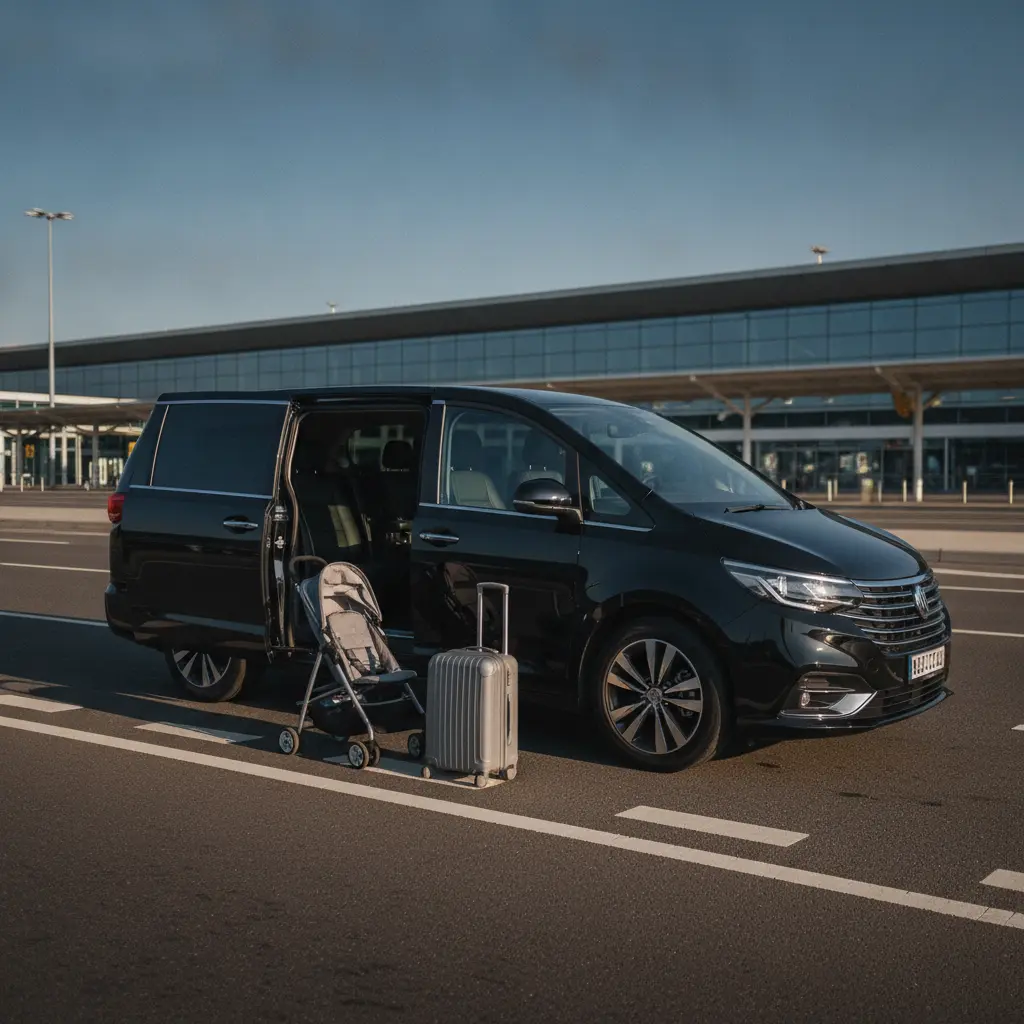
Getting into the vehicle is one of the most important moments of the transfer. For an elderly couple, the right car is less about luxury and more about accessibility and comfort. The vehicle chosen for Margaret and Robert had these features:
- High seats and sliding doors: Easier to enter without bending or climbing.
- Generous legroom: Reduces knee and hip discomfort on the journey.
- Climate control: The driver asked about the preferred temperature before setting off.
- Water: A small bottle of water is a simple but useful detail after a flight.
- Luggage space: The folded walker and two large suitcases fit comfortably.
- Smooth driving: No sudden braking or aggressive lane changes. Older passengers often prefer a calm driving style.
The route to Sultanahmet can involve traffic and narrow streets. It is worth checking in advance whether the hotel has a drop-off point at the entrance. If the vehicle cannot enter the street, the passengers may need to walk a short distance. Discussing this before arrival avoids surprises.
Hotel arrival and check-in support
Many transfer services end when the passenger reaches the hotel door. For an elderly couple, the real relief begins when they are inside the room. A little coordination with the hotel makes a difference:
- Tell the hotel the expected arrival time. If early check-in is not available, arrange luggage storage and lobby seating.
- If the hotel entrance has steps, ask the driver to help with luggage up to reception.
- Ask about lift access, room location and bathroom safety features such as grab bars and non-slip surfaces.
- Make sure the driver hands the luggage to the hotel staff and confirms the count.
- Keep a small amount of cash for tips. It is optional, but practical for luggage assistance.
Margaret and Robert could not check in early, but the hotel stored their bags and showed them a comfortable seating area. The transfer representative stayed until the luggage was handed over. That small wait prevented the couple from managing heavy bags in the lobby on their own.
Common mistakes that turn a good transfer into a stressful one
Most problems in elderly airport transfers come from missing information, not from budget. Here are the most common mistakes:
- Choosing on price alone: The cheapest option may not include a meeting service or luggage help. Ask what is included.
- Not declaring mobility needs: Saying “no problem” may lead to the wrong vehicle or insufficient staff. Be specific about walkers, sticks or wheelchairs.
- Leaving the meeting point vague: “At the exit” is not enough. Specify baggage hall, customs exit or terminal door.
- Not asking about flight tracking: Confirm that the provider monitors the flight and adjusts for delays.
- Under-reporting luggage: Include the walker and cabin bag in the luggage plan.
- Not providing a local phone number: A reachable number and WhatsApp contact are essential.
- Ignoring hotel arrival: Early check-in, lobby waiting and room access should be part of the plan.
- Booking too late: Suitable vehicles and assisted services can be limited in peak season. Book a few days ahead.
Most of these mistakes can be avoided with five minutes of focused questions at the time of booking. If you are arranging the transfer for someone else, write the details down and share them with both the provider and the passenger.
Cost and timing: what shapes the quote
Transfer pricing is not based on distance alone. For an assisted arrival, the quote may depend on the vehicle type, meet-and-greet service, luggage assistance, waiting time, time of day, hotel location and any special assistance request. Ask exactly what is included. A clear service description is more valuable than a low headline price with unclear extras.
Timing also matters. In summer, during public holidays and at busy airport hours, suitable vehicles may be limited. If an accessible vehicle or a large luggage van is needed, plan earlier. It is not responsible to quote fixed prices without knowing the date and service details; instead, confirm the scope in writing and read the cancellation and delay policy.
How Margaret and Robert's arrival came together
When the flight landed, Margaret and Robert took their time. They cleared passport control, collected their bags and walked towards the baggage hall exit. Seeing the name board was the moment the tension dropped. The representative took the suitcases, opened the walker and guided them to the lift. They made a short toilet stop inside the terminal, then went down to the vehicle level. The driver loaded the luggage, opened the door for Margaret and asked about the air conditioning.
At the hotel, the bags were handed to reception. Early check-in was not available, but the lobby seating was ready. Margaret's summary was simple: “The airport was going to be the hard part, but we never felt alone.” That is the measure of a good assisted arrival. The steps the passenger should not have to manage alone are handled by a prepared team.
When planning an Istanbul Airport transfer for an elderly couple, the goal is not the most impressive car. It is the least tiring and most reassuring journey. Build the needs profile, ask exactly what the service includes, confirm the meeting point and make the hotel arrival part of the plan. You can compare suitable vehicle options through Turlago private vehicle rental and create a transfer plan that fits the passengers, not just the route.