Sabiha Gokcen Airport Transfer: A Family of 7 Lands at Night
22:40 — The wheels touch down, and the real work begins
When the aircraft touched down at Sabiha Gokcen, Serkan had exactly one thing on his mind: getting seven people, six large suitcases and a folded stroller through the door of a rented flat in Fatih before the night was over. The flight from Berlin had been uneventful. The difficult part had not started yet.
This is not a ranking of "the best transfer companies in Istanbul." It is a step-by-step record of one family's arrival: what they arranged before landing, what actually happened at the kerb, where things went wrong, and what they changed the second time around.
In Sabiha Gokcen airport transfer planning, the hard part is not finding a car. It is having the right size of vehicle waiting at the right meeting point at the right time. That is not something you want to leave to the operator's judgement. For chauffeur-driven options and a look at vehicle classes, view VIP vehicle rental on Turlago is a sensible starting point.
The family profile: the real inputs to the plan
Most transfer bookings are submitted as a single line: "7 people, airport to hotel." That is nowhere near enough information. Serkan's first booking generated two different vehicle proposals and neither one was quite right, because the operator was missing at least eight details.
- Passengers: 7 (two adults, three children, two grandparents)
- Children's ages: 9, 6 and 2
- Checked luggage: 6 large cases, 23–28 kg each
- Cabin bags: 2
- Special equipment: 1 folding stroller, 1 portable booster
- Arrival time: 22:40 touchdown, roughly 23:30–23:45 out of the terminal
- Terminal: International arrivals
- Destination: Fatih, European side
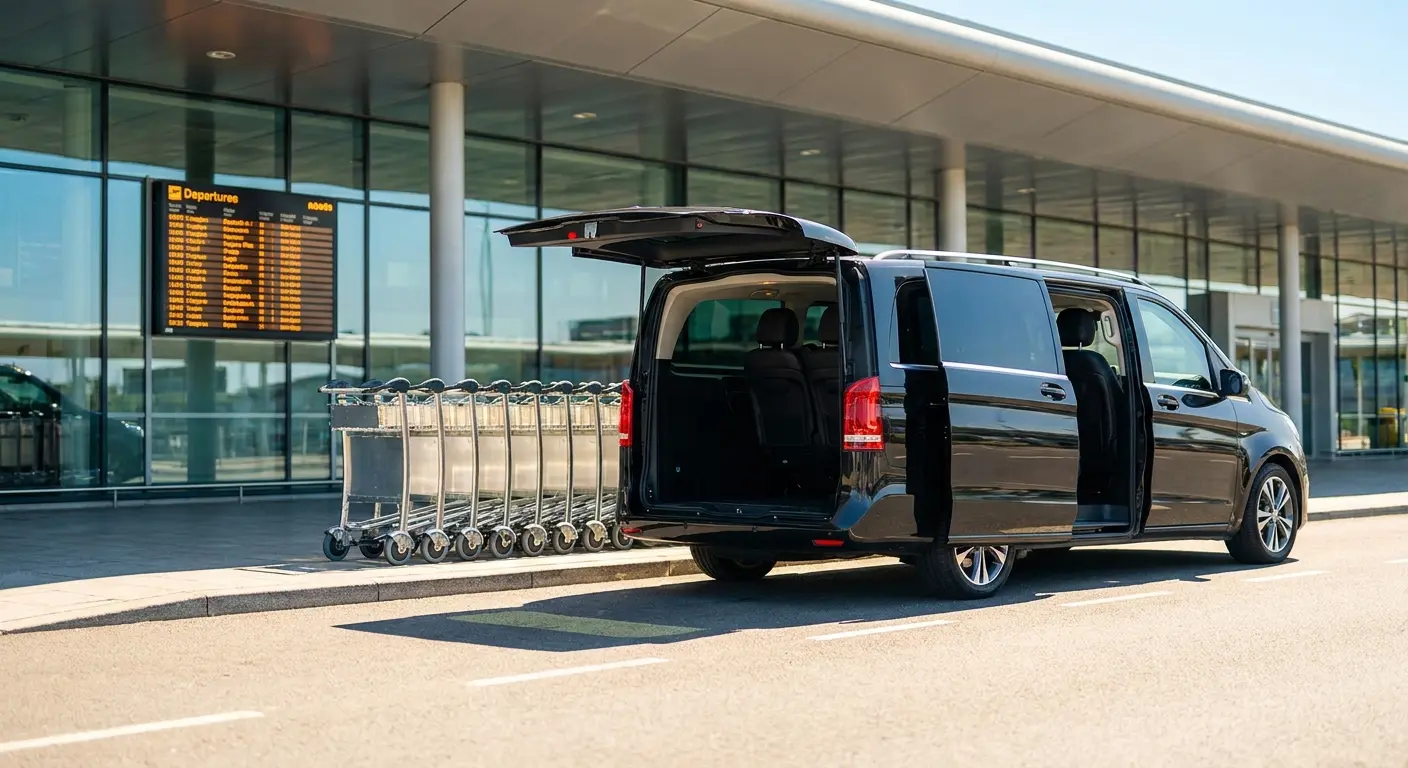
Those eight lines determine everything. Tell an operator "7 people" and you will be quoted a seven-seat vehicle. But a seven-seat vehicle does not mean seven people plus six large cases. The family discovered this at the kerb, with the luggage stacked on the pavement.
Why "how many passengers?" is the wrong first question
Vehicle classes are marketed by seat count, but real capacity is the sum of two independent calculations: seats and luggage volume. They fill up at different rates, and they rarely fill up at the same time.
- Sedan (economy): Comfortable up to 3 passengers; close to its limit with 2 large cases. Four passengers with four large cases usually does not fit.
- SUV / premium sedan: 3–4 passengers, 3 large cases. High comfort, still limited volume.
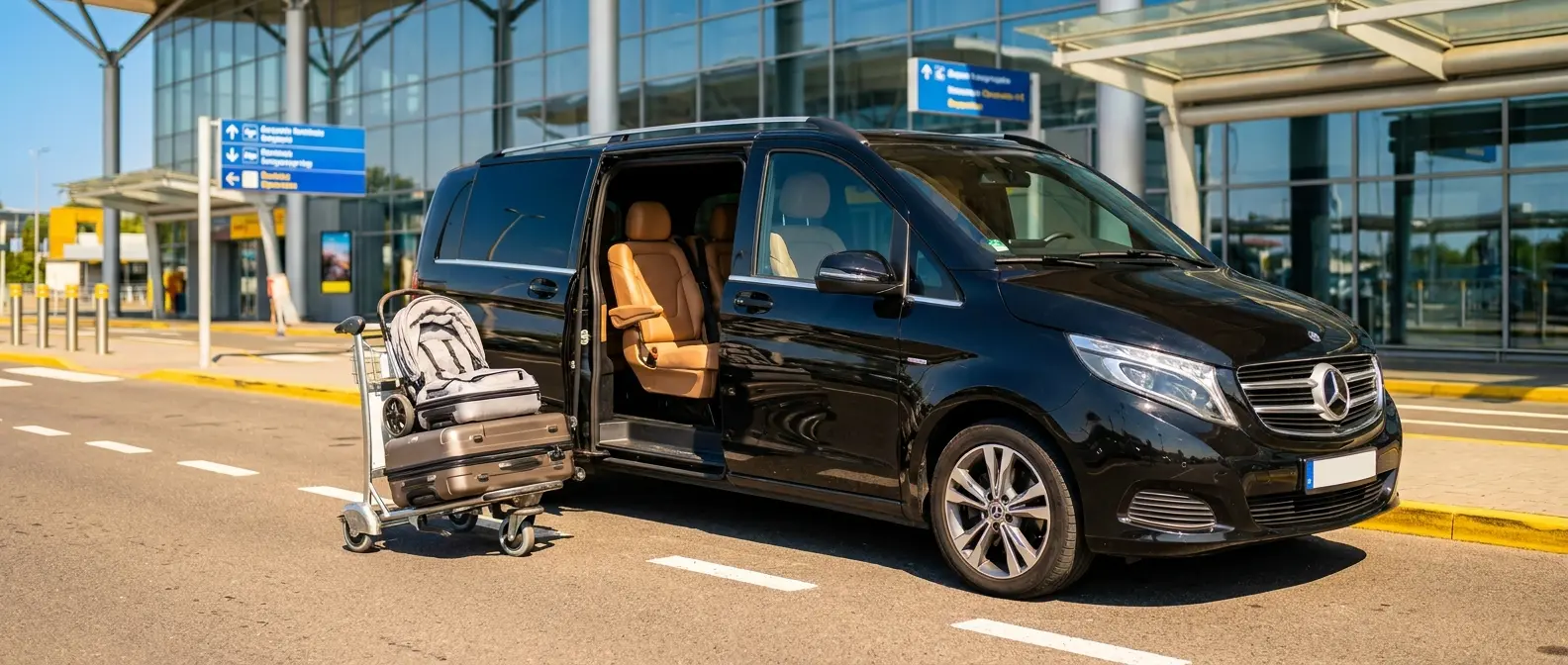
- VIP minivan (Vito / V-Class class): 4–6 passengers, 4–5 large cases. This is the class most often mis-sold to large families; seven people plus six cases will not fit.
- Minibus (Sprinter class): 10–15 passengers, 10+ large cases. For a family of seven, this is usually the correct answer.
Luggage maths you should not skip
A rough rule works well: one large suitcase occupies roughly 0.1–0.15 cubic metres. Six large cases, two cabin bags and a stroller will fill a sedan's boot twice over. Add the fact that cabin bags should not sit under passengers' feet for a 50-kilometre drive, and the minibus class becomes unavoidable.
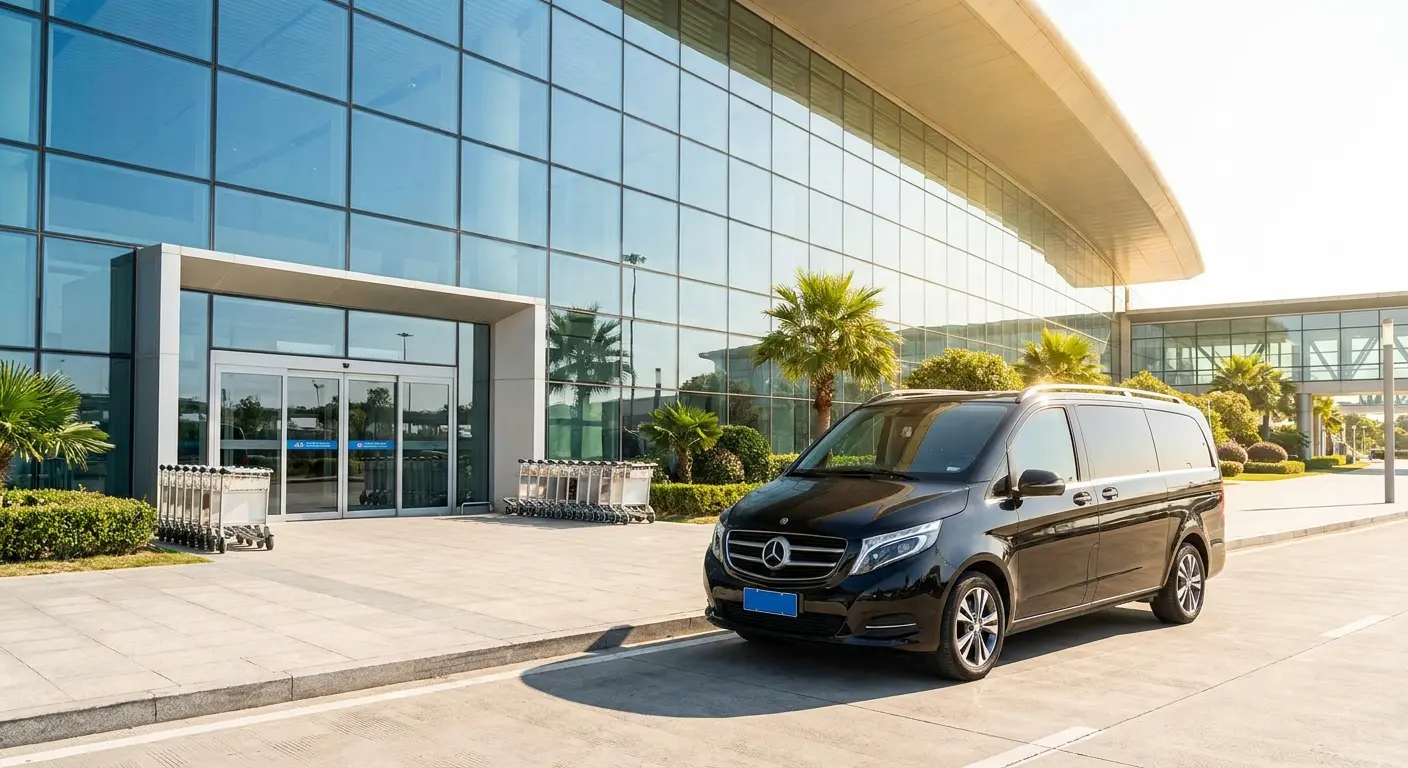
Serkan's first proposal was a VIP minivan. When the driver arrived at the airport and saw the luggage, he laid out the reality: either two passengers travelled in a second car, or part of the luggage travelled on laps. At 23:50, neither option was acceptable.
Child seats, strollers and passengers who need extra help
Child seats are the most commonly "forgotten" line item in a transfer booking. A two-year-old needs a proper child seat; a six-year-old needs a booster. Most fleets carry them, but they are not standard equipment — they are loaded only when requested. State the number of seats and the age group in writing at the time of booking.
For the stroller you have two choices: check it into the hold (and count it in your luggage volume), or take it to the gate and hand it over at the aircraft door. Either way, it will still be in your hands when you board the transfer vehicle.
One more note for passengers with limited mobility or for older travellers: minibus-class vehicles have a higher step than a sedan. Adding "step assistance requested" and "front seat preferred" to the booking notes removes ten minutes of confusion at the kerb entirely.
48 hours before the flight: locking the booking down
What helped this family most on their second trip was a written confirmation sent two days before departure. There is a very large gap between a phone call that ends with "no problem, we'll sort it" and a written confirmation — and at midnight at an airport, that gap is everything.
Eight items your written confirmation must contain
- Flight number and scheduled arrival time — so the driver can track the flight.
- A description of the meeting point — for example, "international arrivals, exit 3."
- Driver's name and mobile number.
- Vehicle make, model, colour and plate.
- Free waiting time — how long after landing is waiting included?
- Delay policy — if the flight is 90 minutes late, is there an extra charge?
- Total price and what it covers — bridge and motorway tolls, night surcharge, luggage.
- Payment and invoicing — cash or card, deposit required?
Putting those eight items into a single message is enough. Almost every argument at an airport kerb traces back to one of them being left vague.
The meet-and-greet moment: what happens in the first ten minutes
At Sabiha Gokcen, domestic and international arrivals exit through different areas. This is the single most common source of confusion for first-time visitors: the driver waits at the domestic exit while the passengers scan the crowd at international arrivals for a name board. Writing the terminal clearly on the booking solves it completely.
Once you walk out of the arrivals hall, follow this order:
- Collect a luggage trolley and move out of the crowd. Standing directly in front of the doors is the worst place to spot a sign.
- Switch your phone on and call the driver. Most drivers will call you first anyway.
- Confirm the plate and vehicle model — rely on the plate, not the sign.
- Tell the driver the number of bags up front, so any capacity problem is solved before you walk to the vehicle.
What happens if your flight is delayed
Flight tracking is standard practice in professional transfer operations. The driver arrives at the airport based on the actual landing time, not the schedule. Sharing your flight number removes the anxiety of "my flight is late" entirely. That said, it is worth asking in advance whether a delay pushes you past the free waiting window; some operators charge separately beyond a set threshold.
From Sabiha Gokcen to the European side at midnight
Sabiha Gokcen sits on the Anatolian side, in Pendik. Destinations such as Fatih, Sultanahmet, Beyoglu or Taksim on the European side sit roughly 45–55 kilometres away, depending on the route. By Istanbul standards, that is not a short hop.
Route and bridge choice
The standard route leaves the airport, joins the TEM or O-1 corridor and crosses one of the Bosphorus bridges. At night, traffic density drops noticeably compared with daytime, but "empty road" is not the same as "fast road": overnight maintenance, lane closures inside tunnels and works around bridge approaches can all add time.
Clarify at the time of booking whether bridge and motorway tolls are included. With fixed-price transfers they usually sit inside the package; with metered options they appear as a separate line.
How to set a realistic time expectation
Between 23:30 and 00:30, reaching the European side from the airport typically takes 50–75 minutes. Planning against the upper end of that range gives you a realistic arrival time once you factor in tiredness and unloading. If your hotel reception closes at 01:00, share that with the driver in advance.
An honest comparison of options for a large family
On the first trip, the family only considered private transfer. On the second, they put every option side by side. For seven people with heavy luggage, the result is fairly clear.
- Yellow taxi: Metered, so the final total is unpredictable. Seven people and six large cases will never fit in one taxi; in practice you need two vehicles, and two vehicles lose each other in traffic. The airport taxi rank may be short at night, but finding a large vehicle is down to luck.
- Metro (M4) plus Marmaray: The cheapest option and completely unaffected by traffic. However, service frequency drops late at night and last-train times should be checked on the day. With seven people, six cases and a stroller, a multi-leg journey adds a second layer of exhaustion on top of the flight.
- Airport shuttle buses (Havaist and similar): Direct to certain hubs, economical and reasonably luggage-friendly. But you get off at a stop and still need a taxi to your accommodation, and late-night frequencies can stretch.
- Hotel shuttle: Comfortable where your property offers it, but it may not run overnight and vehicle capacity is usually limited. Ask for written confirmation.
- Private transfer (fixed price): Door to door, agreed price, meet-and-greet included. For a family of seven, the decisive advantage is a single vehicle moving everyone in one go, with the luggage question already solved.
The summary: for a large family, cost alone is not the deciding factor. Number of transfers, luggage capacity and predictability late at night shape the overall experience.
How pricing actually works, and the questions that matter more than haggling
Transfer pricing in Istanbul is not tied to a single published tariff; it varies by operator, and verified current figures can only be established by requesting a quote. Rather than quoting numbers here, it is far more useful to understand what drives the price and what to ask.
Seven variables that move the price
- Distance: Airport to Fatih and airport to a distant western suburb are not the same journey.
- Vehicle class: Sedan, VIP minivan and minibus differ noticeably.
- Night surcharge: Usually applied between 22:00 and 06:00.
- Bridge and motorway tolls.
- Meet-and-greet and waiting time.
- Child seats and extra equipment.
- Extra stops: Even a supermarket stop en route can change the total.
Questions to ask before you confirm
- Is your quote all-inclusive, or can extra items appear later?
- Is a night surcharge applied?
- Who pays the bridge and motorway tolls?
- How much free waiting time is included if the flight is delayed?
- Is a deposit required, and what are the cancellation terms?
- Will an invoice be issued?
A traveller who gets written answers to those six questions does not get surprised at the airport. This was exactly the difference on the family's second trip: the price was fixed in advance, the scope was in writing, and the vehicle was at the kerb.
Six things that went wrong for this family, and the fix for each
1. The vehicle was the wrong size
A seven-seat VIP minivan was proposed, but the luggage did not fit. Fix: Send passenger count and luggage count in the same message, and confirm the class on "seats plus bags," not seats alone.
2. The driver waited at the wrong terminal
He held the sign at domestic arrivals while the family searched at international arrivals. Fix: Write "international arrivals" on the booking and share the flight number.
3. The meeting point was too crowded to spot a sign
Late at night, the international exit can be busy when several flights land together. Fix: Rely on the plate rather than the sign, and agree to meet a few metres away from the doorway.
4. No child seat
It was never requested, so it was never loaded. Fix: Request seats by age group at the time of booking and get written confirmation.
5. The stroller was not counted
The folded stroller consumed luggage space nobody had budgeted for. Fix: List the stroller as its own line in your luggage count.
6. A mid-route stop changed the price
Stopping at an open convenience store at midnight came with a price adjustment. Fix: Declare extra stops in advance, or accept a reasonable surcharge knowingly.
The return leg: avoiding the same mistakes in reverse
The second half of a transfer experience happens on the way out, and it is usually planned less carefully. The biggest risk on a run to Sabiha Gokcen is traffic: crossing from the European side between 07:00–10:00 or 17:00–20:00 can take far longer than a night drive.
Practical rules for departure day
- For international flights, set your hotel departure time with a traffic buffer, and agree it jointly with your driver.
- Book the return leg in the same reservation as the arrival transfer, not on the day. The rate and vehicle class stay consistent.
- Luggage usually multiplies on the way back. Account for shopping.
- For very early flights (around 06:00) you may need to leave the hotel at 03:00. Vehicle availability is tighter at that hour, so advance booking matters even more.
- Ask the driver which door you will be dropped at; the distance between terminals affects your walking time.
Seven common mistakes, in one list
- Reporting passenger numbers but never mentioning luggage.
- Not sharing the flight number.
- Leaving the domestic/international terminal distinction unclear.
- Not requesting a child seat, or not getting confirmation.
- Not asking what the price covers (tolls, night surcharge, waiting).
- Trying to meet right at the door in the middle of the crowd.
- Leaving the return transfer until the last day.
A one-page checklist
- ✅ Passenger count and age distribution
- ✅ Large cases, cabin bags, stroller
- ✅ Flight number, airline, landing time, terminal (domestic or international)
- ✅ Vehicle class and plate number
- ✅ Driver name and phone number
- ✅ Meeting point description (exit number / level)
- ✅ Free waiting time and delay policy
- ✅ Total price and scope (bridge, motorway, night surcharge included?)
- ✅ Child seat / booster request
- ✅ Payment method and invoice
- ✅ Full destination address and hotel reception contact
Three rules for a late-night arrival with a large family
On their second trip, the family took the same flight, at the same hour, to the same destination. The only thing that changed was the preparation. The result: no arguments at all between walking out of the terminal and opening the door of the flat.
Three rules came out of it:
- Calculate capacity by seats and bags together. Seven people and six large cases does not mean a seven-seat car; it means the minibus class.
- Get everything in writing. Price, scope, meeting point, waiting time and child seats. Anything left verbal becomes a negotiation at midnight.
- Give the flight number and let tracking do the rest. Delays are the most common source of late-night stress, and the easiest problem to eliminate.
A good Sabiha Gokcen airport transfer experience does not come from a magical company. It comes from asking the right questions at the beginning. Settling your vehicle and route in advance leaves you with only one job once you finally sit down: closing your eyes. For chauffeur-driven and fleet options, start with view VIP vehicle rental on Turlago and compare suitable options by date and vehicle class.