St. Petersburg & Moscow Tour: Picking the Right Season for 6 Days
Six days is a generous slice of time for St. Petersburg and Moscow — until you realise that the same six days can feel like two completely different trips depending on the month you book. Both cities are unusually sensitive to light and temperature: St. Petersburg sits at 60° north, where late June nights barely get dark and mid-December daylight is gone by late afternoon. Moscow, 700 kilometres inland, runs hotter in summer and colder in winter. If you are weighing up dates for the St. Petersburg and Moscow tour on Turlago, this guide reads the real day-by-day programme through a seasonal lens — not to tell you which month is "best", but to show what each month actually does to each part of the itinerary.
What a season can and cannot change on this itinerary
Start with what stays fixed. The tour structure does not move: a Pegasus flight from Istanbul Sabiha Gökçen to St. Petersburg, two panoramic city tour days plus free time in St. Petersburg, a train transfer to Moscow, a panoramic Moscow city day, and a final day returning to Istanbul. The included services are equally stable — return flights, the Moscow–St. Petersburg train, airport taxes, five nights in 4-star hotels on bed and breakfast, all airport-hotel-airport transfers, both panoramic city tours, guiding and city taxes.
What changes is everything that happens on top of that skeleton. Three things in particular:
- Hours of daylight. Panoramic city tours happen outdoors, so light directly determines whether the first impression of a city is a photograph or a silhouette through a bus window.
- Crowd rhythm. The Hermitage alone holds more than three million works; in peak season the palace rooms move slowly, while late spring and early autumn let you actually look at what you came for.
- The value of optional tours. A river cruise, a palace excursion or a walking district can be the highlight of a warm evening and a chore on a wet, cold one. Same price, different experience.
So the useful question is not "when is it cheapest" but "which part of this route do I care about most — outdoors, interiors, or light?" The answer usually picks the month for you.
The White Nights window: mid-June to early July
St. Petersburg's famous White Nights stretch roughly from mid-June to the first days of July, when the sky never fully darkens. For this specific programme, the practical benefits are concrete:
- Day 1 panoramic tour: The route past the Pushkin Monument, Gostiny Dvor, the Cruiser Aurora, the Beloselsky-Belozersky Palace, the Admiralty and Moskovskaya Street works at almost any hour. In the White Nights you can step off a flight and still see the city in usable light. In November, the same route becomes a narrated drive past dim shapes.
- Day 4 in Moscow: Poklonnaya Hill and the Moskva River embankments are far more photogenic when the evening light lingers.
- Evening add-ons: The dinner-show Russian Night (€140 per person) and the Radisson river cruise (€150 per person) both fit neatly into a late sunset without clashing with darkness.
The trade-offs are equally real. These are the busiest weeks of the year, palaces and museums are at their most congested, and prices for extras sit near their annual peak. The midnight brightness also disrupts some travellers' sleep — worth factoring in if the next morning starts early. The White Nights suit people who want to live the city; they are less suited to those who want quiet, efficient museum time.
Late May, early June and September: the balance point
If you want one recommendation from someone who has read a lot of traveller feedback on this route, it is this: late May to early June, or September. Here is why that window works so well for this particular six-day structure:
- Enough light, without the extremes. Panoramic tours get the daylight they need, but you are not dealing with midnight sun at bedtime.
- Manageable crowds. The Hermitage becomes navigable rather than a scrum, and Palace Square is not shoulder-to-shoulder.
- Rain is survivable. At these latitudes weather is variable in every month, but mild temperatures turn a shower into "wear a jacket" rather than "lose the day".
- Walking comfort. Pushkin Town and Catherine Palace, New Holland Island, Arbat Street and Red Square are all outdoor-heavy in this programme. Mild weather is what makes them enjoyable rather than endurance tests.
September has a specific advantage for the Moscow leg. The Moscow section of this tour is genuinely outdoor: Tverskaya Street, the Moskva River, Poklonnaya Hill, Red Square and the Kremlin's palace square. Once the continental summer heat breaks, those hours on foot become the best part of the day rather than something to survive.
October to April: quiet cities, short days, serious clothing
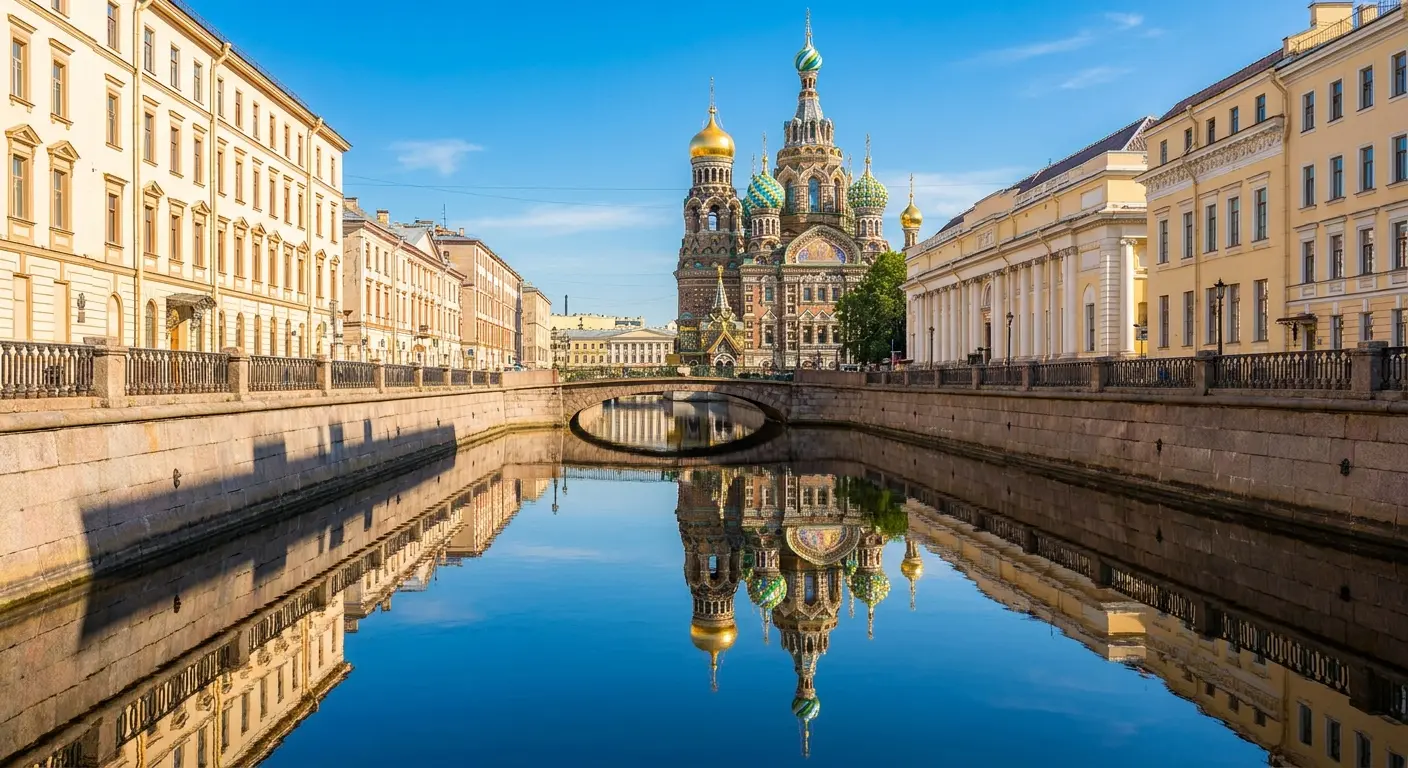
It would be unfair to write off the cold half of the year, but it is also unfair to pretend it behaves like summer. From November to mid-March, St. Petersburg gets only a few hours of daylight and temperatures stay below freezing for long stretches. That shortens the outdoor parts of the programme — the panoramic city tours — and strengthens the indoor parts: the Hermitage, St. Isaac's Cathedral, Kazan Cathedral, the Church of the Savior on Blood, and the Moscow Metro. If you book a winter departure, set expectations like this:
- The panoramic bus tour becomes a "see the landmark, then go inside" rhythm. Do not plan long outdoor walks.
- Visually, the cities are spectacular — Catherine Palace's baroque facade under snow is a genuinely different tour. But it means dressing in layers for six days straight.
- Moscow's cold bites harder, so keep the Arbat walk short and lean on the metro tour. Opened in 1935 and now one of the world's largest and busiest systems with 268 stations, the Moscow Metro is the best bad-weather shelter in the city.
- Winter is the quietest season: fewer queues, calmer museum halls, more space to actually look.
In short, winter is an architecture-and-interiors tour, not an outdoor one. Late April is the transitional month: days lengthen, but the weather is still deciding what it wants to be.
The programme, day by day, with seasonal notes
The flow below is the actual published itinerary; each day ends with how the season changes it.
Day 1 — Istanbul to St. Petersburg: the first impression depends on light
Meet at Istanbul Sabiha Gökçen international terminal at 07:00, three hours before departure. After baggage, ticket and passport formalities, fly with Pegasus to St. Petersburg. On arrival, a welcome and a panoramic city tour by private coach: the Pushkin Monument, Gostiny Dvor, the Cruiser Aurora, the Beloselsky-Belozersky Palace, the Admiralty building and Moskovskaya Street. Transfer to the hotel and free time. In the evening, an optional dinner-show Russian Night (€140 per person).
Seasonal note: This day's value is entirely about light. During the White Nights the panoramic tour runs in near-golden light and the city is won on day one. In winter, it may already be dark when you arrive — in which case treat the drive as route orientation and a mental map for the following days.
Day 2 — Hermitage, St. Isaac's, Kazan, Palace Square and the Church on Blood
Breakfast, then free time. The optional St. Petersburg Combined Tour (€105 per person) covers the Hermitage with entry included, St. Isaac's Cathedral, Kazan Cathedral, Palace Square and the Church of the Savior on Blood. The Hermitage's collection spans antiquity, Western European art and the Middle East across more than three million works; it traces back to Empress Catherine the Great's 1764 purchase of a collection of Western European paintings.
Seasonal note: This looks like the least weather-dependent day, but it is not. In peak season the Hermitage moves slowly and the combined tour stretches; in shoulder months you can walk Palace Square and the canal-side church at your own pace. If you take the combined tour, aim for an early museum slot in any month.
Day 3 — Pushkin Town, Catherine Palace and New Holland Island
Breakfast, then free time. The optional Pushkin Town tour (€75 per person) visits the town where the imperial aristocracy met the tsar's family, including the school where the poet Pushkin studied, and continues with a panoramic visit to Catherine Palace. Built in 1717 and a showcase of baroque splendour, the palace served as a summer residence for Empress Elizabeth and Catherine the Great in the late 18th century. Back in St. Petersburg, there is an optional New Holland Island tour (€55 per person).
Seasonal note: This is the programme's outdoor day. Pushkin Town and New Holland Island are twice as good in dry, mild weather; in rain, the palace interiors rescue the day but the island loses its point. Between May and September this is often the most enjoyable day of the whole six.
Day 4 — Train to Moscow: the most weather-sensitive day
Early breakfast box, transfer to the station, board the train and travel to Moscow. On arrival, a welcome and a panoramic Moscow city tour including Tverskaya Street, the Moskva River, Poklonnaya Hill, the famous Bosoi Theatre, Red Square and the Kremlin's palace square. Transfer to the hotel, room allocation and free time. In the evening, an optional dinner cruise on the Radisson river boat (€150 per person) — dinner on board while Moscow glides past under the night lights, then a coach back to the hotel.
Seasonal note: Two components here are heavily seasonal: the outdoor city tour right after leaving the train, and the evening cruise. In summer the cruise is clearly the best optional of the trip. In cold months, choose a boat with covered seating and dress in layers knowing a long outdoor coach tour comes immediately after the train. In deep winter this day can compress to "transfer, hotel, short tour" — which makes the next day's metro content even more valuable.
Day 5 — Moscow Metro, Arbat and Novodevichy Cemetery
Breakfast, then free time. The optional Moscow Combined Tour (€120 per person) starts at Novodevichy Cemetery, where the Turkish poet Nazım Hikmet is buried alongside many figures from Russian history. It continues with a metro tour — opened in 1935, the system has 268 stations and is one of the largest and busiest in the world, with central stations whose architecture is an attraction in itself — and finishes on Arbat Street.
Seasonal note: This is the most weather-proof day of the itinerary because the weight sits underground. In winter it is the most efficient day you will have; on a wet autumn day it rescues the programme. The Arbat section is outdoor, so it runs longer in summer and shorter in winter. Booking this combined tour for day five rather than the final day also keeps departure day relaxed.
Day 6 — Izmailovo market and the flight home
Breakfast at the hotel, then free time until the guide's appointed hour. The optional Izmailovo shopping and market tour (€40 per person) takes you by private coach with a guide to the market known for antiques and souvenirs. Transfer to the airport, complete baggage and passport formalities, and fly back to Istanbul with Pegasus. Services end on arrival.
Seasonal note: The market is largely outdoors — keep it short in winter, linger in summer. Since this is the day your luggage gets heavier, plan weight limits before you shop.
Choosing optional tours by season and by budget
The optional extras add up to a serious sum on top of the tour price, so prioritise rather than collecting them all:
- St. Petersburg Combined Tour — €105: First priority in any month. Mostly indoors, with Hermitage entry included.
- Moscow Combined Tour — €120: Second priority in any month. The metro section neutralises bad weather.
- Pushkin Town Tour — €75: High value from spring to autumn; in winter the palace interior carries it.
- New Holland Island Tour — €55: The most clearly warm-weather option. Skip in rain or snow.
- Russian Night dinner show — €140: Indoors, so season-proof. Better on night two than night one if you are jet-lagged.
- Radisson river cruise — €150: The most seasonal item on the list. Peak value on a summer evening.
- Izmailovo shopping tour — €40: Works year-round, shorter in winter.
Every optional together can reach roughly €685. Knowing that upfront lets you build a realistic "tour plus extras" budget. Note that museum and site entry fees are not included in the tour price.
What the price covers, and where the season quietly adds cost
The listed tour price is 37,119 TRY, and the inclusions are broad: Pegasus flights Istanbul SAW–St. Petersburg LED and Moscow VKO–Istanbul SAW, the train between Moscow and St. Petersburg, airport taxes and services, five nights in 4-star hotels on bed and breakfast, all airport-hotel-airport transfers, panoramic city tours in both cities, guiding services and city taxes.
Excluded, and worth budgeting separately: travel health insurance (€20), the overseas exit fee, hotel extras and personal spending, optional tours and activities, museum and site entrance fees, and the visa fee plus service charge. The season does not change these line items directly, but it changes what you spend around them — food, local transport, souvenirs and hotel extras all rise in peak periods and soften in quiet ones. With a capacity of 100 guests, popular dates can fill early, so once your month is settled it pays to reserve rather than wait.
Packing for four different versions of the same trip
- May to September: Light walking shoes, a thin waterproof shell, layers, sunglasses. Even in summer, evenings near water can turn cool.
- October–November and March–April: Waterproof shoes with grip, a windproof outer layer, an umbrella. Expect rain during panoramic coach tours.
- December to February: Thermal base layers, insulated gloves, hat, scarf, non-slip soles. Interiors are warm, so removable layers matter — you will spend hours inside museums.
- Every season: Passport, visa paperwork, insurance printout, exit-fee receipt, power bank, adapter, and a small day bag for the train day.
Visa, insurance and exit fee: not seasonal, but expensive to forget
The most common disruption on this route is not the weather — it is paperwork. The visa fee and service charge are not included, travel health insurance (€20) is separate, and the overseas exit fee is your responsibility. Because the group meets at Sabiha Gökçen at 07:00, three hours before the flight, leaving documents to the last day multiplies the stress. Start the visa and insurance process the day you fix your dates, and settle the exit fee at least a week before departure. In winter, when flight delays are more likely, missing paperwork turns a delay into a lost day.
Eight questions to answer before you book
- Am I an outdoor or an indoor traveller? Outdoor: May to September. Indoor: winter holds up well.
- Does photography matter to me? Then aim for the White Nights window or September light.
- Do crowds drain me? If yes, avoid the midsummer peak.
- Can I budget for optional tours? If not, a quieter season reduces your dependence on outdoor excursions.
- How well do I handle cold? If you hesitate, rule out December to February.
- Am I ready for the early train day? A breakfast box is provided, but the start is early.
- Will shopping happen on the last day? If so, plan luggage weight in advance.
- Are my dates flexible? If they are, a calmer week of the same programme always works better.
The season is a choice; the programme is fixed
The strength of this six-day route is that its skeleton does not depend on the calendar: two cities, one train journey, two panoramic tours and a rich menu of optional excursions. In the White Nights you see the city in daylight at midnight; in September you get a calmer Hermitage and comfortable walking; in winter you turn the trip into an architecture-and-interiors tour anchored by the metro and the palaces. Whatever month you pick, read the balance between outdoor and indoor content in the itinerary — because that is exactly what the month changes.
For current dates, pricing and availability, view the St. Petersburg and Moscow tour on Turlago and compare the day-by-day programme against your own calendar. The right month is less about the city and more about the expectations you bring to it.