Uzbekistan Tour 2026: Silk Road Guide and Travel Notes
Uzbekistan 2026: one itinerary, four very different journeys
When people ask about a Uzbekistan tour, the question is rarely about the route. It is almost always about the date. The stops stay the same, but what you actually experience between late June and the end of September changes more than most travellers expect — how hot the afternoons get, how long the light lasts, how crowded the madrasah courtyards feel, and even how much walking you will genuinely enjoy.
The 2026 Summer Season tour with Turkish Airlines, Glorious Uzbekistan: Pearl of the Silk Road, runs on four departure dates: 24 June, 15 July, 19 August and 30 September. It is a 6-day, 5-night programme with 4-star half-board accommodation, Turkish-speaking guiding, and flights on Turkish Airlines. You can open the full listing and read the day-by-day plan at view the Glorious Uzbekistan: Pearl of the Silk Road tour on Turlago. What follows is not a hard sell on any single date — it is a decision tool, written from the actual itinerary, the included services and the real pricing on the listing.
What each departure date actually feels like
Uzbekistan has a continental, dry climate. Summer is genuinely hot, and the difference between late June and late September is the difference between a physically demanding trip and a comfortable one. Here is how each date plays out in practice.
24 June — the softest face of summer
Late June is summer before it peaks. Days are warm, but evenings still cool down, which matters enormously for the first days of the route. The tour starts with an early morning arrival in Urgench at 07:10 local time followed by a transfer straight to Khiva and an immediate city tour. At the end of June, those morning hours are both cooler and softly lit — the mud-brick walls of Khiva read beautifully on camera at that hour.
There is a second advantage. Domestic tourism inside Uzbekistan has not yet hit its peak, so iconic stops such as Registan Square in Samarkand are noticeably calmer. If crowds drain your energy faster than heat does, 24 June is the most balanced option on the list.
15 July — hottest, but longest days
Mid-July gives you the longest daylight of the year. Evening meals can be enjoyed outdoors well into the night, and you will still have light in the sky when you return to your hotel after the city tours. The trade-off is that daytime temperatures are close to their annual peak, and long stretches of open-air walking in Bukhara and Samarkand can be genuinely tiring around midday.
If you choose this departure, plan around shade. The itinerary is not an open-air marathon — there are regular pauses at shaded courtyards, madrasah interiors and museum sections, including Labi Hauz, the Poi Kalon complex and the Chor Minor. Increase your water intake well beyond what feels necessary, and pack light cotton clothing and a wide-brimmed hat.
19 August — summer starts to break
Mid-August is still summer, but it is summer on the way down. Evenings become noticeably more liveable than in July, and since dinner is part of the programme every night, that difference goes straight into your comfort level. It also coincides with the beginning of harvest season, which means the stalls at Siab Bazaar are fuller — dried fruit, spices, breads and seasonal produce appear in far greater variety.
30 September — the most comfortable date
Late September is when this route becomes truly easy to walk. Temperatures drop, days shorten but remain long enough, and the climbs and narrow lanes become far less tiring. The walk up to Shah-i-Zinda in Samarkand, the tight alleys of the Jewish Quarter in Bukhara and Tashkent's wide boulevards all feel better at this time of year. The catch: evenings are cool, so pack a light jacket or cardigan.
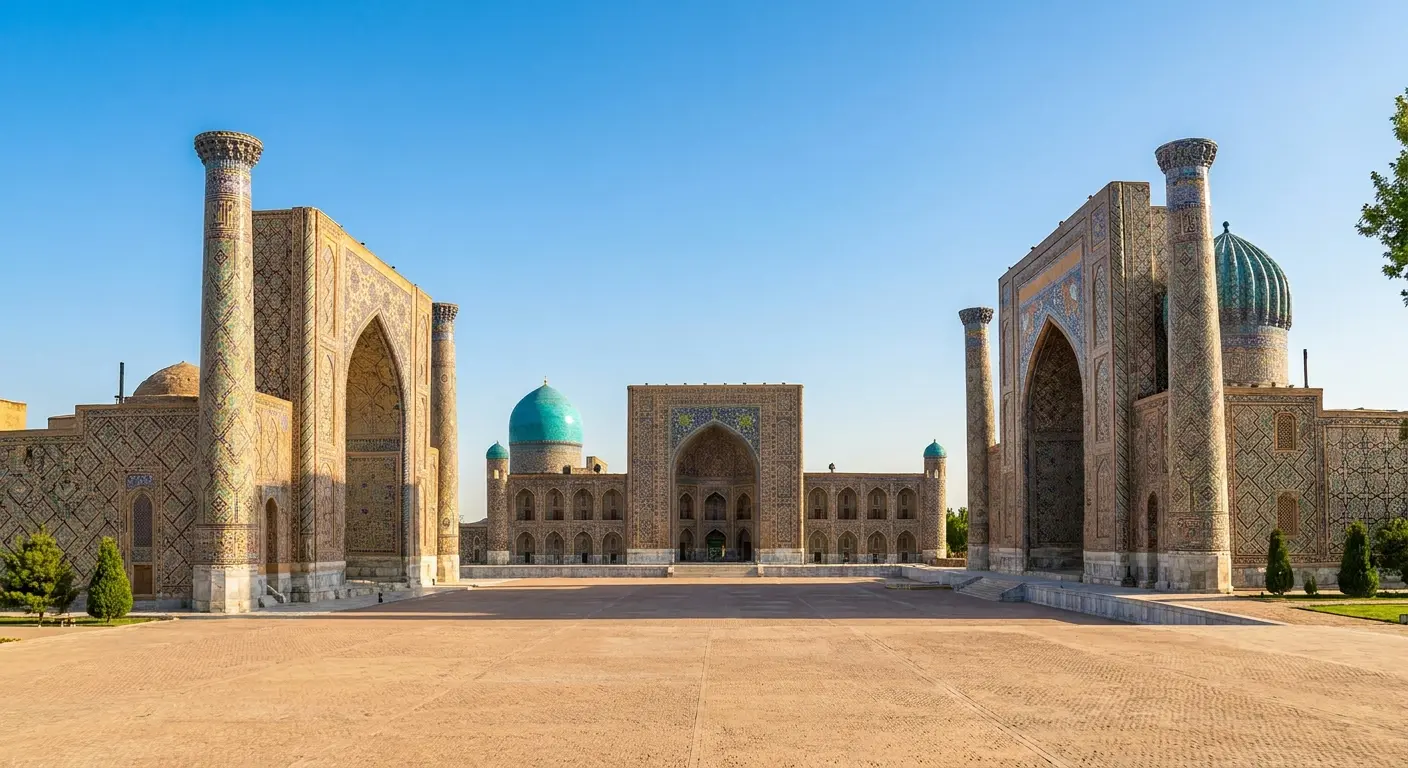
For photographers, one specific note. As the sun angle lowers in late September, the turquoise and cobalt tilework of Samarkand's madrasahs appears deeper and more saturated than in high summer. If tile photography is a priority, this is your date.
Day-by-day: how the season shapes each leg
The programme itself does not change. Only the light and the temperature do. Here is the route as it actually runs.
Day 1 — Istanbul to Urgench, then Khiva
Meeting point is at Istanbul Airport's international departures terminal, at the Turkish Airlines counter, three hours before the flight. There is one detail that catches people out every season: the flight departs at 01:20, which means you must be at the airport the evening before your stated departure date. If your calendar says 24 June, you are at the airport on the evening of 23 June. Build your plans around that.
Flight TK 262 departs at 01:20 and arrives in Urgench at 07:10 local time. A waiting vehicle takes the group to Khiva, and the city tour begins on arrival. This is the hardest day of the trip, physically. Sleeping on the plane is the single most practical thing you can do to make the first day enjoyable.
Day 2 — Khiva to Bukhara
After breakfast at the hotel, the group departs for Bukhara. On arrival, you check in and get free time. Dinner is served at a time set by your guide, somewhere among Bukhara's extraordinary architecture, followed by more free time and an overnight stay. This day is designed as a breathing space after the long transfer, and it is worth using it that way — rest at the hotel rather than pushing through the heat.
Day 3 — Bukhara city tour
One of the fullest days of the programme. Bukhara is one of Uzbekistan's oldest and most historically significant cities, long a cultural and religious centre of Central Asia, and a major seat of Islamic learning for centuries. It sits on the UNESCO World Heritage List, and its madrasahs, mosques and hammams make it feel like an open-air museum.
Stops on the tour include:
- Labi Hauz Mosque and the pool-side square around it
- The Jewish Quarter's narrow, shaded lanes
- The Poi Kalon complex
- The Kalon Minaret, commissioned by the Karakhanids, the first Turkic Islamic state
- Mir-i-Arab Madrasah
- Ulugh Beg Madrasah
- Chor Minor
In summer, finding shade is the whole game. The Jewish Quarter's tight streets act as natural cover, and a good guide will schedule that section for the hottest part of the day. Labi Hauz, by contrast, is ideal for the evening meal and free time.
Day 4 — Bukhara to Samarkand
After breakfast, the group moves on to Samarkand. Sitting at a strategic point on the Silk Road and long a cultural and commercial hub of Central Asia, it is among the oldest and most captivating cities in Uzbekistan. This day mixes religious, scientific and commercial heritage in a single sweep:
- Imam al-Maturidi and Ubaydullah Ahrar
- The Afrasiab Museum of Archaeology
- Paper workshops still producing with 8th-century techniques
- Gur-e-Amir, the tomb of Amir Timur
- Registan Square with the Ulugh Beg, Sher-Dor and Tilya-Kori madrasahs
- The Ulugh Beg Observatory
- Kukeldash Madrasah
- Siab Bazaar
- Shah-i-Zinda necropolis
After the tour, transfer to the hotel, free time, then dinner. This is the day with the most time spent in the open, and Registan Square offers almost no shade. Do not leave the hotel without a hat, sunglasses and a full water bottle.
Day 5 — Samarkand to Tashkent
Breakfast, then departure for Tashkent. Uzbekistan's capital and largest city is one of Central Asia's most important cultural, commercial and industrial centres, with a history reaching back to the 2nd century BC and a place on the Silk Road. It is a city where the modern and the traditional are layered on top of each other.
City tour highlights:
- Barak Khan Madrasah
- Kaffal Shashi Mausoleum
- Tilla Sheikh Mosque
- The original Uthman-era Quran manuscript held at the Muslim Board of Uzbekistan
- Kukeldash Madrasah
Tashkent is the coolest and greenest stop on the route. Wide boulevards and tree-lined avenues take the edge off the summer heat, so treat this day as the recovery leg of the trip.
Day 6 — Tashkent to Istanbul
Breakfast, then transfer to the airport at a time set by your guide. After baggage, ticket and passport formalities, flight TK 367 departs at 15:15 for Istanbul and lands at 18:40 local time. The tour ends there. Because the last morning is free until the transfer, packing your suitcase the night before makes the final day noticeably calmer.
Handling summer heat on walking tours: a practical routine
Whichever date you pick, Uzbekistan in summer is hot. These habits make a measurable difference:
- Start early. The programme already begins after breakfast; the goal is to push shaded sections into the morning hours.
- Move indoors at midday. The Afrasiab Museum, the paper workshops and madrasah interiors all provide natural relief.
- Drink more than you think you need. Closed bottled water is supplied in the vehicle throughout; keep your bottle topped up.
- Dress for the climate and the culture. Light, loose, light-coloured cotton works best. A thin scarf or cardigan that covers shoulders and knees is useful both at religious sites and in direct sun.
- Choose the right shoes. Stone-paved courtyards and cobbled lanes favour a flat, closed walking shoe over sandals.
- Watch your phone battery. Heat drains batteries fast. Carry a power bank.
Budget: what 60,825 TRY covers and what it does not
The listed starting price is 60,825 TRY with a capacity of 100 people. Knowing exactly what is included is the fastest way to build an honest budget.
What is included
- Turkish Airlines flights: Istanbul – Urgench and Tashkent – Istanbul
- Airport taxes
- Airport–hotel–airport transfers and intercity transfers
- 5 nights / 6 days half-board in 4-star hotels, with breakfasts and dinners
- Guided city tours in Khiva, Bukhara, Samarkand and Tashkent
- Museum and heritage site entrance fees
- Closed bottled water in the vehicle
- Turkish-speaking guiding throughout
What is not included
- Turkish international departure fee
- Travel health insurance
- Closed drinks ordered with meals
- Driver and guide tips (EUR 2 per day for the driver, EUR 3 per day for the guide)
Because tips are calculated daily, keep small euro notes on you. Lunches are not part of the programme either, so budget a daily amount for those. Set aside a separate fund for souvenirs and bazaar shopping as well — Siab Bazaar and the handicraft stalls in Bukhara are difficult to walk past.
Visas, passports and paperwork: the timing that matters
The tour is listed under visa-free and visa-on-arrival / e-visa categories, which removes a significant layer of pre-trip stress. The essentials still apply:
- Passport validity: at least six months beyond your return date. This is the most commonly overlooked issue and the most annoying to fix late.
- Departure fee: not included, so sort out payment before you reach the airport.
- Travel health insurance: not included — arrange your own cover.
- Two fixed times: the counter meeting three hours before departure on day one, and the guide-set airport transfer on day six. Put both in your calendar.
Which date suits which traveller
A quick matching guide to shorten the decision:
- Hate the heat: 30 September. Clearly the most comfortable date.
- Families tied to school holidays: 24 June and 15 July align with the Turkish summer break.
- Photographers: 30 September gives the lowest sun angle and the richest tilework; 24 June gives the longest daylight hours.
- Crowd-averse travellers: 24 June and 30 September sit on the shoulders of the season and tend to be quieter.
- Bazaar and harvest enthusiasts: 19 August.
Frequently asked questions
How long is the tour?
Six days and five nights, with half-board accommodation in 4-star hotels — breakfasts and dinners are included.
Which cities are visited?
Khiva, Bukhara, Samarkand and Tashkent, in that order, each with a guided city tour.
Which airline operates the flights?
Turkish Airlines. Outbound TK 262 Istanbul – Urgench; return TK 367 Tashkent – Istanbul.
Is the guide Turkish-speaking?
Yes, Turkish-speaking guiding is provided throughout the tour.
How large is the group?
The listed capacity is 100 people, so expect a substantial group. On large-group tours, walking near the front of the group helps you catch what the guide is explaining.
Are tips mandatory?
They are not included, but the amounts are stated openly in the listing: EUR 2 per day for the driver and EUR 3 per day for the guide. Build them into your budget.
The bottom line: choose the date for yourself, not for the route
Khiva's mud-brick walls, Bukhara's madrasahs, Samarkand's tiled domes and Tashkent's broad avenues will look magnificent whenever you arrive. What changes is the light you see them in and the temperature you walk through. If you handle heat well, 15 July gives you the longest days. If comfort comes first, 30 September is comfortably the best choice. And if you want a balanced middle ground, 24 June is the sweet spot.
To see the full programme, the day-by-day flow and the complete list of included services in one place, view the 2026 Summer Season Glorious Uzbekistan: Pearl of the Silk Road tour on Turlago. Comparing the four dates side by side and checking live availability is the quickest way to commit.