Yacht Rental in Istanbul for a Proposal: A Family Story
It All Started With One Question: 'What About a Boat?'
A request that reached our Istanbul team last summer is still fresh in my mind. The person on the phone was not the one planning to propose — it was his older sister. Her brother Ali had decided to ask his partner Elif to marry him, but after weeks of thinking he still couldn't pick a setting: a restaurant, a waterfront, or a boat? Every option came with a small worry, and every small worry made him back off. Eventually the family stepped in, said "let us organize this," and called us.
I'm writing this piece to bring together everything we discussed during that process. Because anyone considering yacht rental in Istanbul for a marriage proposal tends to carry the same questions: Which boat fits? How many people should be there? What time should we set off? What if the weather turns? How do you keep the surprise intact? And perhaps most important of all — is this really suited to a whole family, or only to a couple who want to be alone? Below, I'll answer all of these through Ali's family story, with concrete steps you can actually use.
How a Proposal Became a Family Project
The moment Ali's family got involved, the whole thing shifted. A plan that had been living in one person's head suddenly became a ten-person organization, and that meant it landed on much firmer ground. His sister started with the simplest question of all: "How many of us will be there?" Getting that first answer right determines everything else — the size of the boat, the departure time, the styling and the logistics.
Within our first week of conversations, we settled the most important point: was this a private, two-people-only moment, or a proposal with the family as witnesses? Ali was initially hesitant, because he doesn't like marking romantic moments in a crowd. But he very much wanted a celebration right after the question. So we found the middle path: a private moment on one part of the boat, and a celebration with the family on the rest. That single distinction ended up shaping the boat choice. If the whole vessel is wooden with a single deck, that private moment is hard to create. But on a two-level motor yacht, the upper deck can be yours and the lower deck can hold the family.
Who Is a Proposal Yacht Actually For? Four Group Profiles
The same service doesn't promise the same thing to everyone. So the question "who is yacht rental for a proposal suited to?" has no single answer. During Ali's process we actively separated four profiles — and you'll likely recognize your own group among them.
1. Couples Alone: When Privacy Comes First
If what you want is simply a two-person moment with no other witnesses, a small motor yacht or a classic yacht is the right address. The boat can be relatively compact here; what matters is a crew that works discreetly and privacy on deck. Ali's family didn't fit this profile, but plenty of couples we've spoken with choose exactly this. In a couple-only scenario, a single elegant table, soft music and a short route are usually all you need.
2. Families: A Proposal With Witnesses
This is exactly where Ali's group landed. When a family joins in, the proposal turns from a single moment into a shared family memory. But there's a fine line to respect here: too much family involvement can overshadow the proposal itself. Our approach was to have the family present for the celebration at full strength, and standing further back during the actual question. To strike that balance, we planned the deck layout in advance.
3. Close Friends: Energetic and Crowded
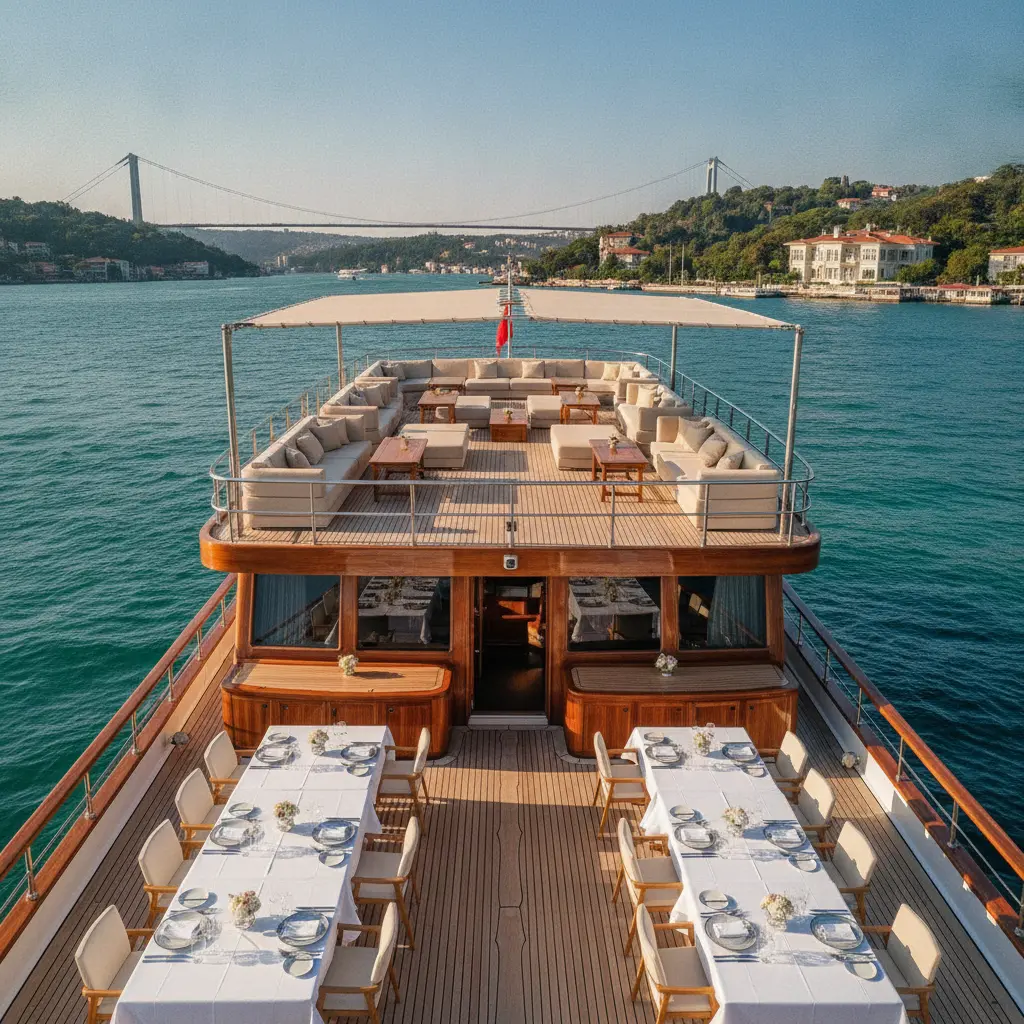
Some proposals happen with a tight group of four or five friends — and even turn into a party afterwards. In this profile the boat gets bigger, the music gets louder, and the program gets more flexible. On the Bosphorus, gulet-style boats are popular for this kind of celebration because the open deck handles a crowd comfortably.
4. Proposals Hidden Inside a Corporate or Special Celebration
This one is less known but very real: a proposal tucked inside a company dinner or a milestone celebration. The planning here demands an entirely different level of care — preparing without everyone knowing and timing the moment down to the second. With this profile, working alongside an event coordinator is almost essential.
Boat Choice: Motor Yacht, Gulet or Classic Yacht?
When we sat down with Ali's family, the first topic was the boat type. Yacht rental on the Bosphorus doesn't mean one single kind of vessel; each has a distinct character, and it shapes your proposal scenario more than you'd expect.
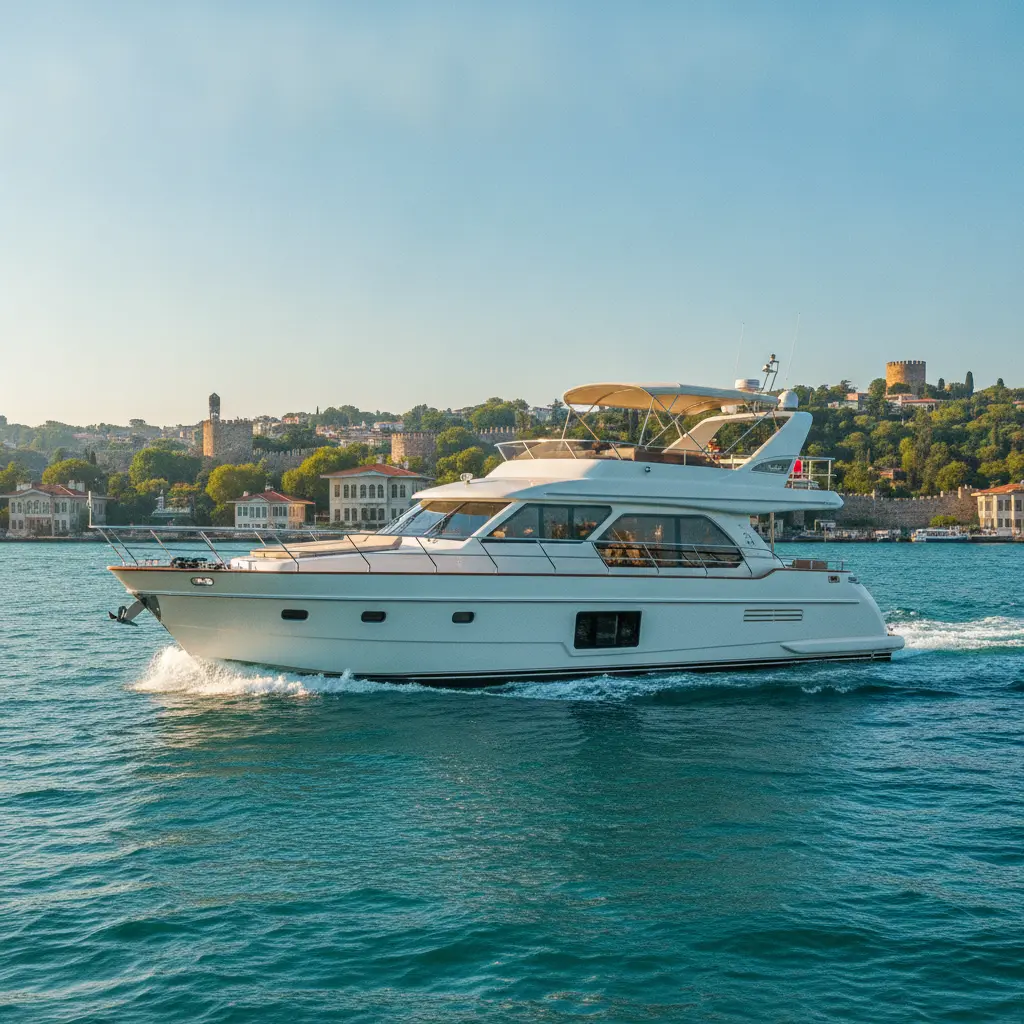
- Motor yacht: Fast, comfortable, often two levels. Offers privacy on the upper deck and a place to gather with family below. The most balanced option for most couple-alone and family profiles.
- Gulet: Wooden, roomy and slow. Ideal for large friend groups and longer celebrations. Its maneuverability is limited, so a shorter route makes sense.
- Classic yacht: More elegant and more full of character; very impressive in photos. But deck space can be tight, so larger families may feel cramped.
There's also a practical point worth raising: no matter how big the boat is, the surprise can fall apart if guests don't know where to stand during the moment. So when choosing a boat, don't just ask "how many people fit?" — also ask "who will stand where during the proposal?" On Ali's trip we talked this through over a sketch, and by the end everyone's position was clear.
The Right Route: Where to Start, Where to Pause
A proposal route on the Bosphorus should be designed differently from an ordinary boat tour. The goal isn't only a beautiful view — it's choosing the exact spot where the question happens. A classic tour covers a long stretch, while a proposal calls for a shorter, more controlled plan.
Most often a marina close to the center works as the starting point; it makes the guests' arrival easier and gets the boat quickly into the most impressive section of the strait. The critical part of the route is choosing the spot for the proposal itself. That spot shouldn't sit in the middle of crowded boat traffic; otherwise the quiet and the surprise both suffer.
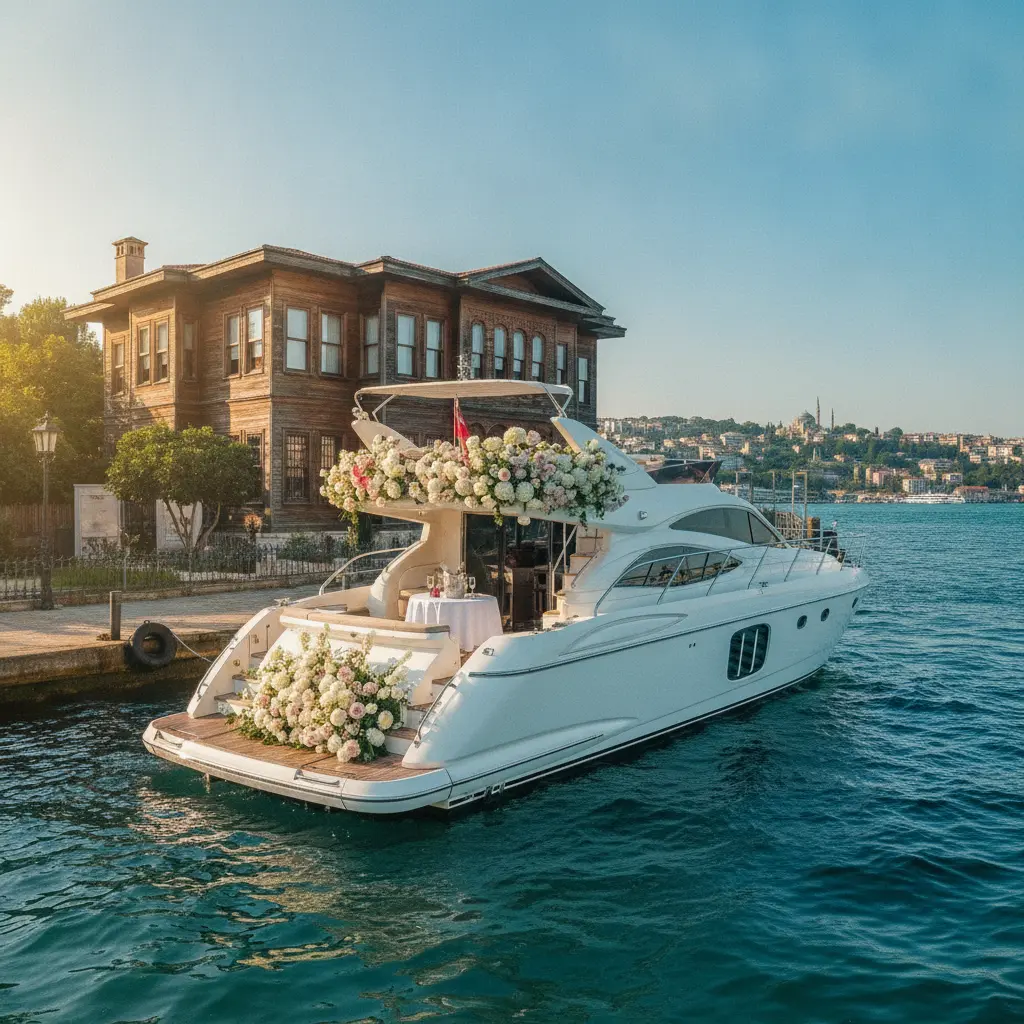
For Ali's family, we decided the proposal would happen in a calmer area lined with historic waterfront mansions. The boat slows there for a short while, the music drops, and the moment unfolds. Afterwards, the boat moves toward a livelier section for the celebration. So the route is two-stage — calm first, celebration second. That two-stage plan is far more effective than one long loop.
Choosing the Time: Daylight, Golden Hour or Night
When you set the time of the proposal, think beyond "the most romantic-looking hour" and weigh photo quality, temperature and boat traffic too. Ali's family wanted early evening at first; we recommended starting in the afternoon and holding the proposal toward sunset. The reason is simple — a cruise that begins in daylight is easier for family photos and captures the moment in natural light.
Night departures are popular too, especially for those who want the city lights on display. But on night trips photography is harder, the air is cooler, and guests' energy can dip faster. For couples alone, a night can be magical; for larger families, fatigue becomes a real risk.
One more practical detail: set the proposal at least an hour after guests board. Between departure, settling in and welcome drinks, the first half hour always passes in a flurry. Put the proposal too early and it arrives before everyone is ready; too late and guests' attention starts to wander.
Protecting the Surprise: Who in the Family Should Know?
This is the most delicate issue in a family proposal. Even Ali's family argued about it at first: did everyone know? The answer was no. To protect the surprise, only three people knew — Ali himself, his sister and our team. The rest of the family was simply told "a family dinner" and boarded accordingly.
The golden rule here is this: the number of people who know should stay under a third of the total guest count. The more people who know, the higher the chance of a leak. Children and chatty relatives are the biggest risk in these situations. The fix is simple: get them excited about a "celebration" until the last moment, and plan the proposal only with people you trust.
Then there's the crew factor. Boat staff are usually very experienced and used to surprise culture. Even so, you should agree in advance on when the proposal starts and what cue triggers it. On Ali's trip we set up a simple system: at the chosen moment the music changes, and that signal was known to only a few people.
Proposal-Day Logistics: Getting to the Marina and Managing Time
No matter how beautiful the boat you choose, if you don't plan the marina transfer, the most stressful part of the day can happen in traffic. Part of Ali's family was arriving from out of town, so we sorted the hotel-to-marina transfer in advance. Instead of moving a large family in one vehicle, arranging comfortable individual transfers through a premium chauffeur car rental service prevented both delays and chaos.
The logic is simple: the tension on proposal day is already high. You don't want guests dealing with parking, public transport or running late. Being at the marina a reasonable amount of time before departure eases boarding and leaves you free for the final surprise preparation. Especially for proposals that happen before dark, when traffic is even harder to predict, keep that buffer generous.
Another time-management tip is to allow a flexible window rather than a single fixed hour. Rather than pinning the proposal to the exact minute, define a fifteen-minute window around it — that way small hiccups don't cause panic. This flexibility is one of the most useful details in the whole organization.
What to Check Before Booking: A Practical Checklist
From the process we walked through with Ali's family, we've pulled together a practical checklist. Going through these steps in order protects most of what matters on the day.
- Is the guest count and profile clear? Couple alone, family or friend group? This sets the boat size.
- Are the proposal moment and the celebration separated? Privacy and a lively party rarely coexist at once — build a two-stage plan.
- Are departure and return times realistic? Factor in traffic, weather and guest fatigue.
- Is the marina transfer sorted? A planned transfer rather than public transport makes the day smoother.
- How many people know about the surprise? Keep the number to a minimum.
- Is there a weather backup plan? Boats with enclosed areas are valuable for exactly this reason.
- Is the cue system clear with the crew? When does the music change, and who does what?
- Who will take photos and video? Assign a responsible person in advance to capture the moment.
At first glance the list looks long, but with Ali's family we covered every item in a single session — and none of it was actually complicated. The only complicated thing is not planning any of it beforehand.
Budget Isn't the Point — Priorities Are
When people think about yacht rental on the Bosphorus, the first question is usually price. A healthier approach is to define what you value first. With a similar budget you can choose between different boat types, durations and levels of styling.
Priorities differ for everyone, but three things stood out for Ali's family: keeping the proposal moment uninterrupted, guest comfort, and good photos. We chose the boat and route around those three. If your priorities change, the boat type and program should change with them. In short, it makes far more sense to shape a yacht rental for a proposal around the needs of the moment than to turn it into a contest for the most expensive option.
It's also worth factoring in the season. In summer, boat traffic on the Bosphorus rises, so early booking and a flexible route matter more. In spring and autumn the air can be cooler, which pushes boats with enclosed areas to the fore. Thinking about these seasonal differences in advance means you won't be dealing with surprises on the day.
After the 'Yes': What Happens Next?
Many people focus on the proposal and skip what comes after. Yet the moment the question is answered is also the start of the celebration. For Ali's family, a small celebration took place onboard right afterwards — soft music, refreshments and family photos. This is one of the boat's biggest advantages: the proposal, the celebration and the photos all happen in one place, in a natural flow.
If you're planning a bigger celebration or a next step afterwards, you can compare different boat types for similar scenarios by browsing the yacht rental options on Turlago. What matters is that the proposal is crowned with an energetic celebration rather than exhaustion. The way to achieve that is to build the program in two stages and keep guests' energy up throughout the day.
Who It Suits — and Who It Doesn't
Honestly, this experience isn't for everyone. Someone who wants a completely silent, two-person moment and dislikes crowds is better served by a small boat and a small, intimate plan. Someone who wants a proposal with family, friends, or tucked inside a celebration, will find the yacht a very strong option for both privacy and organization.
Ali and his family's story sums up the essence well: ask the right questions, know your group, and build the plan in two stages. Whether the proposal happens on a boat or not, this approach makes the day calmer and more meaningful. Keep this framework in mind when you decide on yacht rental in Istanbul for a marriage proposal, and you'll both set your expectations correctly and be genuinely ready for the moment.
Treat the transfer as part of this same framework too; solutions like premium chauffeur car rental that smooth the day's flow are a small but effective difference within the bigger picture.